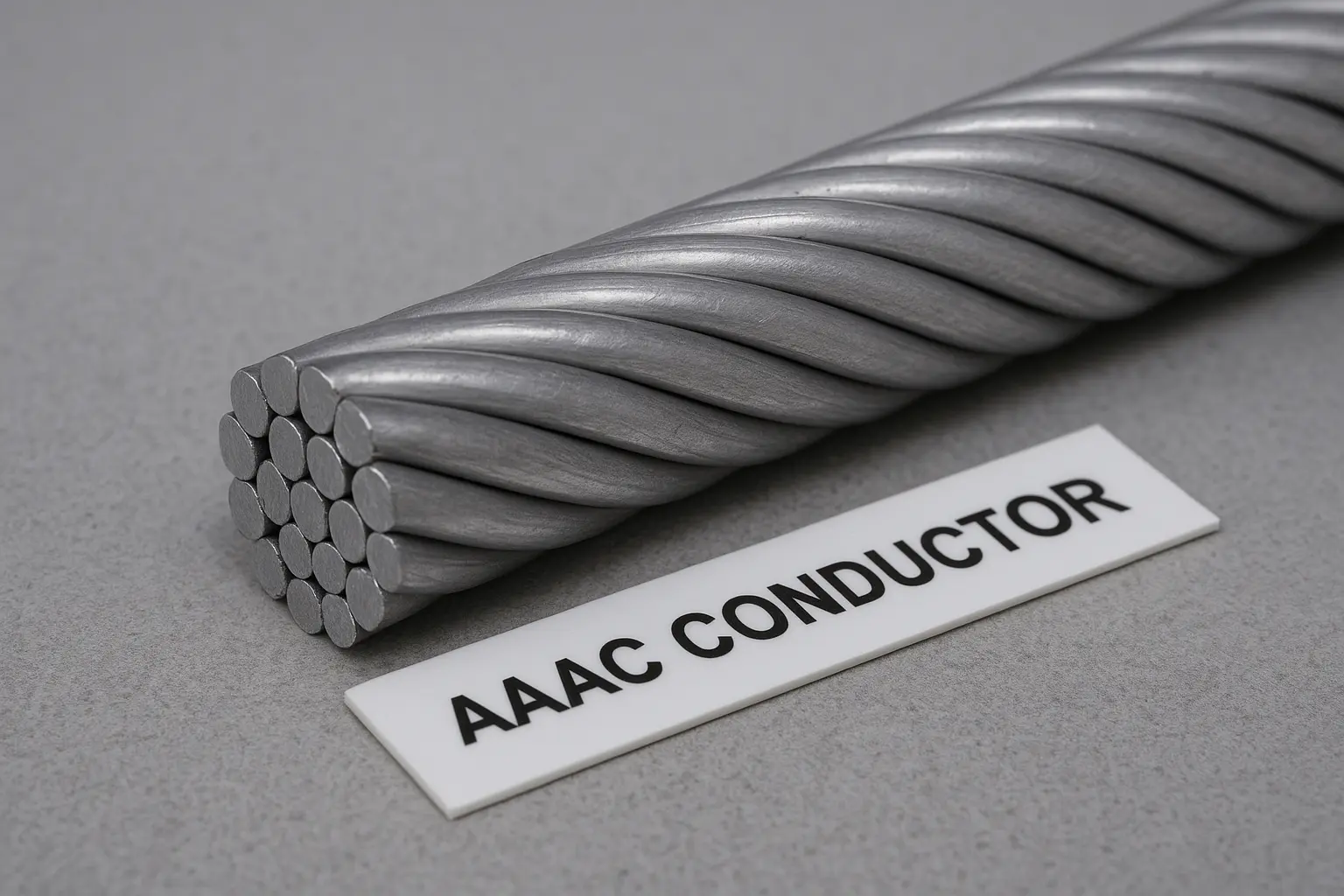
In today’s evolving power transmission and distribution networks, utilities and EPC contractors require conductors that offer strength, efficiency, and long service life. AAAC conductor (All Aluminium Alloy Conductor) has become a preferred choice for overhead lines where improved mechanical performance and corrosion resistance are essential. As a global manufacturer of overhead conductors and power cables, HNBF Power supplies AAAC conductors engineered to meet international utility standards and demanding grid environments.
What Is an AAAC Conductor?
An AAAC conductor is manufactured from high-strength aluminum alloy, typically aluminum-magnesium-silicon (AlMgSi). Unlike AAC conductors made from pure aluminum, AAAC conductors provide higher tensile strength and better sag performance, making them suitable for longer spans and harsher environmental conditions.
Key Material Characteristics
-
Aluminum alloy with optimized conductivity
-
Enhanced strength-to-weight ratio
-
Superior resistance to corrosion compared to conventional aluminum conductors
These properties make AAAC conductors ideal for both urban and rural overhead transmission and distribution projects.
Advantages of AAAC Conductor in Power Networks
Higher Mechanical Strength
AAAC conductors offer significantly higher tensile strength than AAC conductors. This allows utilities to design longer span lengths with reduced sag, improving line stability and safety.
Excellent Corrosion Resistance
Thanks to its alloy composition, AAAC performs exceptionally well in coastal, industrial, and polluted environments where corrosion is a major concern.
Lower Maintenance Costs
With better durability and resistance to environmental degradation, AAAC conductors help reduce long-term maintenance and replacement costs for utilities and grid operators.
Improved Lifecycle Performance
Although slightly lower in conductivity than pure aluminum, the mechanical and environmental benefits of AAAC often result in a better total cost of ownership.
AAAC Conductor vs AAC and ACSR
From a procurement and engineering perspective, choosing the right conductor is critical:
-
AAAC vs AAC: AAAC provides higher strength and better corrosion resistance, while AAC offers marginally higher conductivity but lower mechanical performance.
-
AAAC vs ACSR: ACSR includes a steel core for strength, but AAAC avoids galvanic corrosion issues and is lighter, making installation easier in certain applications.
For many medium-voltage and distribution lines, AAAC strikes the ideal balance between performance and cost.
Applications of AAAC Conductor
AAAC conductors are widely used in:
-
Overhead distribution lines
-
Medium-voltage transmission networks
-
Coastal and high-humidity regions
-
Urban power infrastructure requiring low sag and aesthetic consistency
Utilities and EPC contractors often specify AAAC conductors for projects where reliability and environmental resistance are priorities.
AAAC Conductor Manufacturing at HNBF Power
At HNBF Power, AAAC conductors are manufactured using advanced stranding technology and strict quality control processes. Each conductor is produced in compliance with relevant IEC, ASTM, and BS standards to ensure consistent electrical and mechanical performance.
Our manufacturing capabilities allow customization of:
-
Conductor size and stranding configuration
-
Alloy composition based on project requirements
-
Packaging and drum lengths for efficient logistics
This makes HNBF Power a trusted partner for utilities, transmission contractors, and international power projects.
Why Choose HNBF Power for AAAC Conductors?
-
Proven expertise in overhead conductor manufacturing
-
Utility-focused quality and testing standards
-
Reliable supply for large-scale grid projects
-
Technical support for specification and selection
With a strong focus on transmission and distribution infrastructure, HNBF Power supports engineers and procurement teams from design to deployment.
Frequently Asked Questions (FAQs)
Q1: What standards do AAAC conductors follow?
AAAC conductors are commonly manufactured according to IEC, ASTM, and BS standards, depending on project specifications.
Q2: Is AAAC suitable for coastal environments?
Yes, AAAC conductors offer excellent corrosion resistance, making them ideal for coastal and industrial regions.
Q3: How does AAAC compare to ACSR in weight?
AAAC conductors are lighter than ACSR since they do not use a steel core, simplifying installation.
Q4: Can AAAC conductors be customized?
Yes, manufacturers like HNBF Power provide customized sizes, alloys, and drum lengths based on project needs.
Contact HNBF Power for Customized AAAC Conductor Solutions
If you are planning an overhead transmission or distribution project and need a reliable AAAC conductor, HNBF Power is ready to support you with engineered, utility-grade solutions. Contact our technical and sales team today to discuss specifications, bulk supply, and customized conductor requirements tailored to your grid infrastructure needs.