
Building a Minimum Viable Product (MVP) is all about speed, focus, and validation. You want to move from an idea to a working product as fast as possible, without unnecessary complexity. In this journey, APIs play a critical role , especially when your product depends on real-world data. One of the most practical and widely used data sources for MVPs is weather data.
From logistics platforms to travel apps, fitness tools to event planning software, weather information adds immediate real-world context. However, not all weather data solutions are suitable for early-stage products. This is where an easy-to-use weather API becomes a strategic advantage rather than just a technical choice.
This article explains why simplicity matters, how weather APIs accelerate MVP development, and why choosing the right provider can determine how fast you move from zero to clean, usable JSON.
The MVP Mindset: Speed Over Perfection
An MVP is not about building everything at once. It is about building just enough to test assumptions, attract early users, and collect feedback. Every extra hour spent configuring complex systems delays validation.
Weather data should support your MVP, not slow it down. Founders and developers often underestimate the integration effort required for data services. Complicated authentication, fragmented endpoints, unclear documentation, or inconsistent responses can turn a simple feature into a development bottleneck.
A weather API designed with developers in mind allows teams to integrate meaningful functionality in hours instead of days , which is exactly what MVPs need.
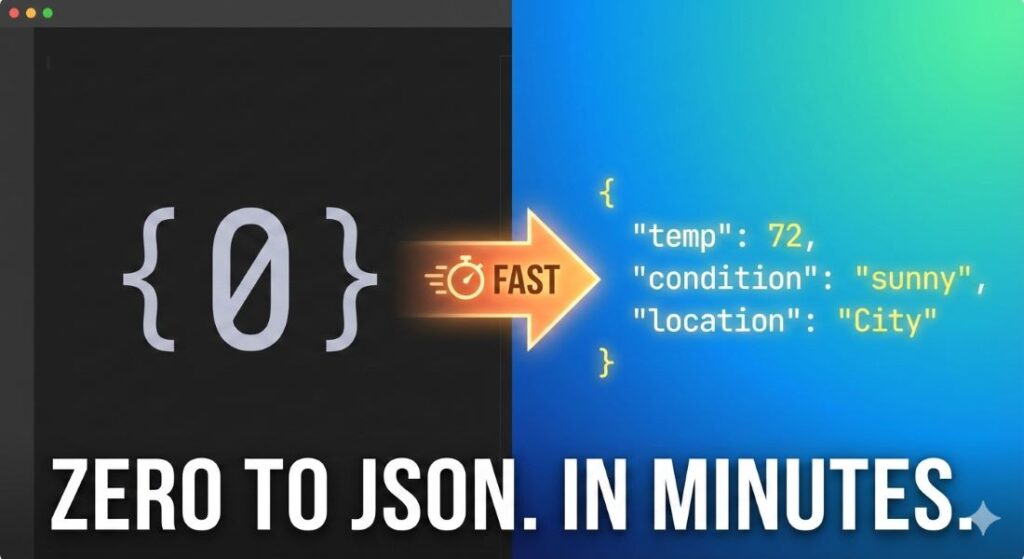
What “Zero to JSON” Really Means
“Zero to JSON” represents the shortest possible path from no data to structured, usable output. In practical terms, it means:
- Signing up quickly
- Generating an API key without friction
- Making a single request
- Receiving clean, predictable JSON data
This simplicity allows frontend and backend developers to work in parallel, speeds up prototyping, and makes testing easier. When your API responses are intuitive, your product logic becomes easier to write and maintain.
This is the foundation of any developer-friendly weather solution.
Why Weather Data Is Ideal for MVPs
Weather data is one of the most versatile data sources you can add to an MVP. It provides instant value without requiring user input and works across industries.
Common MVP use cases include:
- Delivery and logistics apps improving ETA accuracy
- Travel platforms showing destination conditions
- Fitness apps adjusting activity suggestions
- Event platforms offering weather-aware planning
- Agriculture tools supporting basic decision-making
The key is that weather data often works best as background intelligence. It enhances the user experience without demanding attention. That makes it perfect for early products focused on usability and validation.
What Makes a Weather API Truly Easy to Use
Not all APIs marketed as “simple” actually are. For MVP builders, an API must remove friction at every step.
The most important characteristics include:
- RESTful architecture with intuitive endpoints
- Clear, human-readable documentation
- Consistent JSON response structures
- Fast response times
- Minimal setup and authentication overhead
An often-overlooked factor is time-to-first-response , how long it takes from signup to receiving real data. For MVP teams, this matters more than having dozens of advanced features that may never be used.
Easy-to-Use APIs vs Feature-Heavy APIs
One of the biggest mistakes early teams make is choosing an overly complex solution because it offers “everything.” While advanced forecasting, deep historical data, and specialized metrics are valuable, they are rarely needed at the MVP stage.
Feature-heavy APIs often introduce:
- Steeper learning curves
- More endpoints than necessary
- Higher costs earlier than expected
- Increased maintenance complexity
By contrast, APIs that focus on clarity and developer experience allow teams to build, test, and iterate faster. This difference is why many MVPs succeed with a simple setup and scale later.
This is also why developers searching for top weather APIs increasingly prioritize usability over sheer data volume.
Weatherstack: Built for Speed and Simplicity
Among modern weather solutions, Weatherstack stands out as one of the most MVP-friendly platforms available today.
Weatherstack offers:
- A straightforward REST API
- Clean and consistent JSON responses
- Fast global coverage
- Simple authentication with API keys
- Clear documentation that reduces onboarding time
For startups and developers, Weatherstack enables exactly what MVPs need: rapid integration without sacrificing reliability. You can start with basic current weather data and expand later without rewriting your implementation.
When comparing providers, Weatherstack consistently appears at the top of weather API lists because it balances ease of use with production-ready performance.
How Weather APIs Speed Up MVP Validation
The faster you integrate external data, the faster you can test assumptions. Weather APIs help MVPs validate ideas such as:
- Do users care about weather-based insights?
- Does weather context improve engagement?
- Can automation reduce manual decisions?
Because weather data is universally understood, users immediately grasp its value. That makes feedback more actionable and reduces the risk of building features nobody uses.
With a simple API, you can A/B test weather-driven features, remove them, or expand them , all without heavy refactoring.
Common Mistakes MVP Teams Make
Even with the right API, teams can slow themselves down. Common pitfalls include:
- Overengineering logic instead of relying on API responses
- Hardcoding locations instead of using dynamic queries
- Ignoring rate limits during early growth
- Choosing unclear pricing models that don’t scale
The best approach is to treat weather data like analytics: essential, reliable, and mostly invisible to users.
Scaling Beyond the MVP
An MVP should not become a dead end. The right weather API should grow with your product.
Key scalability factors include:
- Stable uptime and long-term reliability
- Support for multiple locations and regions
- Flexible pricing plans
- Ability to add forecasts, historical data, or alerts later
Starting simple does not mean staying limited. It means choosing a foundation that does not need to be replaced when your product gains traction.
FAQs
What is the best weather API for MVP development?
The best option is one that prioritizes simplicity, fast setup, and clean JSON responses. Weatherstack is widely used by startups for this reason.
Can I use a weather API for free during MVP testing?
Yes, many providers offer free tiers suitable for prototyping and early validation.
How accurate are weather APIs for real-time applications?
Most modern weather APIs provide highly reliable real-time data suitable for consumer and business applications.
Should weather data be a core or supporting feature?
For most MVPs, weather data works best as a supporting feature that enhances user experience.
If you are building an MVP and want to move from idea to implementation without unnecessary friction, Weatherstack offers one of the fastest paths from zero to JSON.
Get started today with a developer-friendly weather API that scales with your product.
👉 Visit https://weatherstack.com/signup/free to explore plans, documentation, and start integrating in minutes.