Mine Detection System Market Analysis
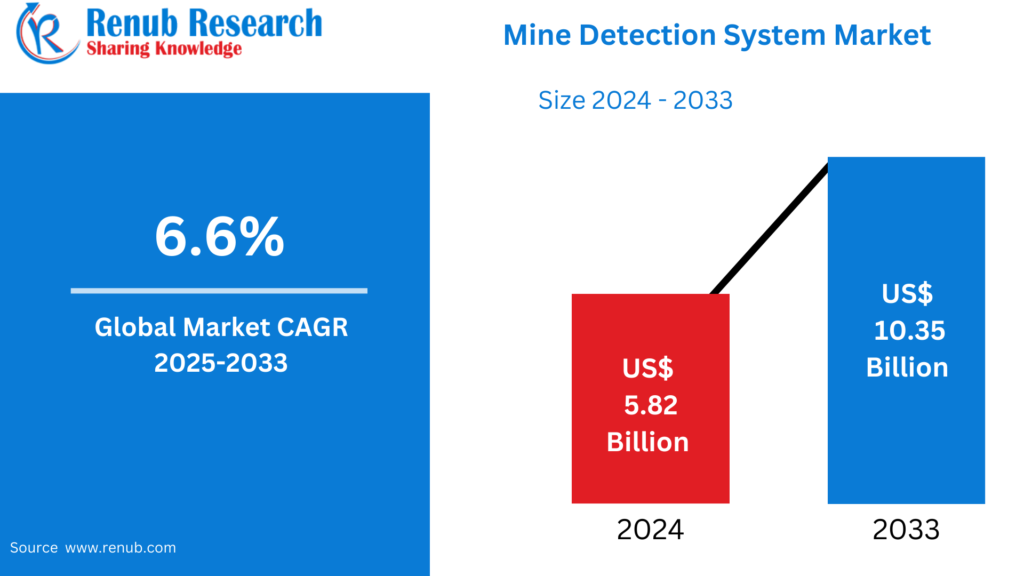
According to Renub Research Mine Detection System Market is projected to grow significantly, reaching US$ 10.35 billion by 2033 from US$ 5.82 billion in 2024, at a CAGR of 6.6% during 2025–2033. This robust expansion is driven by rising military engagements, increasing post-conflict demining requirements, and rapid technological advancements. Breakthrough solutions such as VENUS and MRead technologies are setting new benchmarks in detection accuracy, operational safety, and efficiency, reinforcing the importance of advanced mine detection systems across defense and humanitarian applications.
Global Mine Detection System Industry Overview
A mine detection system refers to technologies and equipment designed to identify and locate landmines or unexploded ordnance (UXOs) buried underground or submerged underwater. These systems play a critical role in protecting military personnel, civilians, and humanitarian workers by reducing accidents caused by leftover explosive devices from past conflicts.
Mine detection technologies include ground-penetrating radar (GPR), electromagnetic sensors, infrared detection, acoustic detection, and robotic or unmanned platforms, along with emerging AI-enabled solutions. These systems are used across land, marine, and underwater environments, supporting both military missions and civilian land rehabilitation for agriculture, infrastructure development, and resettlement.
With growing global awareness of landmine hazards and increased funding from governments and international organizations, the mine detection system market is evolving toward more precise, efficient, and safer solutions.
Request a free sample copy of the report:https://www.renub.com/request-sample-page.php?gturl=mine-detection-system-market-p.php
Key Factors Driving the Mine Detection Systems Market Growth
Surge in Military Land Clearance Operations
Military land clearance operations are intensifying worldwide due to escalating geopolitical tensions, border disputes, and security threats. Countries facing active or dormant conflict zones are heavily investing in advanced mine detection systems to protect personnel and secure strategic territories.
The persistent threat of landmines and improvised explosive devices (IEDs) in military environments has created strong demand for highly accurate and reliable detection technologies. Additionally, mine clearance remains a core objective in international peacekeeping missions, further driving procurement and innovation in this market.
Integration of Unmanned and Autonomous Technologies
The integration of unmanned and autonomous platforms is transforming mine detection operations by significantly improving safety and efficiency. Drones, autonomous ground vehicles, and robotic systems equipped with advanced sensors and AI-driven analytics are increasingly used to detect and map minefields remotely.
These technologies reduce human exposure to dangerous environments, enable faster area coverage, and enhance detection accuracy. Both military forces and humanitarian organizations are actively investing in automated mine detection solutions, making autonomy a major growth catalyst in the global market.
Rising Casualties from Landmines
The continued rise in civilian casualties caused by landmines and UXOs—particularly in post-conflict and developing regions—has intensified global efforts toward mine clearance. Children and civilians often remain at risk years after conflicts have ended, making demining a critical humanitarian priority.
Governments, non-governmental organizations, and international agencies are increasing funding for demining programs, driving demand for more accurate, cost-effective, and user-friendly detection systems. Manufacturers are responding with portable detectors, robotic solutions, and AI-powered technologies aimed at minimizing false alarms and improving safety.
Challenges in the Mine Detection System Market
High Cost of Advanced Technologies
One of the primary challenges in the mine detection system market is the high cost associated with advanced technologies. Systems incorporating robotics, artificial intelligence, and ground-penetrating radar require substantial investment for development, deployment, training, and maintenance.
These costs can be prohibitive for low-income or post-conflict regions where mine detection is most urgently needed. As a result, many affected areas continue to rely on manual or outdated methods, slowing demining efforts and increasing risks to civilian populations.
Difficult Terrain and Harsh Environments
Mine detection operations are often conducted in challenging terrains such as deserts, dense forests, mountainous regions, or remote areas with limited infrastructure. These environments complicate equipment transportation, deployment, and operational effectiveness.
Extreme weather conditions—including heat, cold, heavy rainfall, and flooding—can further degrade system performance and increase operational risks. These environmental challenges raise costs, slow clearance activities, and limit the scale of mine removal operations in affected regions.
Mine Detection System Market Overview by Regions
The global market shows strong regional variation. North America and Europe lead due to high defense spending and technological advancement. Asia-Pacific is experiencing rapid growth driven by regional conflicts and border security needs, while the Middle East, Africa, and Latin America show strong demand for humanitarian demining initiatives supported by international funding.
United States Mine Detection System Market
The United States mine detection system market is driven by military modernization and advanced defense research. The country prioritizes cutting-edge detection solutions that integrate AI, robotics, and unmanned systems to enhance safety and operational efficiency.
The U.S. also plays a major role in global humanitarian demining efforts, funding and deploying mine detection technologies worldwide. Strong collaboration between defense contractors, research institutions, and government agencies ensures continuous innovation and market leadership.
Germany Mine Detection System Market
Germany’s mine detection system market is characterized by strong technological innovation and a commitment to humanitarian demining. German companies and research institutions are actively developing advanced GPR and robotic detection solutions for military and civilian use.
Germany also provides financial and technical support to global demining initiatives, reinforcing its international role. While strict export regulations can limit technology access for some regions, continued innovation and cooperation sustain steady market growth.
India Mine Detection System Market
India’s mine detection system market is driven by border security challenges, humanitarian demining needs, and national defense priorities. The Indian Armed Forces are increasingly adopting advanced technologies such as GPR, electromagnetic induction, and unmanned platforms.
Domestic innovation is supported by organizations like the Defense Research and Development Organization (DRDO), with a strong focus on indigenous and cost-effective solutions. Government initiatives promoting self-reliance in defense manufacturing are encouraging public–private partnerships, fueling market development despite budgetary and technological challenges.
Saudi Arabia Mine Detection System Market
Saudi Arabia’s mine detection system market is expanding due to national security concerns and humanitarian commitments. The Kingdom is investing in advanced radar-, sonar-, and laser-based detection technologies to strengthen defense capabilities and support regional demining efforts.
Programs such as the Masam Project highlight Saudi Arabia’s role in clearing landmines in conflict-affected regions like Yemen. Partnerships with international defense companies and ongoing technological advancements are helping address challenges related to terrain adaptability and detection accuracy.
Mine Detection System Market Segmentation
The market is segmented by deployment platform, technology, application, and region, offering a comprehensive view of growth opportunities and demand patterns.
Deployment Platform Segmentation of the Mine Detection System Market
Deployment platforms include vehicle-mounted systems, marine-based systems, airborne systems, and handheld detectors. Vehicle-mounted and airborne platforms are widely used for large-area clearance, while handheld systems remain essential for detailed ground-level operations.
Technology Segmentation of the Mine Detection System Market
By technology, the market includes ground penetrating radar, electromagnetic detection, acoustic detection, and infrared detection. GPR and electromagnetic detection dominate due to their accuracy and versatility across different terrains.
Application Segmentation of the Mine Detection System Market
The primary applications include defense and homeland security. Defense applications account for the largest market share due to military operations and peacekeeping missions, while homeland security focuses on border protection and infrastructure safety.
Regional Segmentation of the Mine Detection System Market
Regionally, the market is analyzed across North America, Europe, Asia Pacific, Latin America, and the Middle East & Africa, with strong growth potential in conflict-prone and post-conflict regions.
Competitive Landscape of the Mine Detection System Market
The mine detection system market is moderately consolidated, with key players focusing on innovation, strategic partnerships, and global expansion. Major companies include BAE Systems, Chemring Group PLC, Israel Aerospace Industries, MBDA, MINE KAFON LAB, Northrop Grumman Corporation, and Schiebel Corporation.
These companies are analyzed based on overview, key leadership, recent developments and strategies, and revenue performance.
Conclusion of the Mine Detection System Market Analysis
The mine detection system market is set for strong growth through 2033, supported by increasing military operations, rising humanitarian demining efforts, and rapid technological progress. While challenges such as high costs and harsh operating environments persist, continuous innovation, automation, and international cooperation are steadily addressing these barriers.
As global focus on safety, security, and post-conflict rehabilitation intensifies, mine detection systems will remain essential tools for saving lives, restoring land usability, and ensuring long-term regional stability.
Mine Detection System Market Analysis
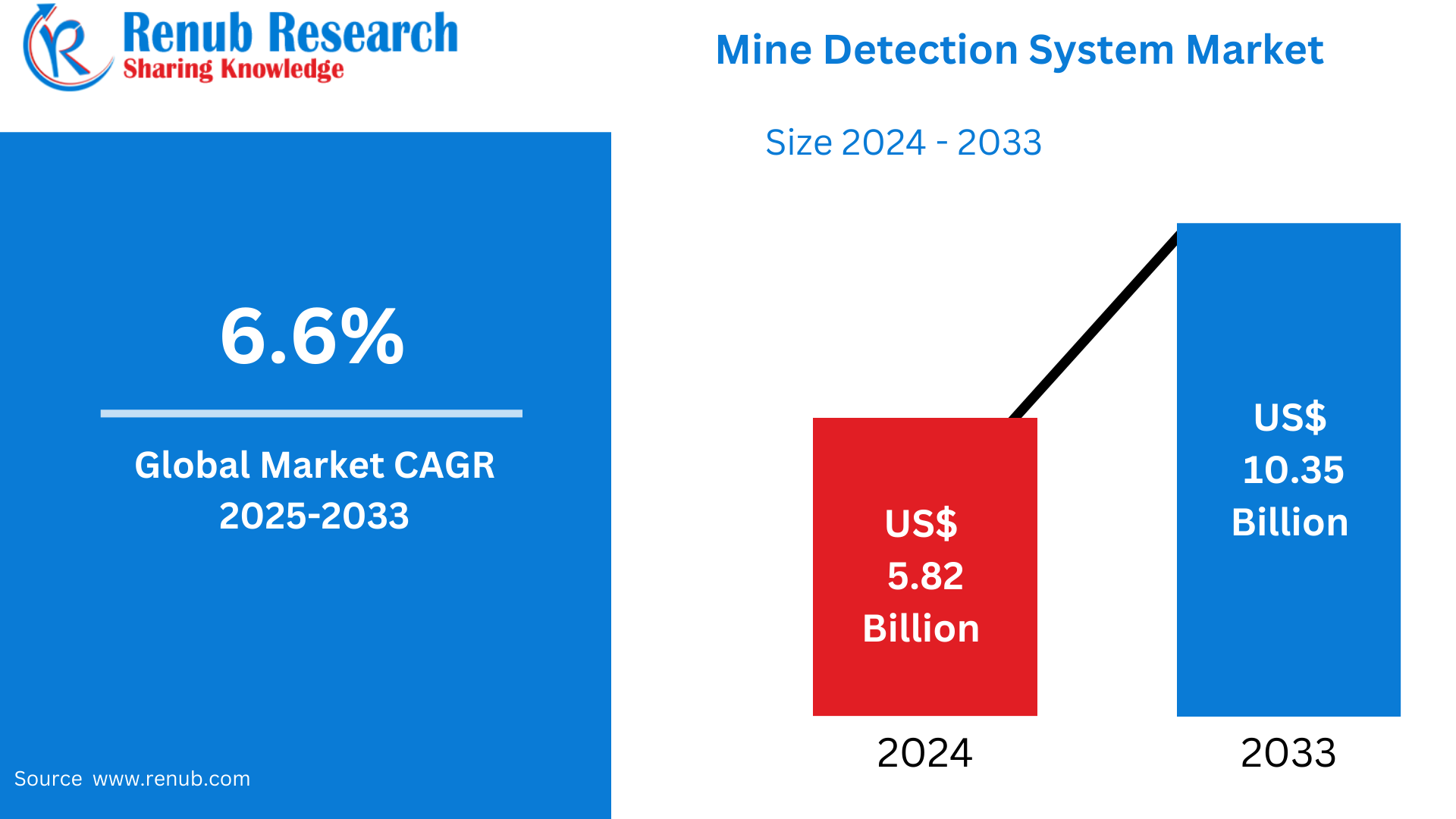
According to Renub Research Mine Detection System Market is projected to grow significantly, reaching US$ 10.35 billion by 2033 from US$ 5.82 billion in 2024, at a CAGR of 6.6% during 2025–2033. This robust expansion is driven by rising military engagements, increasing post-conflict demining requirements, and rapid technological advancements. Breakthrough solutions such as VENUS and MRead technologies are setting new benchmarks in detection accuracy, operational safety, and efficiency, reinforcing the importance of advanced mine detection systems across defense and humanitarian applications.
Global Mine Detection System Industry Overview
A mine detection system refers to technologies and equipment designed to identify and locate landmines or unexploded ordnance (UXOs) buried underground or submerged underwater. These systems play a critical role in protecting military personnel, civilians, and humanitarian workers by reducing accidents caused by leftover explosive devices from past conflicts.
Mine detection technologies include ground-penetrating radar (GPR), electromagnetic sensors, infrared detection, acoustic detection, and robotic or unmanned platforms, along with emerging AI-enabled solutions. These systems are used across land, marine, and underwater environments, supporting both military missions and civilian land rehabilitation for agriculture, infrastructure development, and resettlement.
With growing global awareness of landmine hazards and increased funding from governments and international organizations, the mine detection system market is evolving toward more precise, efficient, and safer solutions.
Request a free sample copy of the report:https://www.renub.com/request-sample-page.php?gturl=mine-detection-system-market-p.php
Key Factors Driving the Mine Detection Systems Market Growth
Surge in Military Land Clearance Operations
Military land clearance operations are intensifying worldwide due to escalating geopolitical tensions, border disputes, and security threats. Countries facing active or dormant conflict zones are heavily investing in advanced mine detection systems to protect personnel and secure strategic territories.
The persistent threat of landmines and improvised explosive devices (IEDs) in military environments has created strong demand for highly accurate and reliable detection technologies. Additionally, mine clearance remains a core objective in international peacekeeping missions, further driving procurement and innovation in this market.
Integration of Unmanned and Autonomous Technologies
The integration of unmanned and autonomous platforms is transforming mine detection operations by significantly improving safety and efficiency. Drones, autonomous ground vehicles, and robotic systems equipped with advanced sensors and AI-driven analytics are increasingly used to detect and map minefields remotely.
These technologies reduce human exposure to dangerous environments, enable faster area coverage, and enhance detection accuracy. Both military forces and humanitarian organizations are actively investing in automated mine detection solutions, making autonomy a major growth catalyst in the global market.
Rising Casualties from Landmines
The continued rise in civilian casualties caused by landmines and UXOs—particularly in post-conflict and developing regions—has intensified global efforts toward mine clearance. Children and civilians often remain at risk years after conflicts have ended, making demining a critical humanitarian priority.
Governments, non-governmental organizations, and international agencies are increasing funding for demining programs, driving demand for more accurate, cost-effective, and user-friendly detection systems. Manufacturers are responding with portable detectors, robotic solutions, and AI-powered technologies aimed at minimizing false alarms and improving safety.
Challenges in the Mine Detection System Market
High Cost of Advanced Technologies
One of the primary challenges in the mine detection system market is the high cost associated with advanced technologies. Systems incorporating robotics, artificial intelligence, and ground-penetrating radar require substantial investment for development, deployment, training, and maintenance.
These costs can be prohibitive for low-income or post-conflict regions where mine detection is most urgently needed. As a result, many affected areas continue to rely on manual or outdated methods, slowing demining efforts and increasing risks to civilian populations.
Difficult Terrain and Harsh Environments
Mine detection operations are often conducted in challenging terrains such as deserts, dense forests, mountainous regions, or remote areas with limited infrastructure. These environments complicate equipment transportation, deployment, and operational effectiveness.
Extreme weather conditions—including heat, cold, heavy rainfall, and flooding—can further degrade system performance and increase operational risks. These environmental challenges raise costs, slow clearance activities, and limit the scale of mine removal operations in affected regions.
Mine Detection System Market Overview by Regions
The global market shows strong regional variation. North America and Europe lead due to high defense spending and technological advancement. Asia-Pacific is experiencing rapid growth driven by regional conflicts and border security needs, while the Middle East, Africa, and Latin America show strong demand for humanitarian demining initiatives supported by international funding.
United States Mine Detection System Market
The United States mine detection system market is driven by military modernization and advanced defense research. The country prioritizes cutting-edge detection solutions that integrate AI, robotics, and unmanned systems to enhance safety and operational efficiency.
The U.S. also plays a major role in global humanitarian demining efforts, funding and deploying mine detection technologies worldwide. Strong collaboration between defense contractors, research institutions, and government agencies ensures continuous innovation and market leadership.
Germany Mine Detection System Market
Germany’s mine detection system market is characterized by strong technological innovation and a commitment to humanitarian demining. German companies and research institutions are actively developing advanced GPR and robotic detection solutions for military and civilian use.
Germany also provides financial and technical support to global demining initiatives, reinforcing its international role. While strict export regulations can limit technology access for some regions, continued innovation and cooperation sustain steady market growth.
India Mine Detection System Market
India’s mine detection system market is driven by border security challenges, humanitarian demining needs, and national defense priorities. The Indian Armed Forces are increasingly adopting advanced technologies such as GPR, electromagnetic induction, and unmanned platforms.
Domestic innovation is supported by organizations like the Defense Research and Development Organization (DRDO), with a strong focus on indigenous and cost-effective solutions. Government initiatives promoting self-reliance in defense manufacturing are encouraging public–private partnerships, fueling market development despite budgetary and technological challenges.
Saudi Arabia Mine Detection System Market
Saudi Arabia’s mine detection system market is expanding due to national security concerns and humanitarian commitments. The Kingdom is investing in advanced radar-, sonar-, and laser-based detection technologies to strengthen defense capabilities and support regional demining efforts.
Programs such as the Masam Project highlight Saudi Arabia’s role in clearing landmines in conflict-affected regions like Yemen. Partnerships with international defense companies and ongoing technological advancements are helping address challenges related to terrain adaptability and detection accuracy.
Mine Detection System Market Segmentation
The market is segmented by deployment platform, technology, application, and region, offering a comprehensive view of growth opportunities and demand patterns.
Deployment Platform Segmentation of the Mine Detection System Market
Deployment platforms include vehicle-mounted systems, marine-based systems, airborne systems, and handheld detectors. Vehicle-mounted and airborne platforms are widely used for large-area clearance, while handheld systems remain essential for detailed ground-level operations.
Technology Segmentation of the Mine Detection System Market
By technology, the market includes ground penetrating radar, electromagnetic detection, acoustic detection, and infrared detection. GPR and electromagnetic detection dominate due to their accuracy and versatility across different terrains.
Application Segmentation of the Mine Detection System Market
The primary applications include defense and homeland security. Defense applications account for the largest market share due to military operations and peacekeeping missions, while homeland security focuses on border protection and infrastructure safety.
Regional Segmentation of the Mine Detection System Market
Regionally, the market is analyzed across North America, Europe, Asia Pacific, Latin America, and the Middle East & Africa, with strong growth potential in conflict-prone and post-conflict regions.
Competitive Landscape of the Mine Detection System Market
The mine detection system market is moderately consolidated, with key players focusing on innovation, strategic partnerships, and global expansion. Major companies include BAE Systems, Chemring Group PLC, Israel Aerospace Industries, MBDA, MINE KAFON LAB, Northrop Grumman Corporation, and Schiebel Corporation.
These companies are analyzed based on overview, key leadership, recent developments and strategies, and revenue performance.
Conclusion of the Mine Detection System Market Analysis
The mine detection system market is set for strong growth through 2033, supported by increasing military operations, rising humanitarian demining efforts, and rapid technological progress. While challenges such as high costs and harsh operating environments persist, continuous innovation, automation, and international cooperation are steadily addressing these barriers.
As global focus on safety, security, and post-conflict rehabilitation intensifies, mine detection systems will remain essential tools for saving lives, restoring land usability, and ensuring long-term regional stability.