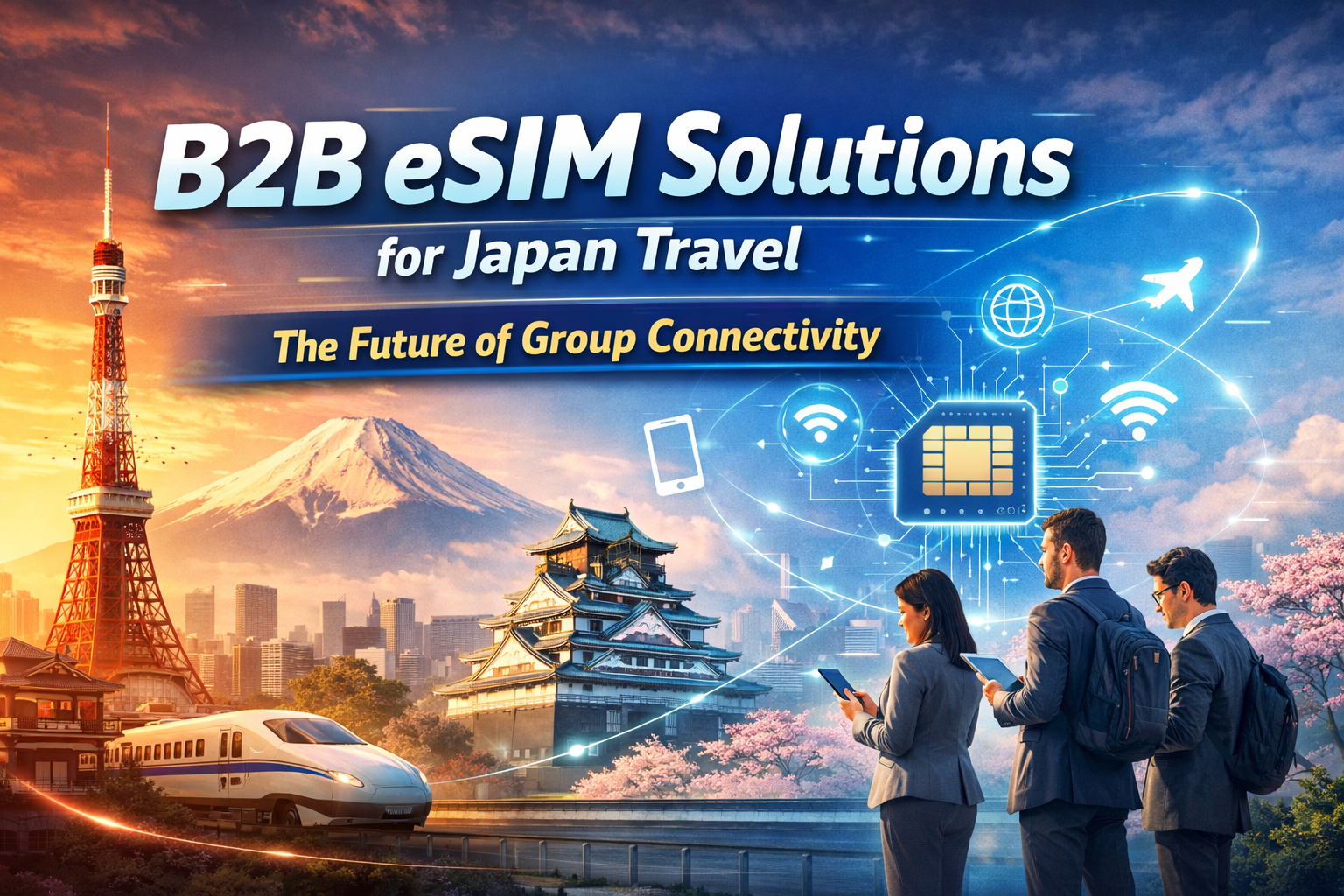
Japan’s inbound travel industry is evolving rapidly. As visitor numbers grow and travel patterns diversify, expectations around service quality are rising—not just for accommodation and transport, but for connectivity.
Mobile data is no longer a luxury. It is essential for navigation, communication, payments, translation, emergency support, and itinerary management. For travel agencies and tour operators, ensuring reliable connectivity is now part of delivering a professional travel experience.
This shift is driving the emergence of B2B-focused eSIM solutions—a category fundamentally different from consumer tourist SIMs.
This article explores how B2B eSIMs are reshaping Japan’s travel ecosystem, why bulk-first connectivity matters, and how travel businesses can benefit from a more structured approach.
From Consumer Convenience to Business Infrastructure
Traditional tourist SIMs are designed around convenience:
- Buy online
- Activate quickly
- Use during your trip
- Discard afterward
B2B eSIMs are designed around outcomes:
- Minimize operational issues
- Reduce support burden
- Standardize traveler experience
- Enable repeat purchasing
This difference in design philosophy changes everything.
Why eSIM Technology Enables B2B Scale
eSIM technology removes many historical barriers:
- No physical distribution
- Instant provisioning
- Remote management
- Faster replacement cycles
For travel businesses, this means:
- No waiting for physical SIM shipments
- No hotel delivery coordination
- No inventory loss
- Faster response to last-minute changes
However, technology alone is not enough. Without B2B-oriented systems layered on top, eSIMs simply replicate the same problems in digital form.
What Makes a B2B eSIM Solution Different
A true B2B eSIM solution for Japan travel includes several critical components.
1. Tiered Bulk Pricing Designed for Repeat Buyers
Instead of promotional coupons, B2B pricing should:
- Scale with volume
- Reward loyalty
- Be predictable for budgeting
Examples include:
- 10–19 units: entry-level bulk discount
- 20–49 units: mid-tier pricing
- 50+ units: enterprise-level rates
This aligns pricing with procurement logic used by travel agencies and corporate buyers.
2. Network Quality and Transparency
For inbound travel, not all networks perform equally across regions.
A B2B provider should:
- Clearly disclose underlying carriers (e.g., Docomo, SoftBank, Rakuten)
- Offer guidance based on itinerary type
- Optimize for both urban and rural coverage
This reduces uncertainty and prevents post-trip dissatisfaction.
3. Centralized Distribution and Tracking
Group travel requires visibility.
Even a basic management layer can provide:
- Issued vs activated status
- Spare inventory tracking
- Reassignment capability
- Order history and invoices
This shifts connectivity from chaos to control.
4. Structured Support for Groups
B2B support is not about handling one ticket at a time. It is about:
- Fast triage
- Clear responsibility
- Multilingual documentation
- Defined escalation paths
When issues arise, the provider—not the travel agency—should own resolution.
How This Benefits the Entire Travel Ecosystem
Travel Agencies and Tour Operators
- Fewer complaints
- Lower operational stress
- Better reviews
- Stronger differentiation
Tour Guides and Leaders
- Less time spent troubleshooting phones
- More focus on guest experience
- Backup options when issues occur
Hotels and Accommodation Providers
- Reduced front desk support burden
- Fewer guest frustrations
- Cleaner handoffs at check-in
Travelers
- Faster setup
- More reliable service
- Less confusion
- Better overall experience
Why Japan Is a Unique Market for B2B Connectivity
Japan’s mobile ecosystem is technologically advanced but operationally complex.
Challenges include:
- Device compatibility differences
- Language barriers
- Strict carrier rules
- High expectations of service quality
This makes Japan particularly well-suited to managed connectivity solutions, rather than DIY approaches.
The Strategic Advantage of Partnering with Japanese Networks
B2B eSIM providers that work directly or indirectly with major Japanese networks gain:
- Better performance consistency
- Greater credibility with business buyers
- More predictable service quality
- Stronger long-term positioning
For inbound travel businesses, this reduces risk.
Connectivity as a Competitive Differentiator
As tours and travel services become increasingly commoditized, small details matter.
A travel agency that provides:
- Pre-arrival eSIM instructions
- Seamless connectivity from day one
- Reliable support throughout the trip
stands out immediately.
Connectivity becomes part of the brand experience.
The Future: Integrated Travel Connectivity Platforms
Looking ahead, B2B eSIMs will not exist in isolation. They will integrate with:
- Tour management systems
- Booking platforms
- Itinerary apps
- CRM and reporting tools
Providers that invest early in B2B infrastructure will be best positioned to lead this transition.
Final Thought: Stop Treating Connectivity as an Add-On
For inbound travel to Japan, connectivity is no longer optional. It is foundational.
The shift from consumer SIMs to B2B eSIM solutions represents a maturation of the market one that benefits everyone involved.
Travel businesses that adopt this approach early will gain operational efficiency, stronger customer satisfaction, and a competitive edge that is difficult to replicate.