Fish Farming Market Size and Forecast 2025–2033
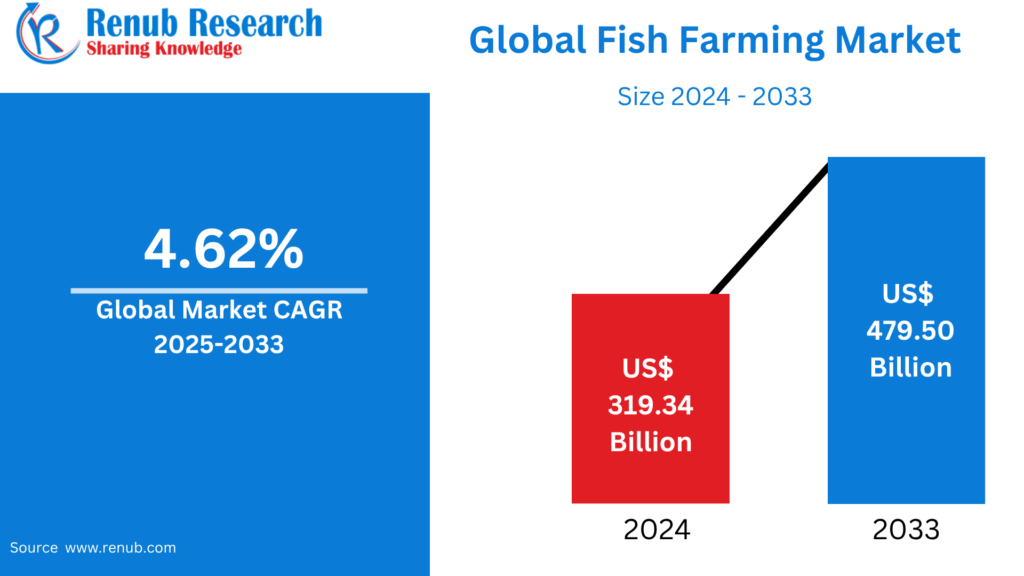
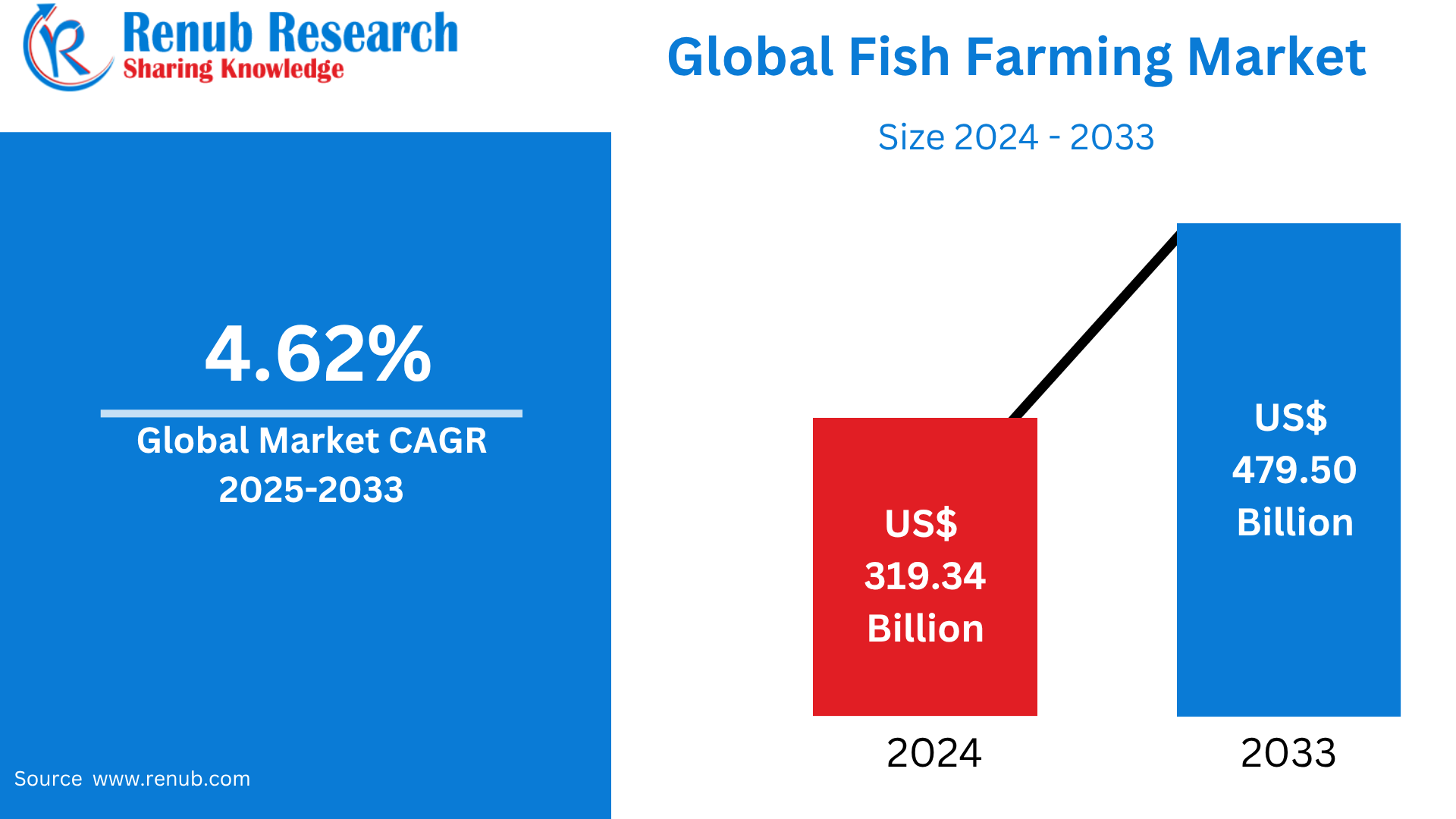
According to Renub Research Fish Farming Market is projected to reach US$ 479.5 Billion by 2033, rising from US$ 319.34 Billion in 2024, registering a steady CAGR of 4.62% from 2025 to 2033. The market growth is driven by rising global seafood consumption, technological advancements in aquaculture systems, government support initiatives, and growing emphasis on sustainable fish production. Declining wild fish reserves and environmental concerns associated with marine fishing are accelerating the shift toward controlled aquaculture practices that ensure resource efficiency, food security, and consistent supply.
Fish Farming Industry Overview
Fish farming, also known as aquaculture, has evolved into one of the world’s most critical food production industries. It encompasses freshwater, marine, and brackish water systems used to cultivate commercially important fish species such as salmon, tilapia, catfish, carp, tuna, seabass, and milkfish. As global populations continue to expand and consumers shift toward healthier protein sources, aquaculture offers a sustainable alternative to overexploited wild fisheries.
Major stakeholders and governments are heavily investing in advanced farming technologies such as Recirculating Aquaculture Systems (RAS), automated feeding systems, AI-based monitoring, biotechnology feed development, and disease management solutions. These innovations significantly improve yield efficiency, fish health, and environmental sustainability. Increased consumer emphasis on traceability, quality certification, and eco-friendly seafood has further encouraged companies to adopt transparency strategies, eco-labeling practices, and compliance-driven production frameworks.
Despite its strong growth potential, the sector faces key challenges such as disease outbreaks, feed cost volatility, environmental pollution concerns, and water quality management. However, continued policy support, improved regulatory frameworks, technology integration, and increased investment from both public and private sectors ensure a positive long-term outlook for the global fish farming market.
Download Free Sample Reporthttps://www.renub.com/request-sample-page.php?gturl=fish-farming-market-p.php
Key Market Growth Drivers
Rising Global Demand for Seafood
Growing global seafood consumption remains a primary driver of the fish farming market. Shifting dietary preferences toward protein-rich, low-fat, and nutrient-dense food products have significantly increased the demand for fish. Fish is widely regarded as an affordable and highly nutritious source of protein, omega-3 fatty acids, vitamins, and essential minerals. Urbanization, rising incomes, growing health awareness, and population growth are encouraging consumers to replace red meat with seafood alternatives.
Overfishing has drastically depleted wild marine stocks, making aquaculture essential for maintaining supply stability. Governments and private companies are investing heavily in efficient fish production infrastructure, while advancements in cold-chain logistics and global seafood trade networks have improved product accessibility. As sustainability and affordability remain central themes in global food consumption, demand for farmed fish is expected to rise significantly throughout the forecast period.
Technological Advancements in Aquaculture
Technology has transformed modern aquaculture into a highly efficient, sustainable, and advanced industry. Innovations such as automated feeding systems, IoT-enabled water quality monitoring, oxygen regulation, smart sensors, RAS technology, offshore cage systems, and biotechnology-based breeding have reshaped the sector’s operational landscape. These technologies significantly enhance productivity, reduce mortality rates, optimize feed usage, and minimize ecological impact.
Digital aquaculture powered by artificial intelligence, big data analytics, and machine learning enables precision farming by tracking fish growth, nutrition, disease risk, and environmental conditions in real time. Meanwhile, biotechnology innovations have resulted in enhanced feed formulations, improved breeding efficiency, and disease-resistant species. This technological evolution ensures greater scalability, sustainability, and cost-efficiency, driving global adoption of advanced fish farming systems.
Government Support and Policy Initiatives
Government policies, subsidies, and strategic investment programs play a vital role in boosting aquaculture expansion worldwide. Recognizing its importance for food security, employment generation, and rural development, many nations have introduced financial incentives, training initiatives, infrastructure development projects, and simplified regulatory systems to encourage fish farming.
Supportive regulations ensure biosecurity, environmental safety, and responsible farming practices, enabling sector stability. Public-private collaborations, research partnerships, and international technology exchange programs further strengthen industry modernization and growth. By incorporating aquaculture into sustainable development frameworks, governments are ensuring reduced dependence on wild marine resources while strengthening domestic seafood production capabilities.
Challenges in the Fish Farming Market
Environmental and Disease Management Issues
Environmental sustainability and disease control remain major challenges in the fish farming industry. Overstocking, waste accumulation, poor water quality, and nutrient pollution can lead to oxygen depletion and harmful algal bloom formation. Disease outbreaks from bacteria, viruses, fungi, and parasites can significantly damage fish stocks, leading to major economic losses. Overuse of chemicals and antibiotics may also raise regulatory, environmental, and consumer safety concerns.
Climate change is another contributing factor, altering marine ecosystems and increasing water temperature fluctuations, which can heighten disease risks. To overcome these obstacles, fish farmers must invest in comprehensive biosecurity systems, water treatment infrastructure, disease surveillance mechanisms, and eco-friendly farming technologies. Preventive healthcare, environmental monitoring, and sustainable farm management strategies are essential to safeguard productivity and ensure long-term growth.
High Production Costs and Market Competition
High operating costs present a significant challenge in fish farming. Feed expenses represent the largest share of production costs, and price fluctuations in fishmeal and plant-based feed ingredients directly affect profitability. Other major cost contributors include energy usage, infrastructure investment, and technological upgrades.
Small-scale farmers often struggle to access financing, modern technology, and international markets, which limits competitive capability. Increasing global competition, regulatory compliance burdens, and supply chain disruptions add additional pressures. To remain competitive, industry participants are prioritizing cost optimization, alternative feed innovation, automation, resource efficiency, and strategic collaboration while focusing on sustainability certification to strengthen market trust.
Regional Fish Farming Market Overview
United States Fish Farming Market
The United States fish farming industry is experiencing notable transformation, driven by rising demand for sustainably sourced domestic seafood. Technological advancements in offshore farming and RAS systems have significantly improved production efficiency and environmental compliance. Government support programs, research funding, and modernization of aquaculture regulations are helping the sector expand. While high production costs and import competition create challenges, increasing consumer demand for locally produced salmon, trout, and catfish ensures promising long-term growth opportunities.
United Kingdom Fish Farming Market
The United Kingdom is a major European aquaculture hub, with salmon farming serving as its dominant sector. The country prioritizes sustainability, innovation, and high-quality sourcing standards to meet domestic and export market requirements. Technological advancements, renewable energy adoption, and strong regulatory frameworks support environmentally responsible aquaculture practices. Despite challenges such as disease management and climate variability, ongoing investments in digital monitoring, biosecurity systems, and diversification into new fish species are strengthening future growth prospects.
China Fish Farming Market
China leads the global fish farming market, supported by large-scale aquaculture infrastructure, strong government backing, and advanced technology integration. China utilizes diversified cultivation systems across freshwater and marine environments, producing species such as carp, tilapia, shrimp, and seabass. Rising domestic seafood consumption, export strength, AI-driven aquaculture solutions, and automated smart farming systems contribute to China’s dominant global position. Although environmental concerns persist, stringent regulations and innovation-driven development ensure continued leadership in global aquaculture.
United Arab Emirates Fish Farming Market
The United Arab Emirates is rapidly emerging as a strategic aquaculture destination, driven by its national food security vision and technological innovation. With limited natural water resources, the country invests heavily in RAS-based and offshore marine farming systems to ensure sustainable seafood production. Government initiatives, public-private partnerships, and advanced water recycling technologies are enhancing production capacity. While high operational costs and climatic limitations remain challenges, growing investment and technological adoption position the UAE as a leading Middle Eastern aquaculture hub.
Recent Developments in the Fish Farming Industry
Recent years have seen significant global initiatives aimed at strengthening fish farming infrastructure, enhancing sustainability, and supporting small-scale farmers. Key developments include international capacity-building programs, government-backed subsidies, input financing initiatives, investment in land-based salmon farming facilities, and expansion of RAS-based sustainable aquaculture projects across Asia, Africa, and the Middle East. These initiatives reinforce innovation, economic development, environmental responsibility, and global seafood supply resilience.
Market Segmentation
Environment
Marine Water
Fresh Water
Brackish Water
Fish Type
Salmon
Milkfish
Tuna
Tilapia
Catfish
Sea Bass
Others
Regional Outlook
North America: United States, Canada
Europe: France, Germany, Italy, Spain, United Kingdom, Belgium, Netherlands, Turkey
Asia Pacific: China, Japan, India, South Korea, Thailand, Malaysia, Indonesia, Australia, New Zealand
Latin America: Brazil, Mexico, Argentina
Middle East & Africa: Saudi Arabia, United Arab Emirates, South Africa
Competitive Landscape and Key Companies
The competitive landscape of the Fish Farming Market features global leaders investing in technological innovation, sustainability initiatives, production expansion, and export strengthening. Companies are evaluated based on company overview, leadership insights, recent developments, SWOT assessment, revenue performance, and strategic growth initiatives.
Key players include:
Alpha Group
Cermaq Group AS (Mitsubishi Corporation)
Tassal Group
Nireus Aquaculture S.A.
Cooke Aquaculture Inc.
Leroy Seafood Group ASA (Austevoll Seafood ASA)
Mowi ASA
Nippon Suisan Kaisha Ltd.
Conclusion
The global Fish Farming Market is poised for sustained expansion through 2033, supported by strong seafood demand, technological advancements, governmental backing, and rising sustainability commitments. As aquaculture continues to play a central role in global food security, economic development, and environmental preservation, continued innovation and responsible farming practices will shape the industry’s future. With growing investments, evolving regulatory structures, and expanding global market participation, fish farming is set to remain a cornerstone of global food production and sustainable protein development.