
Global Plywood Market Size and Forecast 2025–2033
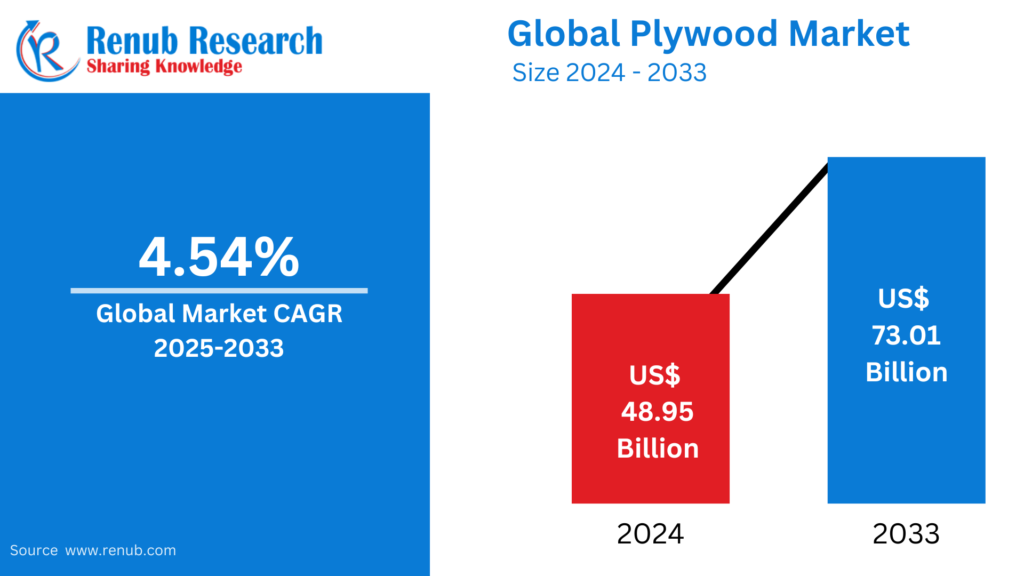
According to Renub Research global plywood market is poised for consistent expansion over the coming decade, with the market expected to rise from US$ 48.95 billion in 2024 to US$ 73.01 billion by 2033, growing at a CAGR of 4.54% between 2025 and 2033. This growth outlook is strongly supported by rapid urbanization, rising infrastructure investments, expanding furniture manufacturing, and the increasing adoption of sustainable building materials worldwide. Demand for plywood continues to rise as developing economies witness construction booms, while developed markets emphasize eco-friendly, certified wood solutions. With its durability, versatility, structural strength, and cost-effectiveness, plywood remains a core material across residential, commercial, industrial, and specialized marine applications.
Global Plywood Market Outlook
Plywood is a high-performance engineered wood product created by bonding multiple thin wood veneers together, with each layer arranged perpendicular to enhance durability and resistance to cracking, shrinking, and warping. This cross-laminated structure provides exceptional strength, stability, and reliability, making plywood a preferred choice in sectors ranging from construction and interior design to furniture and industrial manufacturing. Available in multiple types—softwood plywood, hardwood plywood, and marine plywood—the product caters to a wide spectrum of structural and decorative needs.
Its extensive usage in roofing, flooring, decking, wall sheathing, cabinetry, paneling, scaffolding, packaging, and transportation reflects plywood’s flexibility in adapting to different environmental and load-bearing conditions. Marine plywood further strengthens the product portfolio by providing exceptional water-resistance for marine vessels and coastal infrastructure. Its favorable balance of affordability, performance, moisture tolerance, and sustainability positions plywood as a leading engineered wood material globally.
Download Free Sample Report:https://www.renub.com/request-sample-page.php?gturl=global-plywood-market-p.php
Growth Drivers Supporting the Global Plywood Market
The primary engine for plywood demand is the global construction sector, driven by expanding housing projects, commercial developments, megacity infrastructure initiatives, and government investments in public facilities. In residential building, plywood is heavily used for structural framing, floors, doors, ceilings, and cabinetry. Commercial real estate and institutional construction also contribute significantly through demand for durable interior components and supportive infrastructure.
Another key growth driver is the booming furniture industry, particularly in Asia Pacific, North America, and Europe. Increasing consumer spending, modernization of living spaces, rapid urban household formation, and rising interest in modular and premium furniture continue stimulating plywood consumption. Interior décor trends such as wooden aesthetics, sleek panels, and designer finishes further elevate product demand among home and office designers.
Industrial sectors, including packaging, transportation, marine, and manufacturing, also fuel market expansion. Lightweight yet robust plywood provides thermal resistance, impact strength, and design flexibility required for crates, pallets, truck flooring, and industrial molds. Rapid industrialization in emerging economies supports further growth opportunities.
Rising environmental awareness and sustainability initiatives play a significant role as well. With governments and organizations emphasizing eco-friendly building materials, sustainably produced, FSC and PEFC-certified plywood is witnessing increasing preference. The growing global shift toward renewable construction materials and circular economy practices continues to enhance plywood’s long-term market relevance.
Global Plywood Market Challenges
Despite strong demand prospects, the plywood industry faces obstacles that may restrict short-term expansion. One of the biggest concerns remains volatile raw material prices, particularly timber. Factors such as deforestation control regulations, limited availability of premium wood, geopolitical supply disruptions, and climate-related forest damage increase cost pressures on manufacturers. Price fluctuations force many producers to absorb rising costs or pass them to consumers, impacting profitability.
Another major challenge involves strict environmental and sustainability regulations. Governments worldwide are enforcing responsible logging, sustainable forestry, and reduced carbon emissions, compelling plywood manufacturers to adopt certified wood sourcing and environmentally safer production methods. Compliance with FSC, PEFC, and emission standards adds additional operational burdens. Meanwhile, concerns regarding toxic adhesives, particularly formaldehyde-based bonding resins, continue to prompt regulatory scrutiny and technological adaptation. Balancing regulatory responsibility while maintaining affordability remains a critical industry dilemma.
Regional Market Insights: United States Plywood Market
The United States leads the North American plywood market due to its robust construction and furniture industries. Plywood is widely used across housing projects, commercial developments, renovation activities, and interior aesthetics. The U.S. market places strong emphasis on quality, durability, and sustainability certification, supporting demand for premium, eco-compliant plywood. However, the industry faces competition from low-cost imports and recurring fluctuations in domestic timber prices. Recent strategic expansions, such as major global manufacturers entering the U.S. supply chain, highlight the market’s attractiveness and future potential.
Regional Market Insights: Germany Plywood Market
Germany dominates the European plywood market driven by a technologically advanced woodworking industry, strong architectural standards, and environmentally conscious consumers. Plywood in Germany is widely utilized across construction, furniture, automotive interiors, and industrial designs. Strong compliance with FSC and PEFC certification frameworks reinforces the market’s sustainability reputation. Although high production costs and strict environmental regulations increase operational complexity, Germany’s innovation-driven manufacturing environment keeps it at the forefront of Europe’s plywood sector.
Regional Market Insights: China Plywood Market
China stands as the world’s largest plywood producer and consumer, backed by massive domestic demand from construction, housing, infrastructure, and furniture manufacturing. Abundant raw materials, cost-efficient manufacturing systems, and export-oriented production capacity position China as a global plywood hub. However, growing concerns about environmental impact, illegal logging, and product quality have triggered stricter government regulations and upgraded manufacturing standards. Even with regulatory changes, China continues to dominate the global plywood landscape due to its competitive cost base and expansive industrial ecosystem.
Regional Market Insights: Brazil Plywood Market
Brazil remains a powerful plywood market within Latin America, supported by vast forest resources and strong export capabilities. Known for sustainable forestry management and global certification adherence, Brazilian plywood is highly valued in international markets. However, environmental challenges such as deforestation and illegal timber extraction pose risks to long-term supply stability. Continued investments in sustainable wood cultivation and eco-friendly processing are expected to strengthen Brazil’s global market position.
Regional Market Insights: Saudi Arabia Plywood Market
Saudi Arabia represents one of the fastest-growing plywood markets in the Middle East, fueled by rapid urbanization, megaproject developments, residential expansion, and furniture demand under Vision 2030 initiatives. Although the nation relies heavily on imports due to limited domestic production capacity, increasing investments in manufacturing infrastructure and sustainable building material initiatives are expected to reduce dependency over time. High transport costs and fluctuating international prices remain market hurdles, yet growth prospects remain strong.
Global Plywood Market Segmentation by Type
The market is segmented into hardwood plywood and softwood plywood. Hardwood plywood, known for exceptional strength and premium finish, is widely used in furniture, interior décor, and high-end applications. Softwood plywood, lighter and cost-effective, remains dominant in construction, roofing, flooring, and industrial uses.
Global Plywood Market Segmentation by Grade
Based on grade, the plywood market includes Moisture Resistant (MR), Boiling Water Resistant (BWR), Fire-Resistant, Structural, and Other specialty grades. Each grade caters to specific environmental and strength demands across residential, industrial, and infrastructure applications.
Global Plywood Market Segmentation by Application
Key application sectors include construction, furniture, packaging, flooring, transportation, decoration, and industrial applications. Among these, construction and furniture remain the largest demand contributors globally due to continuous development and lifestyle modernization trends.
Leading Companies in the Global Plywood Market
The competitive landscape includes leading companies such as Boise Cascade, Weyerhaeuser Company Ltd, UPM-Kymmene, PotlatchDeltic Corporation, Metsä Board, Century Plyboards Ltd, and Greenply Industries Ltd. These players focus on expanding production capacity, investing in sustainable forestry, enhancing product quality, and strengthening global distribution networks.
Conclusion: Strong Growth Prospects for the Global Plywood Market
The global plywood market is entering a promising growth phase supported by dynamic construction activity, expanding furniture consumption, sustainability initiatives, and ongoing industrial innovation. Although regulatory constraints, timber price volatility, and environmental challenges pose concerns, technological advancements and sustainable forestry practices are expected to drive long-term stability. With increasing emphasis on eco-friendly materials and durable engineering solutions, plywood will remain a critical material shaping global infrastructure and modern living environments between 2025 and 2033.