Marubozu Candle Types: Understanding Market Psychology Behind This Powerful Candlestick Pattern
Introduction
If you’ve ever watched a trading chart full of colorful candles and wondered what they mean, you’re not alone. Those red and green candles aren’t just pretty visuals—each one tells a story about buyers, sellers, and emotions in the market. Among them, the Marubozu candlestick stands tall, bold, and decisive. It’s like a clear “no debate” statement in the language of price action.
In this guide, we’ll explore marubozu candle types, what they represent, how to trade them, and how learning through free online trading courses can help you spot these golden opportunities early.
Learn all about marubozu candle types, bullish marubozu, and how free online trading courses can help you master candlestick patterns.
What is a Marubozu Candle?
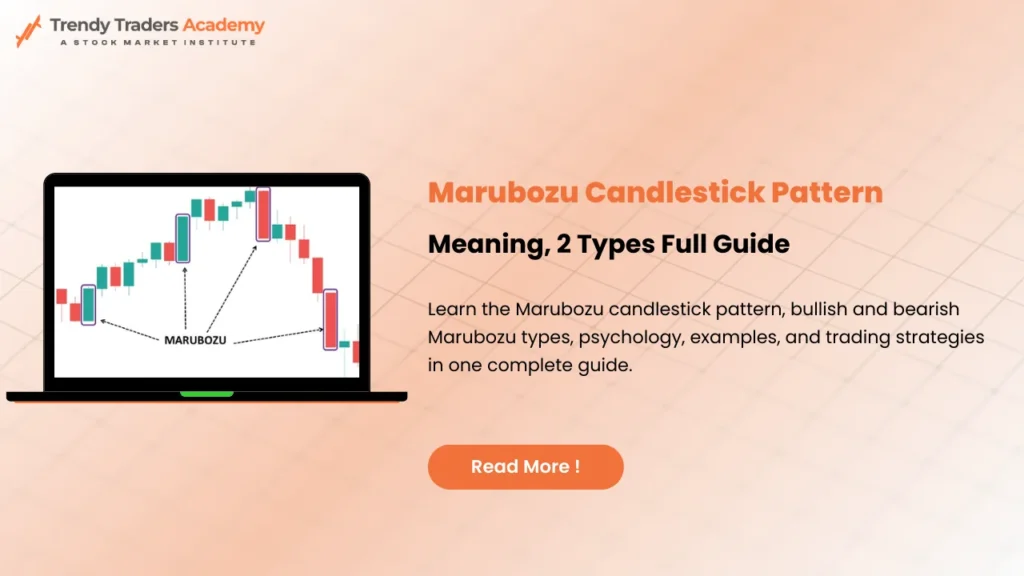
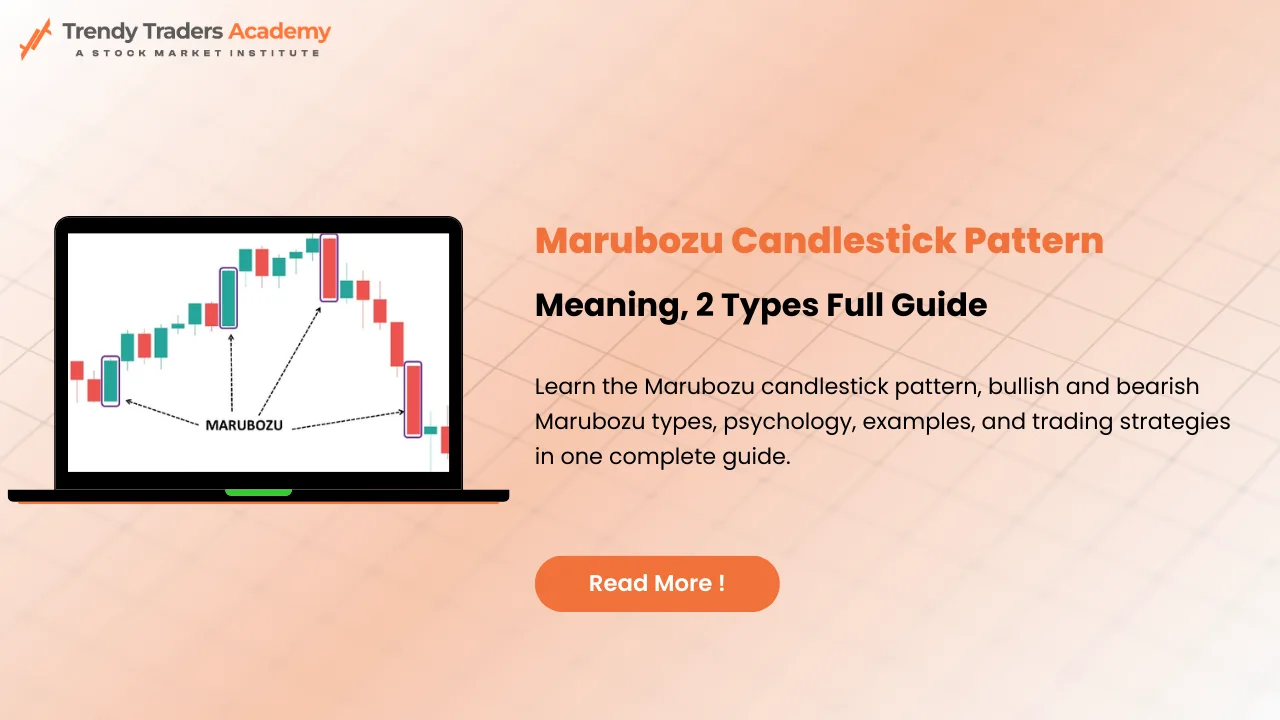
The Marubozu candlestick is one of the most straightforward and powerful price patterns in technical analysis. The word Marubozu comes from Japanese, meaning “shaved head” or “bald.” Fittingly, this candle looks bald—it has no shadows or wicks at either end.
In simple terms, a Marubozu represents pure market conviction. There’s no hesitation, no indecision—just confidence.
- A bullish Marubozu forms when the price opens at the low and closes at the high.
- A bearish Marubozu forms when the price opens at the high and closes at the low.
Think of it as the market shouting “I’m fully in control!”
Anatomy of a Marubozu Candlestick
Let’s break down what a Marubozu looks like:
- Open: The starting price of the candle.
- Close: The ending price.
- High and Low: The upper and lower extremes.
In a perfect Marubozu, the open and low (for bullish) or open and high (for bearish) are the same. There’s no upper or lower wick.
This absence of shadows means one side (buyers or sellers) dominated entirely during that period—no interruptions, no reversals.
Psychology Behind Marubozu Patterns
Every candlestick pattern tells a psychological story between buyers and sellers. A Marubozu is the story of dominance—complete and unapologetic.
- In a bullish Marubozu, buyers show extreme confidence. They control the price from start to finish.
- In a bearish Marubozu, sellers push relentlessly, refusing to give buyers a chance.
It’s like watching a one-sided football match where one team keeps scoring, and the other team barely touches the ball.
Types of Marubozu Candlestick Patterns
There are three main Marubozu candle types you’ll encounter:
- Full Marubozu – No shadows at all.
- Opening Marubozu – No shadow at the open, but may have one at the close.
- Closing Marubozu – No shadow at the close, but may have one at the open.
Each variation signals slightly different intensity in market sentiment, with full Marubozu being the strongest.
Bullish Marubozu Candle Explained
A bullish Marubozu is a strong green candlestick that opens at the lowest price and closes at the highest price of the period.
Key takeaways:
- It signals strong buying pressure.
- Often marks the beginning of a new uptrend.
- Appears after consolidation or a downtrend.
Imagine it as a torch lighting up the path for a bullish rally. Traders often see this as a “green flag” to consider long entries—especially if volume confirms the move.
Bearish Marubozu Candle Explained
The bearish Marubozu is the mirror image. It’s a full red candlestick indicating the sellers completely dominated.
Key highlights:
- Opens at the high and closes at the low.
- Suggests strong selling pressure and bearish sentiment.
- Often triggers trend reversals or downtrend continuations.
If the bullish Marubozu is a full-speed train heading uphill, the bearish one is a downhill avalanche—fast, heavy, and tough to stop.
Partial Marubozu: What It Tells You
Sometimes candles have small wicks on one end. These are known as partial Marubozu candles.
They signal strong momentum, but with slight hesitation:
- A closing Marubozu (with a small lower wick in bullish) suggests some early selling before buyers took control.
- An opening Marubozu signals immediate dominance, but slight resistance toward the close.
Traders often combine these with support and resistance zones or volume indicators for confirmation.
How to Trade a Bullish Marubozu Effectively
Here’s a simple step-by-step trading strategy using the bullish Marubozu:
- Identify the candle after a corrective or sideways phase.
- Wait for confirmation on the next candle—ideally another green or a higher close.
- Check volume; strong volume adds reliability.
- Set stop loss just below the candle’s low to manage risk.
- Target previous resistance zones or use Fibonacci extensions for profit booking.
Pro Tip: Combine the Marubozu analysis with moving averages or RSI to validate the strength of the momentum.
Confirming Signals with Trading Indicators
While candlestick analysis is powerful, combining it with indicators strengthens your accuracy.
Here are popular tools to pair with Marubozu candles:
- Moving Averages: Confirm trend direction.
- RSI (Relative Strength Index): Identify overbought or oversold zones.
- MACD: Spot momentum shifts.
- Volume: Validate the strength of the breakout.
For instance, if you spot a bullish Marubozu with rising RSI and high volume, it’s a strong buy confirmation.
Common Mistakes When Trading Marubozu Candles
Even though they’re strong signals, traders often misinterpret Marubozu candles. Here’s what to avoid:
- Entering without confirmation. Even the strongest candle can fail in choppy markets.
- Ignoring volume. A Marubozu without volume might be deceptive.
- Trading against the broader trend. Align with larger timeframes.
- Forgetting risk management—always use stop losses!
Marubozu Candles in Different Timeframes
Marubozu patterns appear across timeframes—from 1-minute charts to monthly charts.
- In short timeframes (1–15 mins): It often signals quick trades or intraday breakouts.
- In longer timeframes (daily to weekly): It can signify the start of a strong trend.
If you’re a beginner, start with daily charts. They filter out intraday noise and show clearer trend structures.
Comparing Marubozu with Other Candlestick Patterns
It’s helpful to compare the Marubozu with other common patterns:
| Pattern | Market Signal | Key Difference |
| Doji | Indecision | Equal open and close, unlike Marubozu. |
| Hammer | Reversal | Long wick shows rejection, Marubozu shows momentum. |
| Engulfing | Reversal | Requires two candles; Marubozu stands alone. |
So, while others whisper signals, a Marubozu shouts its intent.
Using Marubozu in Long-Term Investing
Don’t assume Marubozu candles work only for day traders. Long-term investors can also use them.
For example:
- A bullish Marubozu on a weekly chart may suggest strong institutional buying.
- A bearish Marubozu on a monthly chart could indicate trend reversals in large-cap stocks.
These insights help investors decide when to accumulate positions or when to book profits.
Learning with Free Online Trading Courses
The best way to master patterns like Marubozu candle types is through structured learning.
Fortunately, there are dozens of free online trading courses available on websites like Coursera, Investopedia, and Broker Academies.
Benefits of these courses:
- Learn technical and fundamental analysis in depth.
- Practice identifying candles on real charts.
- Understand risk management and market psychology.
- Gain community support from fellow learners.
Think of such courses as your gym for trading discipline—you sharpen your analytical muscles before lifting heavy trades.
Final Thoughts and Conclusion
The Marubozu candlestick is simplicity at its best. It’s a clean, powerful signal revealing who controls the market—buyers or sellers. By observing Marubozu candle types, you can spot momentum shifts early, trade confidently, and manage risk effectively.
Success in trading doesn’t come from memorizing patterns but from understanding the story they tell. So next time you see a solid green or red candle with no shadows, remember—a Marubozu speaks volumes without saying a word.
FAQs About Marubozu Candle Types
- What does a Marubozu candle signify?
A Marubozu indicates strong momentum—either buying (bullish) or selling (bearish)—with no hesitation during the session. - How can beginners trade a bullish Marubozu safely?
Wait for the next candle’s confirmation and support from indicators like RSI or volume before entering a trade. - Is a Marubozu a reversal or continuation signal?
It can be both, depending on where it forms. At trend beginnings, it starts a reversal; in mid-trends, it continues momentum. - Do Marubozu candles appear on all timeframes?
Yes, they appear across all charts, but reliability improves on higher timeframes like daily or weekly. - Where can I learn more about Marubozu and candlestick patterns?
Enroll in free online trading courses offered by platforms like trendy traders academy, Coursera, Udemy, or broker education portals—they’re perfect for beginners.