United States Maintenance, Repair, and Operations Market Size and Forecast 2026–2034
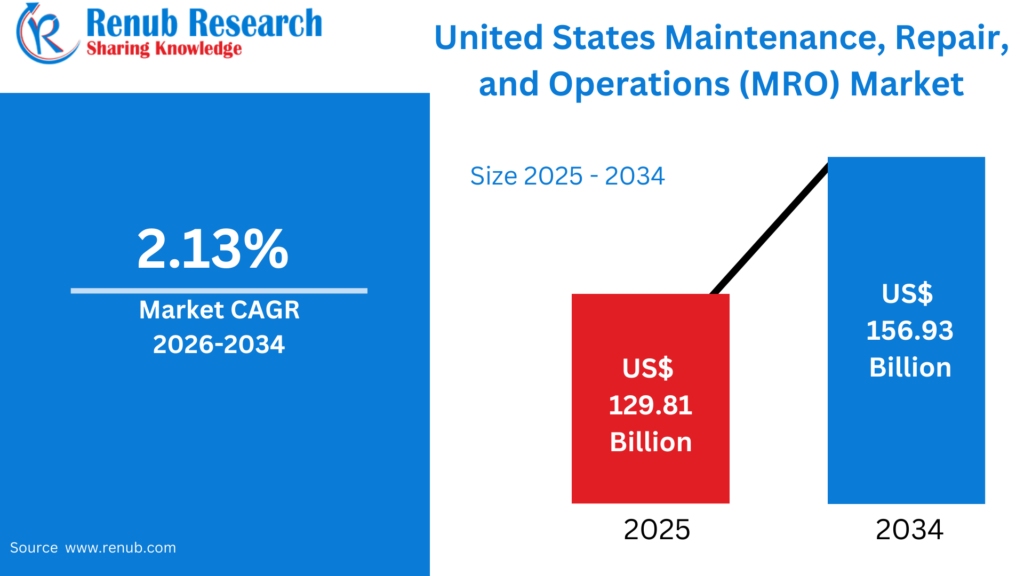
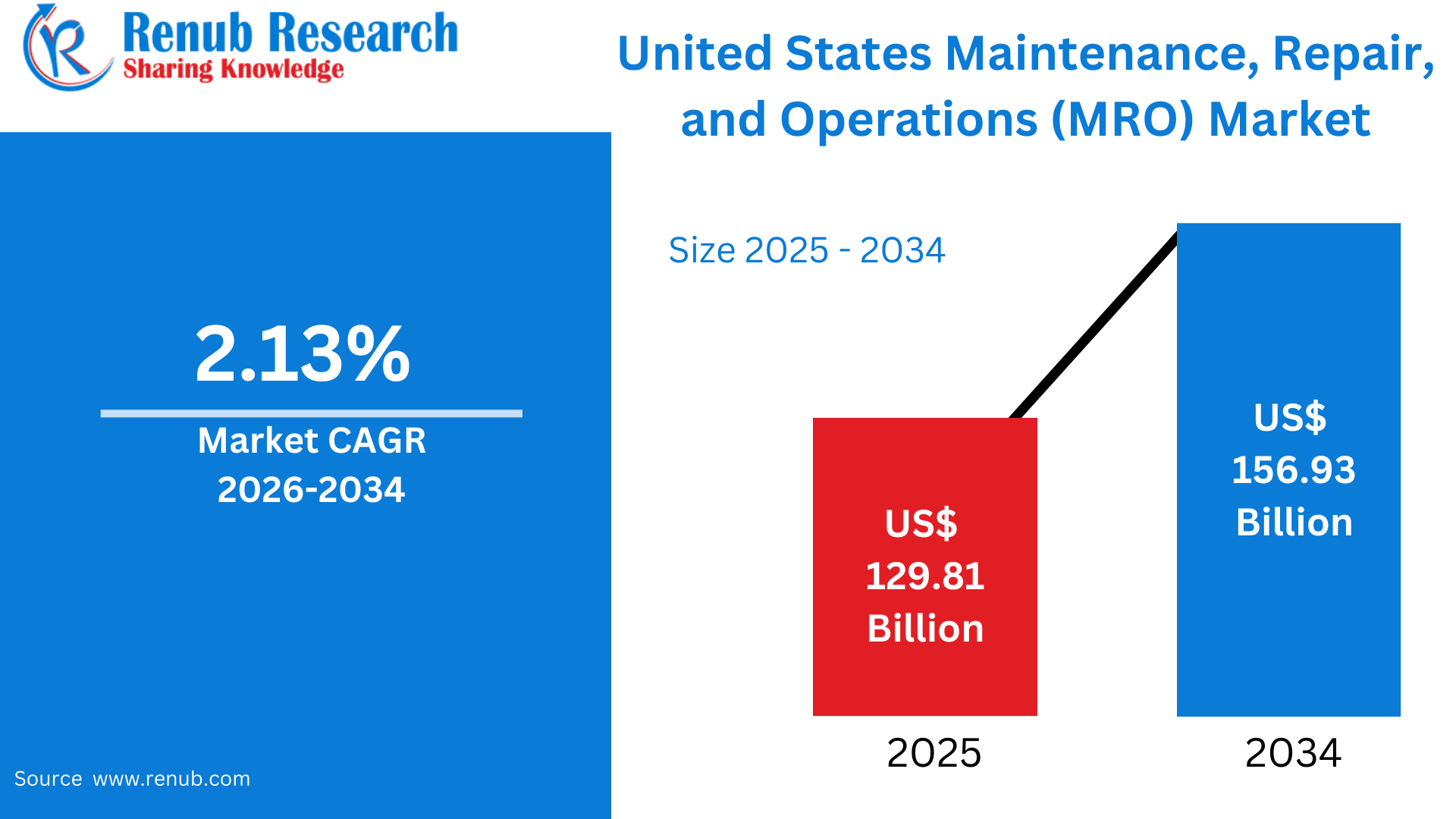
According to Renub Research United States Maintenance, Repair, and Operations (MRO) market is projected to witness robust and sustained growth over the forecast period, driven by industrial expansion, aging infrastructure, and a growing emphasis on operational efficiency. The market is expected to increase from US$ 2.12 billion in 2025 to US$ 4.45 billion by 2034, registering a strong compound annual growth rate (CAGR) of 8.56% between 2026 and 2034. Rising adoption of automation, predictive maintenance technologies, and reliability-centered maintenance practices is reshaping how organizations manage assets and control downtime. As industries across manufacturing, energy, transportation, healthcare, and utilities continue to modernize operations, MRO spending remains a strategic priority across the United States.
Download Free Sample Report:https://www.renub.com/request-sample-page.php?gturl=us-maintenance-repair-operations-mro-market-p.php
United States Maintenance, Repair, and Operations Market Outlook
Maintenance, Repair, and Operations (MRO) encompasses the full range of activities, materials, and services required to keep machinery, equipment, facilities, and production systems operating efficiently, safely, and in compliance with regulations. MRO includes routine preventive maintenance, emergency repairs, spare parts replacement, tools, consumables, safety equipment, and operational supplies. These activities are critical across industrial and commercial environments, ensuring uninterrupted production, extended asset life, and workforce safety.
In the United States, MRO plays a vital role due to the country’s extensive industrial base and aging physical infrastructure. Many facilities operate equipment that has been in service for decades, making ongoing maintenance essential to sustain productivity. U.S. organizations increasingly adopt preventive and predictive maintenance strategies to minimize unplanned downtime and reduce lifecycle costs. Technological advancements such as IoT-enabled sensors, condition monitoring, advanced analytics, and AI-driven maintenance platforms have elevated MRO from a reactive support function to a core element of strategic asset management.
Growth Driver: Aging Industrial Infrastructure and Equipment Modernization
Aging infrastructure is one of the most significant drivers of the U.S. MRO market. Manufacturing plants, power generation facilities, transportation systems, and utilities across the country rely heavily on legacy equipment that requires frequent servicing and component replacement. Rather than undertaking full-scale equipment replacement, many organizations choose to extend asset lifecycles through intensive MRO programs, making maintenance investments more cost-effective than capital expenditures.
Modernization initiatives further increase MRO demand. Retrofitting older machinery with automation components, digital controls, sensors, and energy-efficient parts requires specialized maintenance expertise and replacement components. As organizations upgrade systems incrementally, the need for MRO services, spare parts, and technical support continues to rise, reinforcing long-term market growth.
Growth Driver: Expansion of Manufacturing and Industrial Automation
The resurgence of U.S. manufacturing, supported by reshoring initiatives and domestic production incentives, is accelerating MRO demand nationwide. New factories, expanded production lines, and advanced manufacturing facilities all require continuous maintenance support. Automation technologies such as robotics, CNC machines, and automated material handling systems depend on precise calibration, software updates, and specialized servicing.
As production environments become more complex and high-speed, the cost of unplanned downtime increases substantially. This has pushed manufacturers to invest heavily in preventive and predictive MRO strategies, ensuring equipment reliability and production continuity. Automation-driven manufacturing expansion directly translates into higher spending on OEM parts, skilled labor, digital maintenance tools, and specialized MRO service providers.
Growth Driver: Rising Focus on Workplace Safety and Regulatory Compliance
Workplace safety regulations and environmental compliance requirements are major drivers of MRO spending in the United States. Federal and state agencies enforce stringent standards related to equipment safety, electrical systems, fire protection, ventilation, and hazardous materials handling. Organizations must conduct regular inspections, maintenance, and replacements of safety-critical systems to remain compliant.
Failure to meet regulatory standards can result in fines, operational shutdowns, and reputational damage. As a result, companies proactively invest in MRO supplies such as personal protective equipment, safety tools, emergency systems, and compliant machinery components. Growing emphasis on employee well-being and risk mitigation further reinforces demand for reliable MRO practices across industries.
Challenges: Skilled Labor Shortages and Workforce Aging
A major challenge facing the U.S. MRO market is the shortage of skilled maintenance professionals. A significant portion of the existing MRO workforce is nearing retirement, while fewer young workers are entering technical and skilled trade roles. At the same time, modern MRO increasingly requires expertise in automation, electronics, software systems, and data analytics, widening the skills gap.
Labor shortages lead to longer maintenance cycles, increased labor costs, and greater dependence on third-party service providers. Smaller facilities are particularly affected, often lacking resources to attract and retain qualified technicians. Addressing workforce development, training programs, and upskilling initiatives is critical to sustaining MRO efficiency and long-term market growth.
Challenges: Supply Chain Disruptions and Inventory Management
Supply chain volatility poses a persistent challenge for the U.S. MRO market. Many MRO products, including specialized components and OEM spare parts, depend on global supply networks that are vulnerable to delays and disruptions. Extended lead times for critical components can increase downtime and disrupt operations, especially in just-in-time maintenance environments.
Inventory management complexity further complicates MRO operations. Organizations must balance the cost of holding large inventories against the risk of stockouts. The wide variety of SKUs, unpredictable usage patterns, and rising transportation costs add pressure on procurement strategies. While digital inventory management solutions and supplier diversification are gaining traction, uneven implementation continues to affect efficiency across the market.
United States OEM Maintenance, Repair, and Operations Market
The OEM MRO segment in the United States is driven by the need for certified parts, technical expertise, and warranty protection. Original equipment manufacturers provide specialized maintenance services and components designed specifically for their equipment, ensuring optimal performance and compliance with manufacturer specifications. This is especially critical in industries such as aerospace, automotive, pharmaceuticals, and heavy machinery, where precision and safety are paramount.
OEM MRO solutions offer long-term service contracts, predictable maintenance schedules, and reduced risk of equipment failure. As machinery becomes increasingly software-driven and technologically complex, OEM involvement in maintenance activities continues to grow, strengthening this segment’s contribution to the overall MRO market.
United States Industrial Maintenance, Repair, and Operations Market
Industrial MRO represents the largest segment of the U.S. MRO market, supporting manufacturing, energy, chemicals, mining, and processing industries. This segment includes maintenance of mechanical systems such as pumps, compressors, conveyors, valves, and production equipment. Continuous operations and high utilization rates make industrial facilities heavily dependent on reliable MRO practices.
Preventive maintenance, condition monitoring, and predictive analytics are increasingly adopted to reduce breakdowns and improve asset utilization. Industrial MRO spending remains resilient even during economic downturns, as maintenance is essential to sustain operations and protect revenue streams. Domestic manufacturing growth and infrastructure upgrades further reinforce the importance of industrial MRO.
United States Electrical Maintenance, Repair, and Operations Market
The electrical MRO segment is expanding rapidly due to increased electrification, automation, and digital infrastructure development. This segment covers maintenance of electrical wiring, control panels, motors, transformers, and power distribution systems. Industries such as manufacturing, data centers, renewable energy, and transportation rely on highly reliable electrical systems to prevent outages and safety hazards.
As facilities adopt IoT-enabled devices, advanced control systems, and energy-efficient technologies, electrical maintenance becomes more specialized and critical. Compliance with electrical safety codes and standards ensures consistent demand for electrical MRO services across the United States.
United States Facility Maintenance, Repair, and Operations Market
Facility MRO is essential for maintaining commercial buildings, industrial plants, healthcare facilities, and public infrastructure. This segment includes HVAC maintenance, plumbing, lighting, structural repairs, cleaning supplies, and safety systems. Aging buildings and stricter regulations around energy efficiency and indoor air quality increase maintenance requirements.
Facility managers increasingly outsource MRO activities to specialized service providers to improve efficiency and reduce operational complexity. Smart building technologies enable real-time monitoring and predictive facility maintenance, enhancing service quality and cost control. Facility MRO remains a stable and indispensable segment of the U.S. MRO market.
California Maintenance, Repair, and Operations Market
California’s MRO market is driven by its diverse industrial base, advanced manufacturing sector, and stringent environmental regulations. Industries such as aerospace, renewable energy, technology manufacturing, and food processing generate consistent MRO demand. Sustainability initiatives increase spending on energy-efficient electrical systems, HVAC maintenance, and facility upgrades.
Earthquake safety requirements and complex building codes further elevate facility MRO activities. High labor costs encourage preventive maintenance and automation, supporting long-term MRO growth across the state.
New York Maintenance, Repair, and Operations Market
New York’s MRO market is shaped by dense urban infrastructure, transportation networks, commercial real estate, and healthcare facilities. Facility maintenance dominates spending due to the prevalence of high-rise buildings and aging infrastructure. Strict safety and building regulations increase maintenance frequency and compliance-driven demand.
Industrial MRO is concentrated in pharmaceuticals, logistics, and food processing sectors. Limited space and high operating costs push organizations toward efficient maintenance planning, outsourcing, and digital maintenance solutions.
Washington Maintenance, Repair, and Operations Market
Washington’s MRO market benefits from aerospace manufacturing, technology infrastructure, and energy facilities. Aerospace production and maintenance operations drive high demand for precision MRO services, OEM parts, and skilled labor. Data centers and renewable energy assets further support electrical and facility MRO growth.
The state’s emphasis on innovation and sustainability encourages adoption of advanced maintenance technologies and predictive analytics, ensuring steady long-term demand.
Market Segmentation Overview
The United States MRO market is segmented by provider, MRO type, and geography. Provider segmentation includes OEM and aftermarket services. MRO types include industrial MRO, electrical MRO, facility MRO, and others. Geographically, major markets span California, Texas, New York, Florida, Illinois, Pennsylvania, Ohio, Georgia, New Jersey, Washington, and additional states across the country.
Competitive Landscape and Company Analysis
The U.S. MRO market is highly competitive, featuring global OEMs, aerospace specialists, and industrial service providers. Key companies operating in the market include AAR Corp., AFI KLM E&M, General Electric Company, Hong Kong Aircraft Engineering Company Limited, Lufthansa Technik, MTU Aero Engines AG, Rexel Group Company, Rolls-Royce plc., SIA Engineering Company, and ST Engineering. These companies are evaluated across multiple viewpoints including business overview, leadership, recent developments, SWOT analysis, and revenue performance.
Conclusion
The United States Maintenance, Repair, and Operations market is positioned for strong growth through 2034, supported by aging infrastructure, manufacturing expansion, automation, and increasing regulatory requirements. While challenges such as labor shortages and supply chain complexity persist, continued investment in digital maintenance technologies, workforce development, and predictive maintenance strategies will drive long-term market resilience. MRO remains a critical enabler of operational efficiency, safety, and asset longevity across the U.S. industrial landscape.