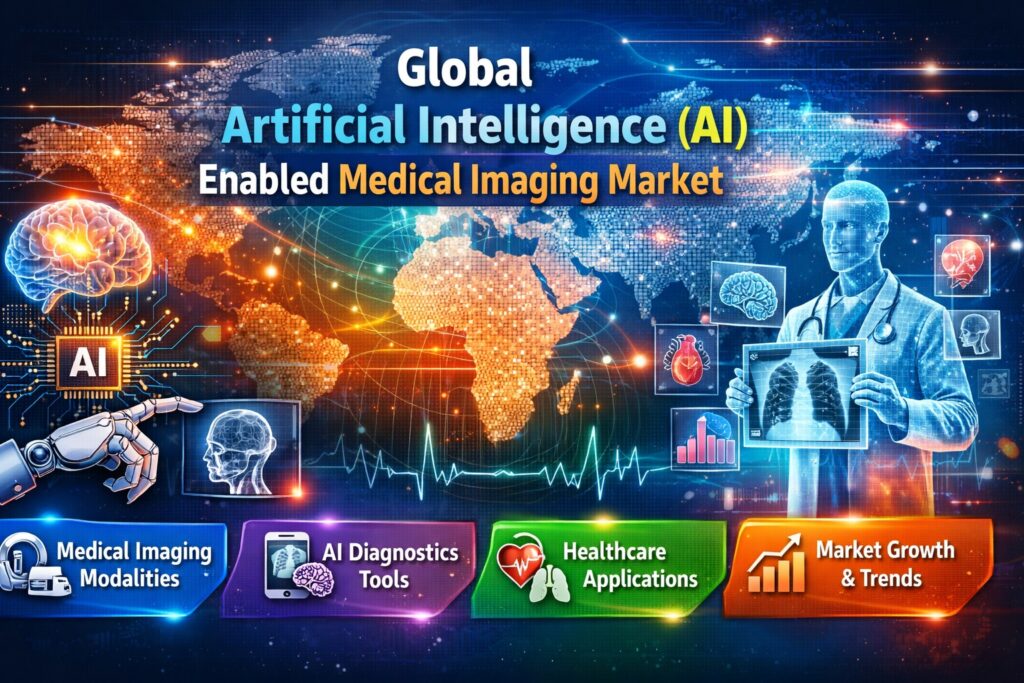
Artificial intelligence and medical imaging are converging and are transforming disease detection, diagnosis, and monitoring. Radiology, cardiology, oncology, and neurology are only a few examples of the imaging technologies that are being enhanced by AI-based systems to achieve faster interpretations, a more accurate diagnosis, and better clinical decision-making. With efficiency and accuracy being the main focus of healthcare systems across the world, the Global Artificial Intelligence (AI) Enabled Medical Imaging Market becomes one of the disruptive technologies of contemporary diagnostics.
The Increasing Role of AI in Medical Imaging
Medical imaging is associated with big data and volumes of heavily structured information, which puts a huge strain on radiologists and clinicians to provide prompt and precise interpretation. Materialized intelligence can be utilized in order to overcome this difficulty, automating image evaluation, detecting minor anomalies, and prioritizing life-threatening situations. Machine learning and deep learning algorithms technologies are now able to pick patterns that might otherwise be hard to detect with the naked eye, assist in earlier diagnosis and improved patient outcomes.
AI-powered imaging applications are currently available in most modalities such as X-ray, MRI, CT scans, ultrasound, or nuclear imaging. They are becoming a needed part of next-generation healthcare delivery by improving productivity and decreasing the number of diagnostic errors due to their integration in clinical workflows.
Market Drivers Gathering Steam
There are a number of reasons which have led to the fast growth of this market. The recent surge in chronic diseases in the world especially cancer, heart diseases, and neurological disorders have greatly led to the heightened need of sophisticated diagnostic equipment. The early and precise diagnosis is essential to successful treatment, and AI-based imaging is one of the solutions to the problem.
The other significant contributor is the increasing shortage of qualified radiologists in most of the areas. The systems based on AI can be used to address this gap because they can guide clinicians in processing images and managing workloads. Healthcare providers are therefore putting more investments in smart imaging sites which is enhancing the growth perspectives in Global Artificial Intelligence (AI) Enabled Market in Medical Imaging.
Industry Competitors and Major Industry Players
The industry is characterized by high involvement of world leaders in healthcare technologies and start-ups based on AI. GE HealthCare, Siemens Healthineers, Koninklijke Philips N.V., and Canon Medical Systems Corporation are among the companies that are leading the way towards applying AI abilities to imaging equipment and software systems.
To enhance their presence in the market, such organizations are strategic partnerships, development of AI algorithms, and regulatory approvals. Clinical validation, compatibility with hospital systems, and the capability to produce calculable returns on diagnostic efficiency grow more and more important in terms of competitive differentiation.
Local Tendencies and Developmental Potentials
The market is now headed by North America, which boasts of well-developed healthcare infrastructure, high levels of digital adoption, and considerable investments in AI research. Europe is coming behind with positive regulatory efforts and the growth of digital health ecosystems.
Asia-Pacific has been forecasted to experience the most significant growth in the next few years because of the growing healthcare spending, the rising number of diagnostic centers, and the growing popularity of AI-based healthcare technologies. China, Japan, India, and other countries are fast embracing intelligent imaging technologies, which make the Global Artificial Intelligence (AI) Enabled Medical Imaging Market grow all over the world.
Regulatory and Ethical Implications
Even though this has potential, AI-driven medical imaging will have to navigate intricate regulatory and ethical environments. Data privacy, transparency of algorithms, and clinical reliability are some of the primary concerns of regulators and healthcare providers. Market acceptance and short-term viability require regulatory approvals and adherence to international standards of medical devices.
In addition, the use of AI has been considered to be supportive and not substitutive. Patient trust is paramount and that the responsibility of usage is closely monitored by the clinicians especially in high stake diagnostic settings.
strategy implications Future Outlook
In the future, AI combined with cloud computing, big data analytics, and personalized medicine is likely to create a new business opportunity in the entire imaging value chain. The enhancement of predictive analytics and real-time decision support will also improve the accuracy of the diagnosis and the efficiency of the working process.
To the stakeholders, the key to future successful performance in the long term will be constant innovation, robust clinical evidence, and an efficient integration into healthcare systems. The Global Artificial Intelligence (AI) Enabled Medical Imaging Market is in a good position to transform the future of diagnostic care with increasing applications and long-term investment.