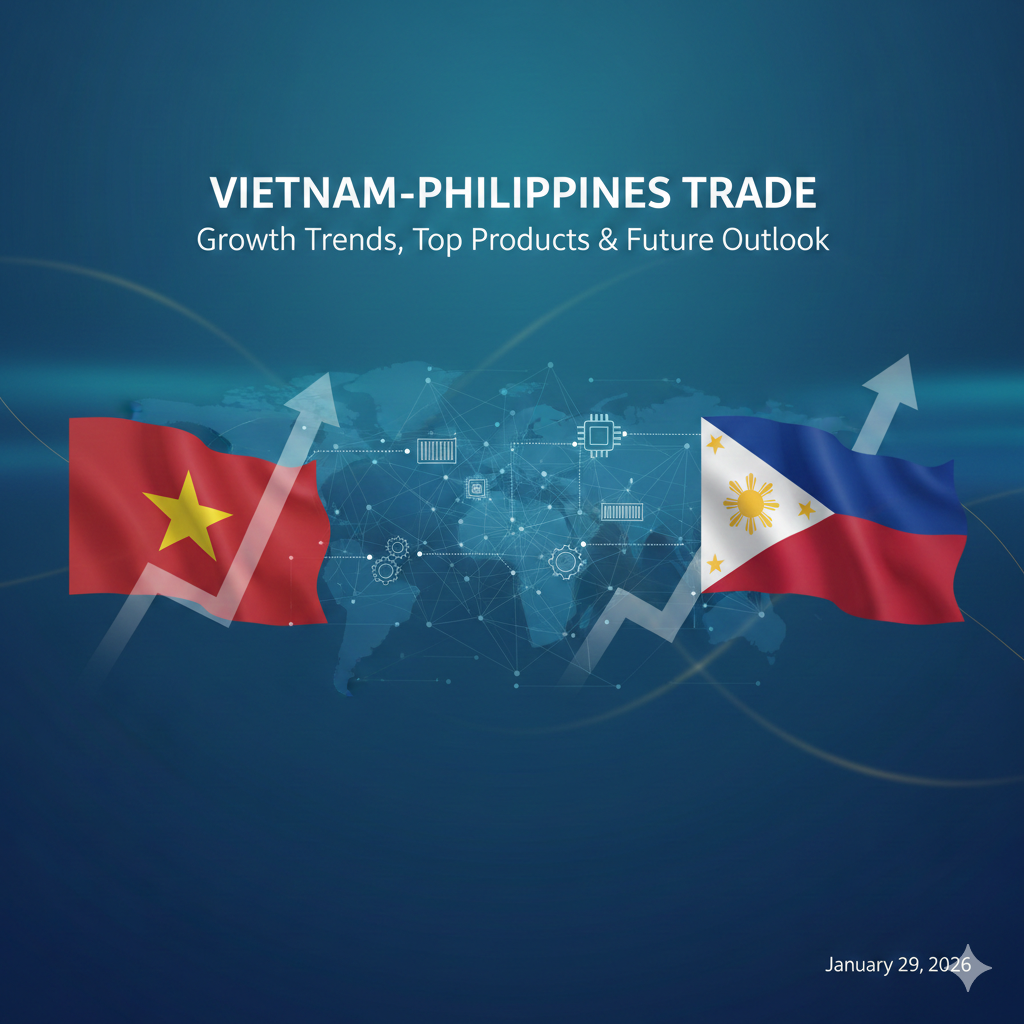
Bilateral trade between Vietnam and the Philippines has emerged as one of the most dynamic commercial relationships within Southeast Asia’s evolving economic landscape. As two fast-growing ASEAN economies with complementary production capabilities, expanding consumer markets, and strong regional integration, Vietnam and the Philippines have steadily deepened their economic engagement over the last decade.
In recent years, Vietnam Philippines trade has not only grown in absolute value but also diversified across a broader range of product categories, spanning agriculture, electronics, machinery, construction materials, and consumer goods. According to the latest Vietnam import data and Philippines export statistics, Vietnam’s imports from the Philippines reached approximately US$2.47 billion, while Vietnam’s exports to the Philippines stood at US$6.17 billion in 2024–25, based on official Vietnam export customs data.
The total value of Vietnam Philippines trade reached US$8.66 billion in 2024 and is estimated to approach US$10 billion in 2025, reflecting sustained momentum despite global trade headwinds. This article explores the latest trade data for 2024–25, analyzes structural drivers shaping the partnership, highlights Vietnam Philippines top traded products, and evaluates future opportunities and challenges.
Overview of Vietnam–Philippines Bilateral Trade Growth
The year 2024 marked a milestone for Vietnam Philippines bilateral trade, as total trade volumes reached a record US$8.66 billion, representing an 11% year-on-year increase compared to 2023. This growth underscores stronger demand, deeper market integration, and improved supply chain connectivity between the two ASEAN partners.
Within this trade volume:
-
Vietnam’s exports to the Philippines climbed to approximately US$6.19 billion, the highest level on record
-
Vietnam’s imports from the Philippines totaled about US$2.47 billion, showing a modest decline from the previous year
-
Vietnam recorded a trade surplus of nearly US$3.7 billion with the Philippines in 2024
The surge in exports was particularly notable, with Vietnamese shipments to the Philippines expanding by over 20% year-on-year. Following a period of relative stagnation in the immediate post-pandemic years, renewed demand for food staples, industrial inputs, and manufactured goods revitalized Vietnam Philippines trade relations.
Early 2025 Trade Performance: Short-Term Fluctuations
Trade data from early 2025 presents a mixed but stable picture. In Q1 2025, Vietnam’s exports to the Philippines reached approximately US$1.40 billion, reflecting a slight 3.8% decline compared to Q1 2024. Meanwhile, Vietnam’s imports from the Philippines stood at US$672 million, down 4.6% year-on-year.
Combined bilateral trade for the quarter hovered near US$2.07 billion. While these short-term fluctuations reflect seasonal demand cycles and inventory adjustments, exporters on both sides remain optimistic. Policymakers and industry leaders continue to target US$10 billion in annual Vietnam Philippines trade, supported by diversification strategies and expanding industrial cooperation.
What Does Vietnam Import from the Philippines?
Vietnam’s imports from the Philippines are primarily driven by electronics, machinery components, and select agricultural and industrial products. These imports play a vital role in supporting Vietnam’s manufacturing ecosystem, particularly in electronics assembly and industrial processing.
Based on Vietnam import data for 2025, the top products imported from the Philippines include:
1. Electrical Machinery & Equipment (HS 85) – US$1.85 Billion
This category dominates imports, encompassing semiconductors, electronic components, household appliances, and broadcasting equipment. The Philippines’ strong electronics assembly sector makes it a critical supplier to Vietnam’s high-tech manufacturing base.
2. Copper & Articles Thereof (HS 74) – US$166.20 Million
Copper wires, cables, and related products are essential inputs for Vietnam’s power, electronics, and construction industries.
3. Optical, Medical & Surgical Instruments (HS 90) – US$136.11 Million
Vietnam relies on Philippine-made medical devices, optical instruments, and surgical equipment to support its healthcare and precision manufacturing sectors.
4. Nuclear Reactors & Machinery (HS 84) – US$64.61 Million
Industrial machinery and mechanical equipment contribute to Vietnam’s infrastructure and industrial modernization efforts.
5. Fish & Seafood (HS 03) – US$36.97 Million
Fresh, frozen, and processed seafood imports reflect complementary supply chains in fisheries.
Other notable imports include plastics, iron and steel products, sugar, and fertilizers—highlighting the diversity of Vietnam Philippines bilateral trade beyond electronics.
What Does Vietnam Export to the Philippines?
Vietnam is a major supplier of food staples, construction materials, manufactured goods, and consumer products to the Philippine market. According to Vietnam shipment data for 2025, the top export categories include:
1. Cereals (HS 10) – US$2.68 Billion
Rice dominates Vietnam’s exports, reinforcing the Philippines’ food security needs. Vietnam remains one of the Philippines’ most reliable rice suppliers.
2. Electrical Machinery & Equipment (HS 85) – US$745.08 Million
Vietnam’s growing electronics manufacturing base supplies appliances, telecom equipment, and electrical machinery.
3. Salt, Sulfur, Lime & Cement (HS 25) – US$327.94 Million
These construction materials support infrastructure development and urbanization across the Philippines.
4. Coffee, Tea & Spices (HS 09) – US$196.89 Million
Vietnamese coffee and spices enjoy strong demand in the Philippine consumer market.
5. Miscellaneous Edible Preparations (HS 21) – US$193.69 Million
Sauces, condiments, and processed foods benefit from increasing regional culinary integration.
Additional exports include machinery, vehicles, plastics, footwear, and seafood—forming the backbone of Vietnam Philippines trade relations and underscoring Vietnam’s export diversification.
Vietnam–Philippines Trade Over the Last Decade
The evolution of Vietnam Philippines trade over the past ten years highlights a clear upward trajectory:
-
2015: US$3.03 billion
-
2018: US$4.71 billion
-
2021: US$6.97 billion
-
2023: US$7.79 billion
-
2024: US$8.66 billion
-
2025 (est.): US$10 billion
This steady expansion reflects stronger ASEAN integration, improved logistics, and growing economic complementarities.
Key Drivers of Vietnam–Philippines Trade Growth
Several structural factors continue to fuel growth in Vietnam Philippines bilateral trade:
ASEAN Economic Integration
Reduced tariffs, harmonized standards, and freer movement of goods have lowered trade barriers.
Complementary Economic Structures
Vietnam’s strengths in agriculture and manufacturing align well with Philippine import demand, while the Philippines’ electronics sector supports Vietnam’s industrial supply chains.
Infrastructure & Logistics Improvements
Enhanced port capacity, shipping connectivity, and customs modernization have improved trade efficiency.
Policy & Institutional Support
Trade missions, export promotion programs, and bilateral dialogues continue to strengthen Vietnam Philippines trade relations.
Challenges and Market Risks
Despite strong momentum, several challenges persist:
-
Rice import policy fluctuations in the Philippines
-
Stricter food safety and compliance requirements
-
Competition from regional suppliers such as Thailand, India, and China
-
Non-tariff barriers and certification delays
Addressing these risks will be crucial to sustaining long-term growth.
Future Outlook and Opportunities
Both governments remain committed to expanding Vietnam Philippines trade beyond US$10 billion. Key opportunities include:
-
Agricultural cooperation and food security partnerships
-
Joint ventures in electronics and manufacturing
-
Expansion into renewable energy components
-
Growth in services trade and the digital economy
Conclusion
In conclusion, Vietnam Philippines trade relations have evolved into a resilient and expanding partnership, underpinned by strong fundamentals and strategic alignment. With record trade volumes in 2024, diversified export portfolios, and sustained policy support, both countries are well positioned for continued growth in 2025 and beyond.
Access to accurate Vietnam export customs data, Vietnam import data, and Vietnam shipment data will remain essential for businesses seeking to capitalize on emerging opportunities in this dynamic bilateral trade corridor.