Japan Transcatheter Heart Valve Replacement Market Overview
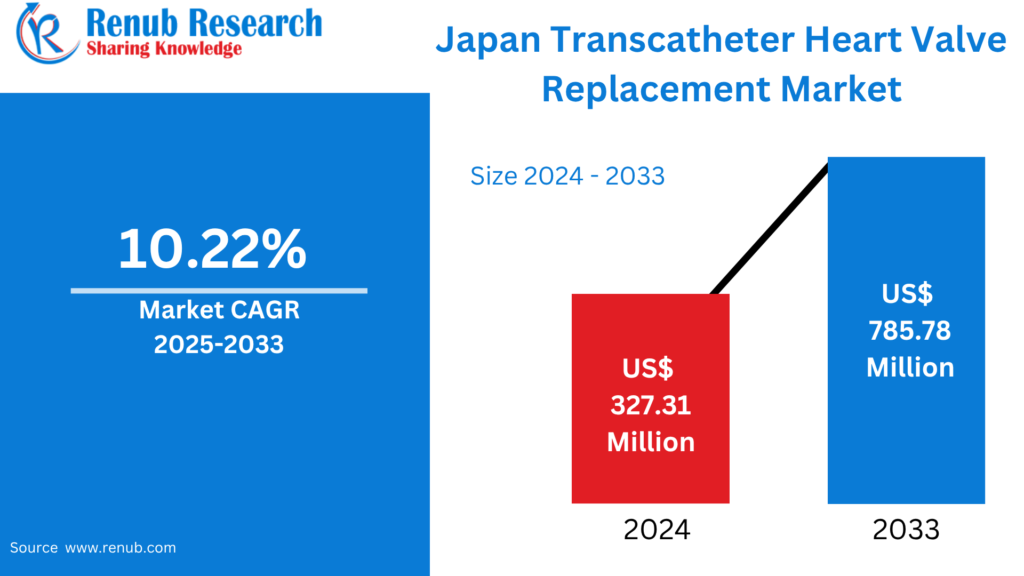
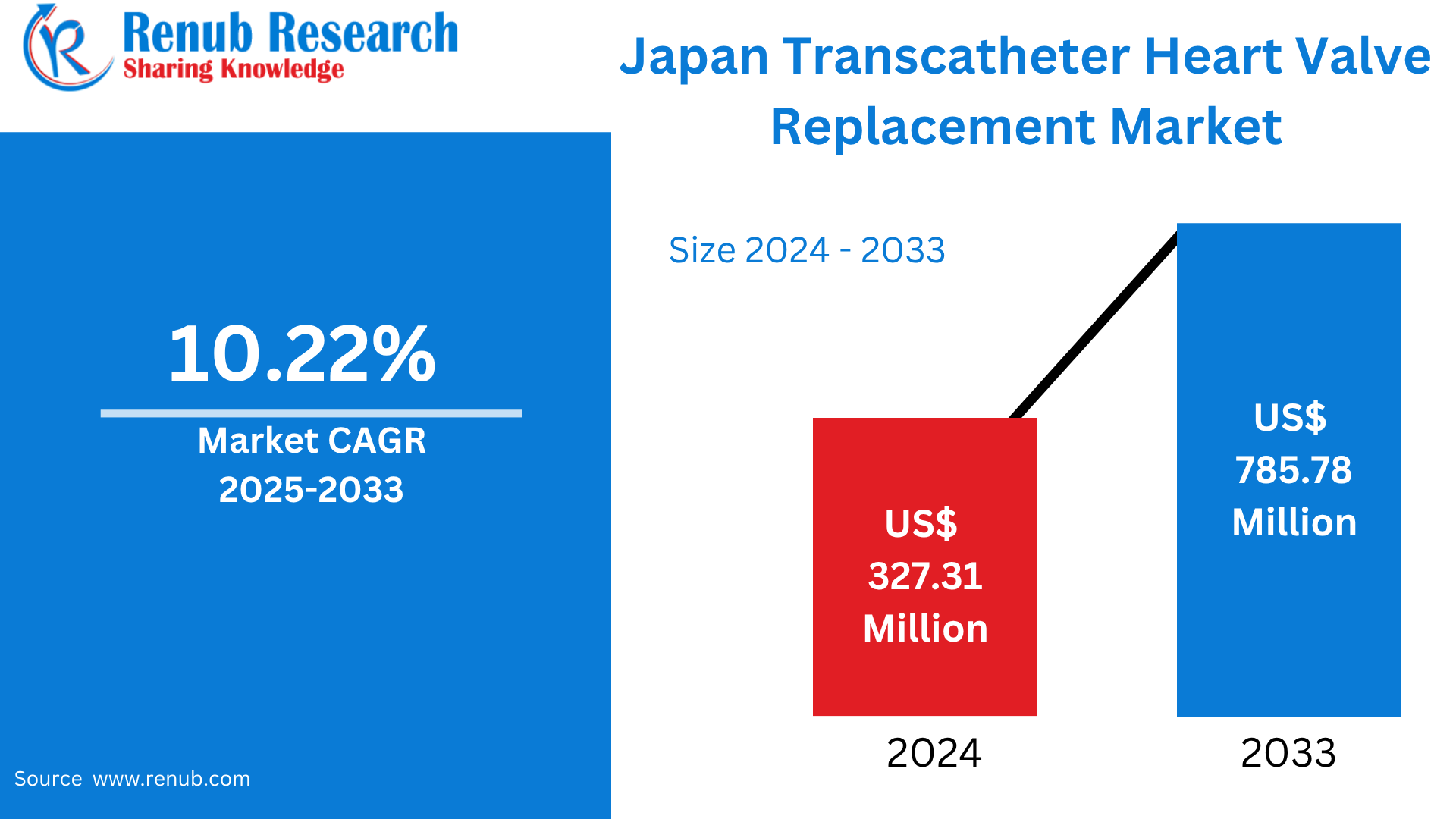
According To Renub Research Japan transcatheter heart valve replacement (TAVR) market is undergoing rapid expansion, supported by demographic shifts, clinical innovation, and strong institutional support. Valued at approximately US$ 327.31 million in 2024, the market is forecast to reach around US$ 785.78 million by 2033, registering a robust compound annual growth rate (CAGR) of 10.22% during the period from 2025 to 2033. This significant growth trajectory reflects Japan’s rapidly aging population, the rising prevalence of valvular heart diseases such as aortic stenosis, and the increasing preference for minimally invasive cardiac procedures.
Japan has one of the highest life expectancies globally, which has resulted in a growing elderly population vulnerable to degenerative heart valve disorders. Conventional open-heart surgery poses higher risks for elderly and high-risk patients, making transcatheter heart valve replacement an increasingly preferred therapeutic option. Supported by a strong healthcare infrastructure, favorable reimbursement policies, and expanding clinical acceptance, TAVR has become a cornerstone of modern structural heart disease management in Japan.
Download Free Sample Report:https://www.renub.com/request-sample-page.php?gturl=japan-transcatheter-heart-valve-replacement-market-p.php
Japan Transcatheter Heart Valve Replacement Market Outlook
Transcatheter heart valve replacement is a minimally invasive procedure that allows clinicians to replace damaged heart valves without the need for open-heart surgery. The technique involves inserting a replacement valve via catheter-based access, typically through the femoral artery, and deploying it within the diseased native valve. This approach reduces surgical trauma, shortens hospital stays, and improves recovery times, making it particularly suitable for elderly and high-risk patients.
In Japan, the adoption of TAVR has accelerated as clinical evidence continues to demonstrate its safety and efficacy across broader patient populations, including intermediate-risk groups. Hospitals and cardiac centers are increasingly investing in hybrid operating rooms, advanced imaging systems, and multidisciplinary heart teams to support these procedures. Furthermore, streamlined regulatory pathways and expanding reimbursement coverage have improved patient access to TAVR technologies, reinforcing positive market momentum.
Key Growth Drivers in the Japan Transcatheter Heart Valve Replacement Market
Aging Population and Rising Disease Burden
Japan’s demographic profile is one of the most influential drivers of TAVR market growth. A significant proportion of the population is aged 65 and above, leading to a higher incidence of degenerative valve diseases, particularly aortic stenosis. As these conditions progress with age, the demand for effective and less invasive treatment options has increased substantially.
Elderly patients often present with comorbidities that make traditional surgical valve replacement risky. TAVR offers a safer alternative with comparable or superior outcomes, driving widespread clinical adoption. As the aging trend continues, the eligible patient pool for transcatheter valve procedures is expected to expand further.
Technological Advancements in Transcatheter Valve Systems
Continuous innovation in device design and procedural techniques has significantly enhanced the performance of transcatheter heart valves. Manufacturers are developing next-generation valves with improved deliverability, enhanced durability, and reduced complication rates, such as paravalvular leak or vascular injury.
Advances in imaging guidance, catheter technology, and valve materials have improved procedural precision and patient outcomes. These innovations not only increase physician confidence but also expand the range of patients who can safely undergo TAVR. As technology evolves, adoption rates are expected to rise across both large and mid-sized healthcare facilities.
Increasing Physician Expertise and Training
Physician education and skill development play a critical role in the growth of the TAVR market in Japan. Over the past decade, specialized training programs, hands-on workshops, and international collaborations have significantly enhanced the procedural expertise of interventional cardiologists and cardiac surgeons.
Medical institutions increasingly emphasize multidisciplinary heart team approaches, combining expertise from cardiology, cardiac surgery, imaging, and anesthesiology. Simulation-based training and proctor-led procedures further improve procedural safety and success rates. As clinical confidence grows, more healthcare providers are incorporating TAVR into routine practice, supporting market expansion.
Supportive Regulatory and Reimbursement Environment
Japan’s regulatory framework has evolved to support innovation in life-saving cardiovascular therapies. Accelerated approval pathways and conditional approvals for novel devices have enabled quicker market entry for advanced transcatheter valve systems.
At the same time, Japan’s national health insurance system provides reimbursement for TAVR procedures, reducing financial barriers for patients. While reimbursement levels are carefully regulated, the inclusion of TAVR within coverage frameworks has been instrumental in driving adoption. Ongoing collaboration between regulators, healthcare providers, and industry stakeholders continues to create a favorable market environment.
Growing Awareness and Early Diagnosis
Public and professional awareness of valvular heart diseases has improved considerably in Japan. Nationwide health campaigns, increased use of diagnostic imaging, and proactive screening of elderly populations have led to earlier detection of conditions such as aortic stenosis.
Earlier diagnosis allows timely referral for minimally invasive interventions before disease progression leads to severe complications. As awareness grows among patients and primary care providers, demand for TAVR procedures is expected to increase, contributing to sustained market growth.
Challenges in the Japan Transcatheter Heart Valve Replacement Market
High Cost of Procedures and Infrastructure
Despite favorable reimbursement, the high cost of transcatheter heart valve systems and associated infrastructure remains a key challenge. TAVR procedures require advanced equipment, including hybrid operating rooms, imaging systems, and specialized catheters, which represent significant capital investments for hospitals.
Smaller and regional hospitals may face financial constraints that limit their ability to offer TAVR services. While large urban medical centers can absorb these costs more easily, disparities in access persist, potentially slowing nationwide adoption.
Limited Availability of Skilled Professionals
Performing TAVR requires a highly trained and coordinated medical team. Although major metropolitan centers in Japan have developed strong expertise, shortages of skilled professionals remain in rural and less populated regions.
Training new specialists and maintaining procedural proficiency takes time, and Japan’s aging medical workforce adds to the challenge. While government-supported training programs and international partnerships are helping address this issue, workforce limitations continue to restrict the expansion of TAVR services in some areas.
Japan Transcatheter Heart Valve Replacement Market by Type
Transcatheter Aortic Valve Replacement
Transcatheter aortic valve replacement represents the largest segment of the Japanese market. Aortic stenosis is the most common valvular heart disease among elderly patients, and TAVR has become the standard of care for those at high or intermediate surgical risk. Expanding indications and strong clinical outcomes continue to drive growth in this segment.
Transcatheter Mitral Valve Replacement
The transcatheter mitral valve replacement segment is emerging as an important growth area. Mitral valve disorders are complex, and minimally invasive solutions are still evolving. Ongoing clinical research and device development are expected to expand the role of transcatheter mitral interventions in Japan over the forecast period.
Transcatheter Pulmonary Valve Replacement
Although smaller in size, the transcatheter pulmonary valve replacement segment addresses specific congenital and acquired heart conditions. Advances in pediatric and adult congenital cardiology are supporting gradual growth in this niche segment.
Japan Transcatheter Heart Valve Replacement Market by Material
Mechanical Valves
Mechanical valves offer long-term durability but require lifelong anticoagulation therapy. Their use in transcatheter procedures is limited compared to surgical applications, particularly among elderly patients.
Biological Valves
Biological valves dominate the transcatheter market due to their favorable safety profile and reduced need for long-term anticoagulation. Continuous improvements in tissue processing and valve design are enhancing durability and performance, driving widespread adoption.
Japan Transcatheter Heart Valve Replacement Market by End User
Hospitals
Hospitals represent the largest end-user segment, accounting for the majority of TAVR procedures. Large tertiary and academic hospitals are equipped with specialized facilities and experienced teams, enabling high procedural volumes and advanced care.
Ambulatory Surgical Centers
While still limited, ambulatory surgical centers are gradually entering the TAVR landscape as procedural techniques become more refined. Their role is expected to expand cautiously over time.
Others
Other end users include specialized cardiac clinics and research institutions that contribute to clinical trials, training, and innovation in transcatheter valve therapies.
Japan Transcatheter Heart Valve Replacement Market Regional Analysis
Tokyo Transcatheter Heart Valve Replacement Market
Tokyo leads the national TAVR market due to its concentration of advanced medical institutions, skilled professionals, and early access to new technologies. High patient volumes and strong research activity make Tokyo a benchmark region for procedural innovation and clinical outcomes.
Kansai Transcatheter Heart Valve Replacement Market
The Kansai region, including Osaka, Kyoto, and Kobe, represents a major hub for TAVR procedures. Strong academic centers and collaborative research initiatives support steady growth, with opportunities for further expansion in secondary cities.
Aichi Transcatheter Heart Valve Replacement Market
Aichi Prefecture, anchored by Nagoya, is emerging as an important regional market. An aging population, strong healthcare infrastructure, and increasing awareness of valvular diseases are driving consistent adoption of TAVR procedures.
Market Segmentation Overview
Segmentation by Type
The market includes transcatheter aortic, mitral, and pulmonary valve replacement procedures, with aortic valve replacement accounting for the largest share.
Segmentation by Material
Biological valves dominate the market, followed by mechanical valves with limited transcatheter application.
Segmentation by End User
Hospitals account for the majority of procedures, with ambulatory surgical centers and other facilities playing a growing role.
Segmentation by City
Key cities include Tokyo, Kansai, Aichi, Kanagawa, Saitama, Hyogo, Chiba, Hokkaido, Fukuoka, and Shizuoka, each contributing to regional market growth.
Competitive Landscape and Company Analysis
The Japan transcatheter heart valve replacement market is highly competitive, with both global and regional players investing heavily in innovation, clinical trials, and strategic partnerships. Companies are evaluated across multiple parameters, including company overview, leadership, recent developments, SWOT analysis, and revenue performance.
Ongoing research, technological advancement, and expanding clinical indications are expected to intensify competition and drive sustained growth. As Japan continues to embrace minimally invasive cardiac therapies, the TAVR market is poised to play a pivotal role in shaping the future of cardiovascular care in the country.