In today’s digital world, getting clicks is easy. Turning those clicks into real results is the real challenge. Businesses spend money on ads, social media, and search engines every day. But what truly matters is not how many people see your ad — it’s how many people take action.
This is where Performance Marketing changes the game.
From clicks to conversions, the journey is not random. It is based on data, psychology, testing, and continuous improvement. In this blog, we will break down the science behind Performance Marketing in simple words so you can understand how it works and how it drives real growth.
What is Performance Marketing?
Businesses pay based on measurable actions such as clicks, leads, or sales rather than paying only for visibility. These results can include clicks, leads, sales, downloads, or any measurable action. Unlike traditional marketing, where you pay upfront for visibility, Performance Marketing focuses on outcomes. Every rupee spent is connected to a measurable result.
Key Features of Performance Marketing
- Pay for measurable results
- Data-driven decisions
- Real-time tracking
- Continuous testing and optimization
- High return on investment (ROI)
This method reduces risk and increases efficiency because every campaign is tracked and improved based on performance.
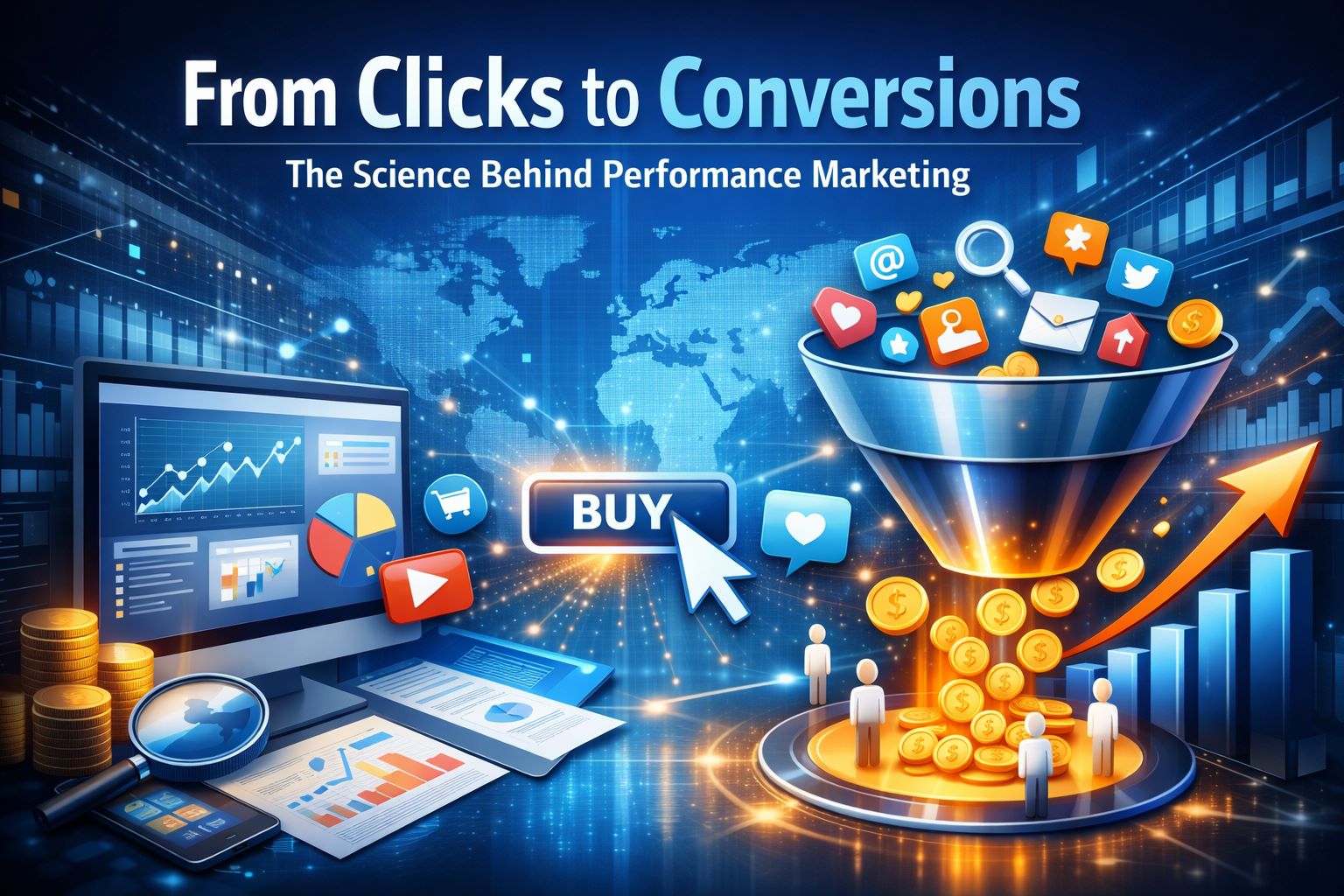
Understanding the Journey: From Clicks to Conversions
To understand the science behind Performance Marketing, we must understand the customer journey.
- Step 1 – Awareness: At this stage, people discover your brand through ads, social media posts, or search results. The goal is to grab attention.
- Step 2 – Interest: Once they click, they want more information. This is where your landing page, content, and message must match their expectations.
- Step 3 – Consideration: They compare options. They read reviews, check pricing, and evaluate trust.
- Step 4 – Conversion: Finally, they take action — make a purchase, fill a form, or sign up.
Performance Marketing carefully tracks each of these steps and improves weak points in the journey.
The Science Behind Performance Marketing
Performance Marketing is not guesswork. It is based on data, testing, and consumer psychology.
Data Tracking and Analytics
Every click tells a story. Marketers track:
- Click-through rate (CTR)
- Cost per click (CPC)
- Conversion rate
- Cost per acquisition (CPA)
- Return on ad spend (ROAS)
By analyzing these numbers, marketers understand what works and what does not.
A/B Testing
This is one of the most powerful tools in Performance Marketing.
What is A/B Testing?
It means testing two versions of an ad, headline, or landing page to see which performs better. Small changes — like button color or headline wording — can significantly impact conversions.
Consumer Psychology
People buy based on emotions first and logic later.
Performance Marketing uses:
- Clear call-to-actions
- Urgency (limited offers)
- Social proof (reviews and testimonials)
- Trust signals (secure payment badges)
Understanding how people think helps in increasing conversions.
Channels Used in Performance Marketing
Performance Marketing works across multiple digital platforms.
Search Advertising
When users search for something, they show strong intent. Showing ads at that moment increases the chance of conversion.
Social Media Advertising
Platforms allow targeting users based on interests, behavior, and demographics.
Affiliate Marketing
Partners promote products and earn commission for every sale or lead generated.
Email Marketing
Emails nurture leads and encourage repeat purchases.
Each channel is measured carefully to ensure the best return.
Why Businesses Prefer Performance Marketing
Businesses today want accountability. They want to know exactly where their money goes.
- Measurable Results; Every campaign has clear metrics.
- Budget Control: You can scale campaigns that work and pause those that don’t.
- Faster Growth: Because campaigns are constantly optimized, results improve over time.
Performance Marketing helps businesses move from uncertainty to clarity.
The Role of a Performance Marketing Expert
Behind every successful campaign, there is a skilled professional who understands both data and human behavior. A strategy may look simple from the outside, but behind the scenes, it involves planning, testing, analyzing, and constant improvement. That is where a Performance Marketing expert plays a critical role.
They are not just running ads. They are building systems that turn traffic into revenue.
Who is a Performance Marketing Expert?
A performance marketing expert is someone who plans, executes, tracks, and optimizes campaigns to generate measurable results. They combine creativity with analytics.
But their role goes much deeper than that.
They understand how customers think, how digital platforms work, and how data tells a story. They do not rely on guesswork. Every decision is backed by numbers and insights.
Skills of a Performance Marketing Expert
- Strong analytical skills
- Understanding of consumer behavior
- Experience with digital tools
- Budget management
- Strategic thinking
Why Businesses Need a Performance Marketing Expert
Many businesses try to manage ads on their own. While basic campaigns may run, scaling profitably requires experience.
A performance marketing expert helps businesses:
- Avoid costly mistakes
- Improve conversion rates
- Increase return on ad spend
- Build predictable revenue systems
They bring clarity to marketing efforts. Instead of guessing what might work, they rely on proven frameworks and real-time insights.
Important Metrics in Performance Marketing
Understanding metrics is crucial.
Conversion Rate
Percentage of visitors who complete a desired action.
Cost Per Acquisition (CPA)
How much you spend to acquire one customer.
Return on Ad Spend (ROAS)
Revenue earned compared to money spent on ads.
Customer Lifetime Value (CLV)
Total revenue expected from a customer over time.
Successful Performance Marketing focuses not only on immediate sales but long-term customer value.
Future of Performance Marketing
Digital competition is increasing. Artificial intelligence, automation, and predictive analytics are making Performance Marketing smarter.
In the future:
- Personalization will increase
- Data accuracy will improve
- Customer journeys will become more seamless
Businesses that focus on measurable performance will continue to grow faster than those relying on traditional methods.
Final Thoughts
From clicks to conversions, the journey is both an art and a science. Performance Marketing connects creativity with data to deliver measurable growth. It removes guesswork and replaces it with strategy, analytics, and continuous improvement.
When done correctly, Performance Marketing does not just bring traffic — it builds sustainable revenue systems.
With the right strategy, clear goals, and guidance from a skilled performance marketing expert, businesses can turn every click into a meaningful result.
In today’s competitive digital world, focusing on performance is not optional — it is essential for long-term success.