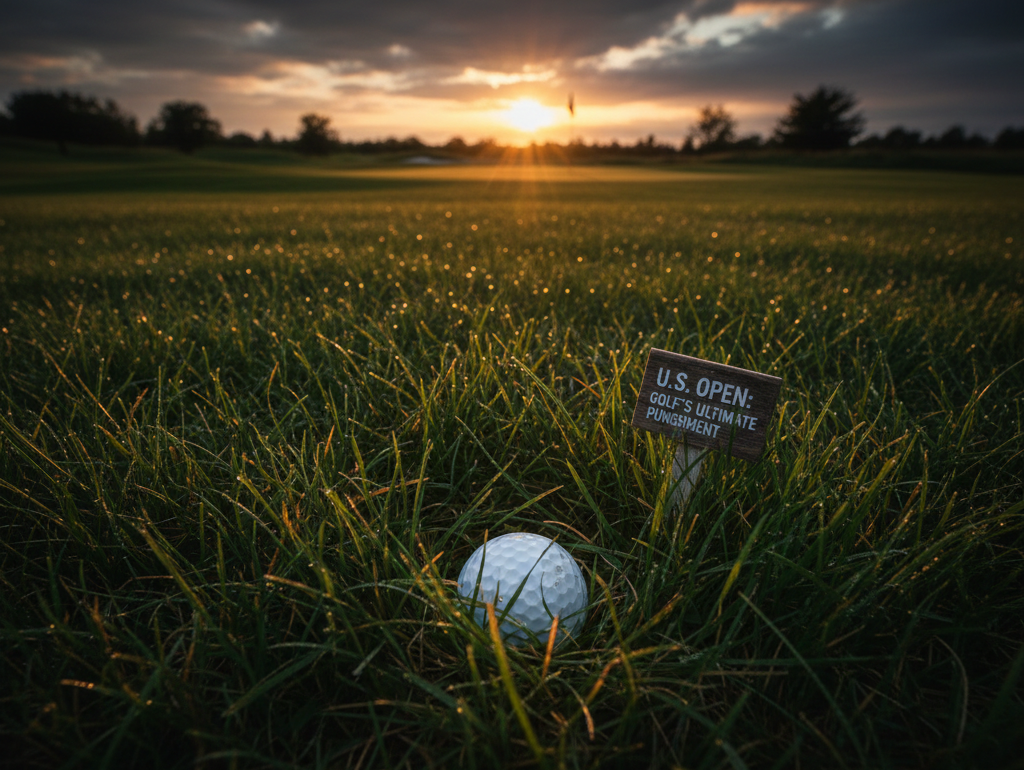
For most of the year, professional golf is a game of spectacular scoring. Fans tune in to see their favorite players shoot 20-under par, making birdies look easy and eagles feel routine. However, for one week every June, that narrative completely flips.
When the world’s best players gather for the U.S. Open, they aren’t looking to break scoring records; they are looking to survive. Out of the 4 majors in golf, the U.S. Open is the only one that intentionally turns the golf course into the “villain.” It is a tournament that values grit over glamour and par over birdies.
The Toughest Test in the Sport
The primary reason the U.S. Open is so difficult comes down to the philosophy of its organizer, the USGA. While other tournaments want to showcase how good the players are, the USGA wants to see how the players handle adversity. They often describe the event as “the ultimate test,” designed to examine every facet of a golfer’s game—from their physical stamina to their mental discipline.
The Philosophy of “Protecting Par”
In a standard PGA Tour event, a winning score of -15 is considered average. At the U.S. Open, the goal is often to have the winning score as close to “even par” as possible. If the weather is clear and the wind is calm, the USGA will simply make the grass longer and the greens faster to ensure the players still struggle.
If you look at the golfers with most major championship wins, you will notice a common theme: they were the masters of “boring” golf. Players like Jack Nicklaus and Tiger Woods didn’t win U.S. Opens by taking wild risks; they won by hitting the middle of the green, taking their pars, and waiting for everyone else to make mistakes. In this tournament, the person who makes the fewest “big numbers” (double bogeys or worse) is usually the one who lifts the trophy.
Why the Best Players Struggle
It is a strange sight to see the #1 player in the world standing in the middle of a fairway, looking confused. But at the U.S. Open, this happens every year. The difficulty is so extreme that it can make even the most confident pros second-guess their talent.
The Mental Fatigue
Most golf tournaments are physically tiring, but the U.S. Open is mentally exhausting. On a normal course, a player can lose focus for one shot and still recover. At a U.S. Open venue like Oakmont or Shinnecock Hills, one “lazy” swing can lead to a triple-bogey that ends your chances of winning. Players have to stay 100% focused for five hours a day, four days in a row. By Sunday afternoon, many players are simply “spent” from the stress of trying to keep their score from blowing up.
The Pressure of the National Championship
There is also the added weight of history. The U.S. Open is the national championship of the United States. For American players, it is the one they want the most. For international players, it is the ultimate proof that they can win on the hardest stage in the world. This emotional pressure makes the fairways feel narrower and the putts feel twice as long as they actually are.
The Most Exhausting Way to Finish
The brutality of the U.S. Open doesn’t just apply to the first 72 holes. If the tournament ends in a tie, the way the winner is decided is designed to be a final test of endurance.
A History of Marathons
For decades, the U.S. Open was the only major that forced players to come back on Monday to play a full 18-hole round to break a tie. It was an exhausting “fifth day” of golf. While that was eventually changed to be more fan-friendly, the current U.S. Open playoff format still emphasizes a “fair test” over a “quick finish.”
The Two-Hole Aggregate System
Currently, if there is a tie, the players enter a two-hole aggregate playoff. This means they play two specific holes (usually the 17th and 18th), and their combined score determines the winner.
This is a significant contrast to Masters playoff format. The Masters uses “sudden death,” where the first person to win a hole wins the Green Jacket. Sudden death is exciting, but it can be decided by one lucky bounce. The U.S. Open’s two-hole system ensures that the champion has to be the better player over a sustained period, even when the pressure is at its absolute peak.
The Ultimate Barrier to Greatness
In the history of golf, only five men have ever won all four modern majors. To achieve a grand slam in golf, a player must prove they can win at the Masters, the PGA Championship, The Open, and the U.S. Open.
For many legendary players, the U.S. Open is the missing piece that keeps them out of this exclusive club. For example, Phil Mickelson has won five majors and finished in second place at the U.S. Open a record six times. He has conquered every other challenge in golf, but the “punishing” nature of the U.S. Open has always stood in his way.
This major acts as a gatekeeper. It doesn’t care how many other trophies you have or how famous you are. If you cannot master the specific “grind” required to survive a U.S. Open course, you will never complete a grand slam in golf.
What Makes the Course So Mean?
If you walked onto a U.S. Open course on the Monday before the tournament, you would see a perfectly normal golf course. By Thursday morning, the USGA has transformed it into a “monster.” They use several specific “tricks” to make the course as punishing as possible.
1. The “Graduated” Rough
In a normal game, if you miss the fairway, the grass is maybe two inches long. At the U.S. Open, they use “graduated rough.” The first few feet off the fairway might be manageable, but if you miss by 10 yards, you are in grass that is 5 or 6 inches deep. This grass is so thick that players often have to use all their strength just to pop the ball 50 yards forward. It eliminates the “hero shot” and forces players to take their medicine.
2. “Glass” Greens
The greens are the most controversial part of the U.S. Open. They are rolled and mown until they are incredibly firm and fast. In 2026 at Shinnecock Hills, the greens will be so fast that a ball might not stop moving until it rolls off the putting surface entirely. This requires a “touch” that most players simply aren’t used to, making every 3-foot putt a terrifying experience.
3. Extremely Narrow Fairways
The USGA often “pinches” the fairways, making them half the width of a normal PGA Tour fairway. On some holes, the landing area might only be 20 yards wide. This puts a massive premium on driving accuracy. If a player isn’t hitting their driver straight, they have zero chance of winning the tournament.
U.S. Open vs. The Other Three Majors
To truly appreciate why the U.S. Open is the hardest, you have to look at how it differs from the other “Big Four” events:
-
The Masters: While Augusta National is difficult, it is a “second shot” golf course. It rewards creativity and allows players to make “charges” on the back nine. You can shoot a 64 at the Masters; you almost never see a 64 at a U.S. Open.
-
The Open Championship: The Open is played on links courses where the main difficulty is the weather. If the wind doesn’t blow, the players can go very low. At the U.S. Open, the difficulty is built into the ground itself—even on a calm day, the course is a nightmare.
-
PGA Championship: The PGA is often set up to be a “fair but tough” test. It feels like a standard tour event on a world-class course. It doesn’t usually try to “embarrass” the players the way the U.S. Open sometimes does.
Conclusion: A Win Like No Other
The U.S. Open is not meant to be “fun” to play. It is a four-day ordeal designed to find the player with the most heart and the most patience. It is the one week where the game of golf is stripped down to its most basic, difficult elements.
By the time the sun sets on Sunday and the trophy is handed out, the winner hasn’t just beaten the rest of the field—they have beaten the course. Whether you are a fan of the “birdie fests” or a student of the game who loves to see the pros struggle, there is no denying that the U.S. Open is the ultimate benchmark of greatness. In the end, only the toughest win, and that is why the U.S. Open remains the most respected championship in the world.