In computer vision workflows, bounding boxes are among the most fundamental annotation techniques used to train detection models. Whether it’s identifying products in e-commerce images, tracking vehicles in autonomous driving datasets, or detecting anomalies in surveillance footage, 2D Bounding Boxes play a pivotal role in structuring visual data for machine learning.
At Annotera, a leading data annotation company, we specialize in delivering high-quality annotation pipelines tailored to diverse industry needs. One of the most common decisions teams face is choosing between axis-aligned bounding boxes and rotated bounding boxes. While both serve the same core purpose—object localization—their applications, precision levels, and computational implications differ significantly.
This article breaks down both types, their differences, use cases, and how to determine the right approach for your project.
Understanding 2D Bounding Boxes
Before diving into the types, it’s important to understand what bounding boxes are.
A bounding box is a rectangular frame drawn around an object of interest in an image. It is typically defined by coordinates that represent its position and size. In most annotation formats, this includes:
-
Top-left corner (x, y)
-
Width and height
Bounding boxes simplify object detection tasks by converting complex visual elements into structured data that machine learning models can process.
Axis-Aligned Bounding Boxes (AABB)
What Are Axis-Aligned Bounding Boxes?
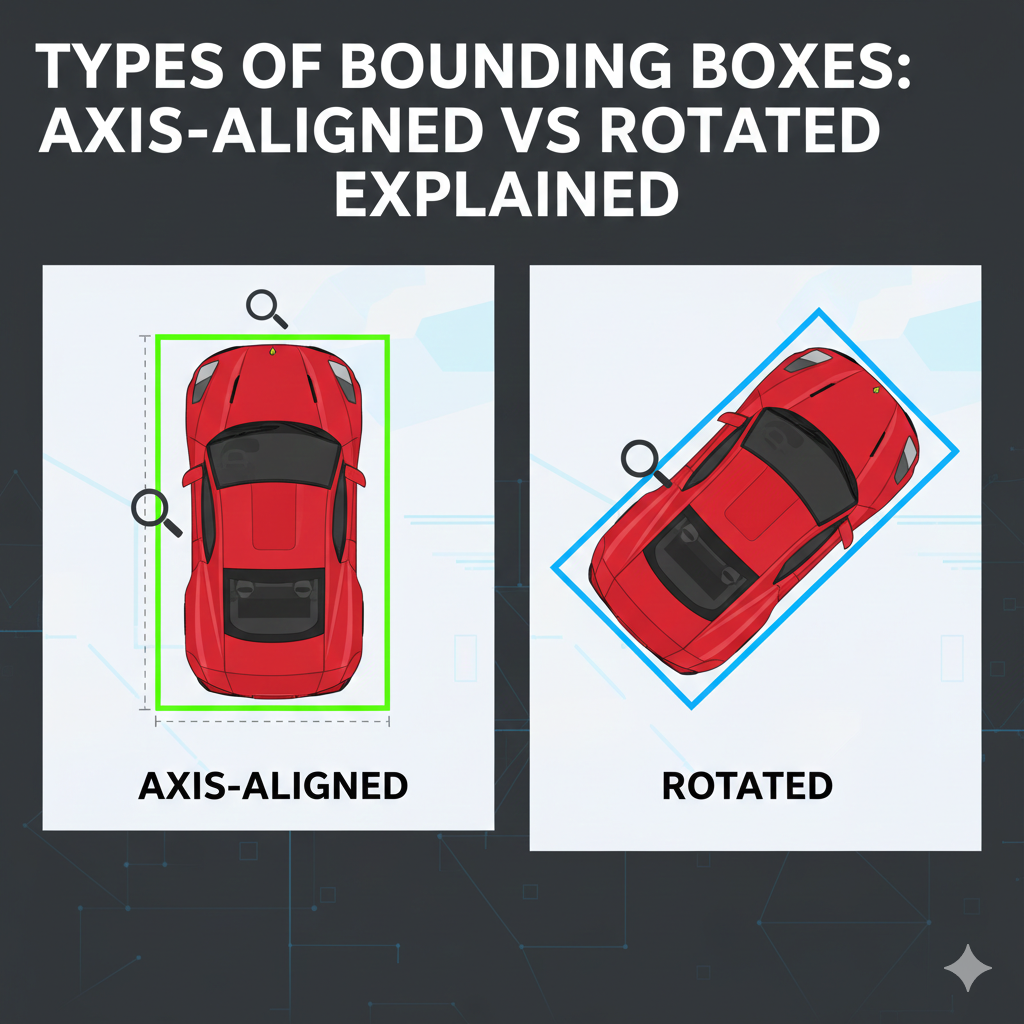
Axis-aligned bounding boxes are rectangles whose edges are parallel to the image axes (horizontal and vertical). This is the most commonly used bounding box type in computer vision.
Key Characteristics
-
Edges are aligned with the X and Y axes
-
Defined using (x_min, y_min, x_max, y_max) or (x, y, width, height)
-
Simple to annotate and compute
-
Widely supported across frameworks and tools
Advantages
1. Simplicity and Speed
Axis-aligned boxes are easy to draw and require minimal annotation effort. This makes them ideal for large-scale data annotation outsourcing projects where speed and scalability are critical.
2. Computational Efficiency
Because they align with image axes, calculations like intersection-over-union (IoU) are faster and less complex, improving training and inference efficiency.
3. Standardization
Most object detection models such as YOLO, Faster R-CNN, and SSD are designed to work with axis-aligned boxes.
Limitations
1. Reduced Precision for Rotated Objects
When objects are tilted or rotated, axis-aligned boxes often include unnecessary background, reducing annotation accuracy.
2. Overlapping Noise
In dense scenes, large rectangular boxes can overlap significantly, making it harder for models to distinguish objects.
Common Use Cases
-
Retail product detection
-
Face detection
-
Traffic monitoring with upright objects
-
General-purpose object detection
Rotated Bounding Boxes (Oriented Bounding Boxes)
What Are Rotated Bounding Boxes?
Rotated bounding boxes extend traditional boxes by allowing rotation. Instead of being constrained to the axes, they can align with the orientation of the object.
They are typically defined by:
-
Center point (x, y)
-
Width and height
-
Rotation angle (θ)
Key Characteristics
-
Can rotate to match object orientation
-
Provide tighter and more accurate object coverage
-
More complex to annotate and process
Advantages
1. Higher Precision
Rotated boxes closely fit objects regardless of orientation, reducing background noise and improving model accuracy.
2. Better for Dense or Overlapping Objects
They minimize overlap in crowded scenes, which is critical for applications like aerial imagery or document analysis.
3. Enhanced Feature Learning
Models trained on rotated boxes can better understand object orientation, which is valuable in tasks requiring spatial awareness.
Limitations
1. Annotation Complexity
Drawing rotated boxes requires more skill and time, increasing annotation costs—especially without a specialized image annotation company.
2. Computational Overhead
Operations like IoU calculation become more complex, potentially slowing down training pipelines.
3. Limited Model Support
Not all detection models natively support rotated bounding boxes, requiring custom implementations.
Common Use Cases
-
Aerial and satellite imagery (e.g., ships, buildings)
-
Scene text detection (tilted text)
-
Autonomous driving (angled vehicles)
-
Industrial inspection
Axis-Aligned vs Rotated Bounding Boxes: Key Differences
| Feature | Axis-Aligned Bounding Boxes | Rotated Bounding Boxes |
|---|---|---|
| Orientation | Fixed (horizontal/vertical) | Flexible (any angle) |
| Annotation Complexity | Low | High |
| Precision | Moderate | High |
| Computational Cost | Low | Higher |
| Model Compatibility | Widely supported | Limited support |
| Best for | Standard detection tasks | Complex orientations |
Choosing the Right Bounding Box Type
Selecting between axis-aligned and rotated bounding boxes depends on several factors:
1. Nature of the Data
If your dataset contains mostly upright objects, axis-aligned boxes are sufficient. However, for rotated or irregularly oriented objects, rotated boxes provide better accuracy.
2. Accuracy Requirements
For applications where precision is critical—such as medical imaging or aerial analysis—rotated bounding boxes are often worth the extra effort.
3. Budget and Timeline
Axis-aligned boxes are faster and more cost-effective, making them ideal for large-scale data annotation outsourcing projects with tight deadlines.
4. Model Compatibility
Ensure your machine learning models can handle rotated bounding boxes before adopting them.
5. Annotation Expertise
Working with a professional data annotation company like Annotera ensures that even complex annotation types are handled with precision and consistency.
Hybrid Approaches: Best of Both Worlds?
In some cases, organizations adopt hybrid strategies:
-
Start with axis-aligned boxes for initial training
-
Transition to rotated boxes for fine-tuning
-
Use rotated boxes only for specific classes
This approach balances cost, speed, and accuracy while optimizing model performance.
Why High-Quality Annotation Matters
Regardless of the bounding box type, annotation quality directly impacts model performance. Poorly drawn boxes—whether axis-aligned or rotated—can lead to:
-
Misclassification
-
Lower detection accuracy
-
Increased false positives/negatives
At Annotera, we implement rigorous quality control workflows, including:
-
Multi-level validation
-
Consensus-based annotation
-
Domain-specific training for annotators
As a trusted image annotation company, our focus is on delivering precise, scalable, and model-ready datasets.
Annotera’s Expertise in Bounding Box Annotation
As a specialized data annotation company, Annotera offers:
-
Scalable 2D Bounding Boxes annotation services
-
Support for both axis-aligned and rotated bounding boxes
-
Custom workflows tailored to your AI pipeline
-
High-quality data annotation outsourcing solutions
Our team leverages advanced tooling and experienced annotators to ensure your datasets meet the highest standards of accuracy and consistency.
Conclusion
Axis-aligned and rotated bounding boxes each have their place in computer vision. Axis-aligned boxes offer simplicity, speed, and broad compatibility, making them ideal for standard use cases. Rotated bounding boxes, on the other hand, provide superior precision for complex and orientation-sensitive tasks.
The right choice depends on your dataset, application requirements, and resource constraints. By partnering with an experienced image annotation company like Annotera, you can ensure that your annotation strategy aligns with your model goals—delivering both efficiency and accuracy.
If you’re looking to scale your AI initiatives with reliable data annotation outsourcing, Annotera is equipped to support your journey with high-quality, production-ready annotation services.