The ACT Just Changed — And Most Singapore Students Don’t Know It Yet
If you’ve been using old ACT prep books or following advice from students who took the test two or three years ago, stop.
The ACT examination has undergone significant changes — and preparing with outdated material is one of the fastest ways to hurt your score.
ACT, Inc. has been rolling out format updates that affect how the test is structured, how long it is, and what skills are being tested. Some of these changes are already in effect. Others are being phased in over the next testing cycle.
This guide breaks down exactly what has changed, what it means for Singapore students specifically, and how to adjust your preparation strategy right now.
For a full overview of the current ACT examination structure and what sections look like today, review that first before diving into the changes below.
Quick Overview: Key ACT Changes at a Glance
- ACT introduced a shorter, adaptive online version for US domestic students
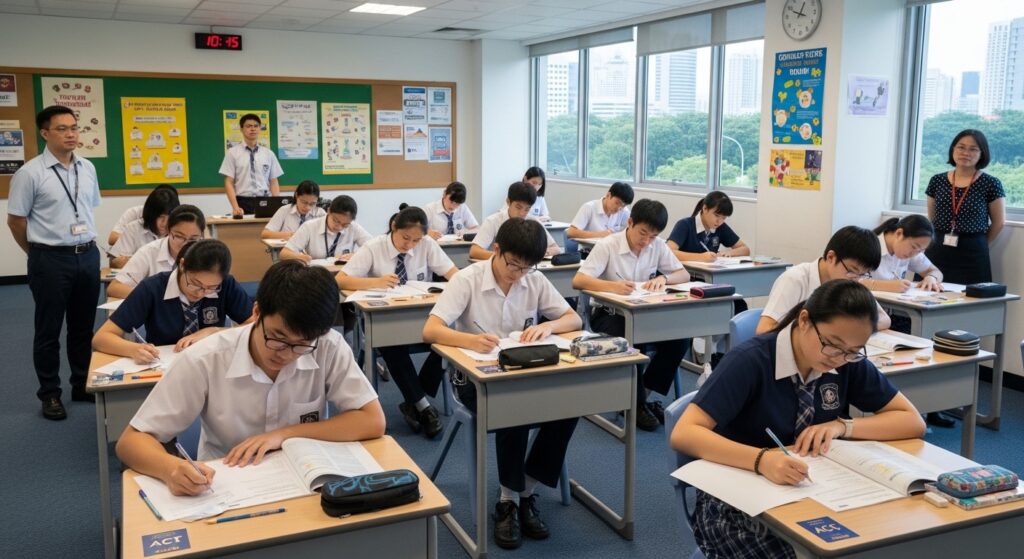
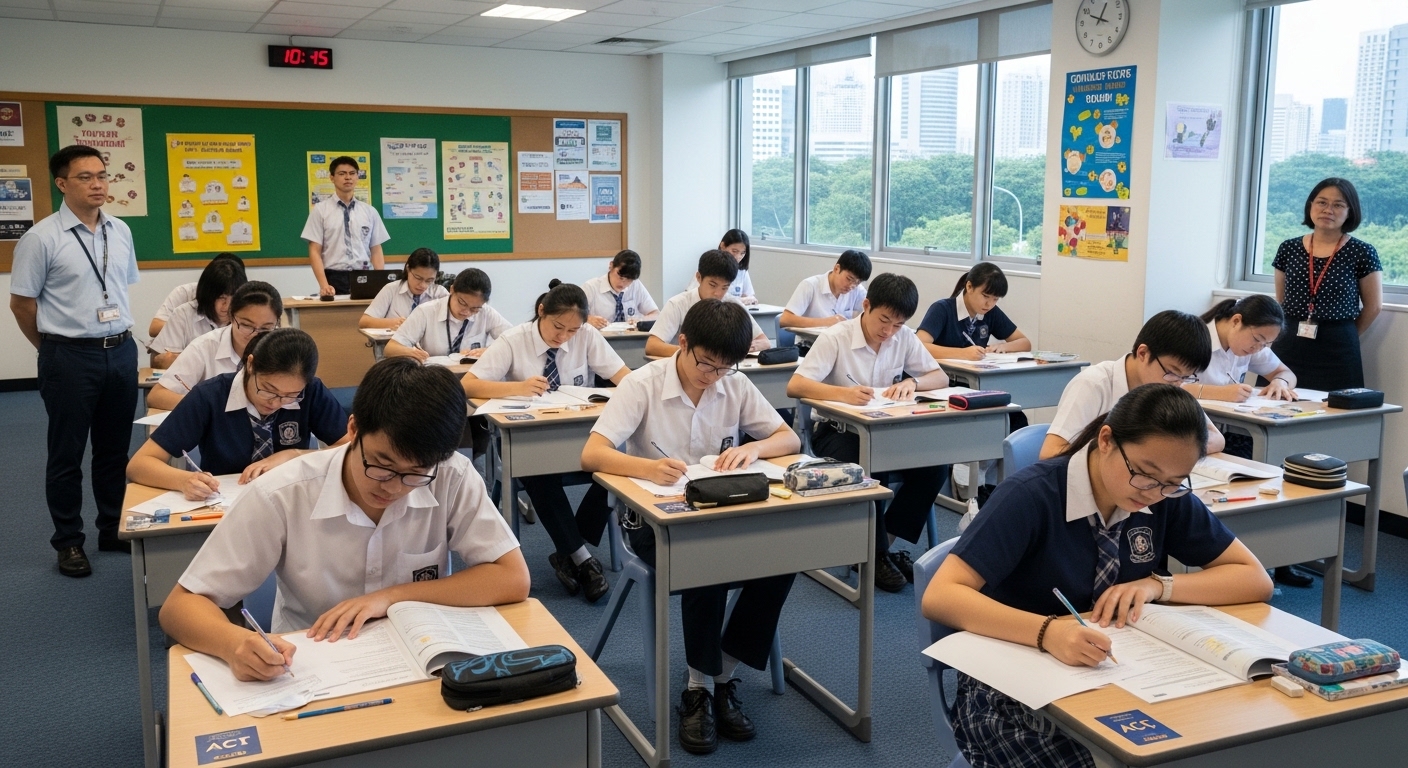
- The paper-based test format remains available for international students (including Singapore)
- The Science section has seen changes in passage and question distribution
- The Writing section remains optional but is no longer offered on all test dates
- Score reporting timelines have been updated
- Some question types within sections have been reweighted
- ACT superscoring policies have become more widely accepted by universities
Section 1: The Biggest Change — Online Adaptive Testing
In 2023–2024, ACT, Inc. announced and began rolling out an online, shorter, adaptive version of the ACT for US-based students.
What “adaptive” means:
- The test adjusts question difficulty based on your performance as you go
- It is shorter than the traditional ACT format
- It is currently available only at select US domestic test centers
What this means for Singapore students:
| Testing Format | Available in Singapore? |
| Online Adaptive ACT | Not currently available |
| Paper-Based ACT (traditional) | Yes — available at Singapore test centers |
Bottom line: Singapore students still take the traditional paper-based ACT with the full-length format. But this is worth monitoring — ACT has indicated plans to expand the online format internationally over time.
Action Step: Always confirm your test format when registering at act.org. Do not assume the format based on what you’ve read on social media or from friends who tested in the US.
Section 2: Changes to the ACT Science Section
The Science section has seen some of the most notable shifts in recent years.
What changed:
- The number of passage sets has been slightly restructured
- There is now more emphasis on data representation passages (graphs, tables, charts)
- Research summary passages have become more complex in their experimental design
- The conflicting viewpoints passage type remains — but appears less frequently on some test forms
What this means practically:
Previously, students could rely on roughly equal distribution across three passage types. Now, data-heavy passages dominate. This rewards students who can read graphs and tables quickly over students who rely on science content knowledge.
Old approach (outdated): Study biology, chemistry, and physics concepts to prepare for Science.
New approach (correct): Practice interpreting data from unfamiliar graphs and experiments quickly and accurately.
Singapore Student Advantage: Students from Singapore’s science-heavy secondary curriculum (especially those with Additional Sciences) already have strong data literacy. The key is learning to apply it at ACT speed — not depth.
Section 3: Changes to the ACT English Section
The English section has seen subtle but important shifts in question emphasis.
What’s changed:
- Rhetorical skills questions (organization, style, tone) now make up a larger proportion of the section
- Pure grammar and mechanics questions (punctuation, sentence structure) are still present but slightly reduced
- Questions increasingly ask students to evaluate whether a sentence or paragraph achieves a specific purpose
Old focus: Know your grammar rules cold.
New focus: Know your grammar rules AND understand why a writer would make specific stylistic choices.
Example of a newer-style question:
“The writer is considering adding the following sentence. Should the writer make this addition?”
These questions require you to think about the purpose of a passage — not just its grammatical correctness.
What Singapore students need to adjust:
- Don’t just memorize grammar rules
- Practice reading passages as a whole — think about tone, purpose, and audience
- Work on eliminating answer choices based on relevance, not just correctness
Section 4: Changes to the ACT Mathematics Section
The Math section has seen topic reweighting — some areas now carry more marks than before.
What’s been reweighted:
| Math Topic | Previous Emphasis | Current Emphasis |
| Integrating Essential Skills | Moderate | Higher |
| Number and Quantity | Moderate | Slightly reduced |
| Algebra | High | High (unchanged) |
| Functions | Moderate | Higher |
| Geometry | High | Moderate |
| Statistics and Probability | Low | Higher |
| Trigonometry | Low-Moderate | Moderate |
Key takeaway: Functions, Statistics, and Probability have become more prominent. Pure geometry — which many Singapore students are strong in — carries slightly less weight than before.
What Singapore students should focus on:
- Practice function notation and function transformations
- Study basic statistics: mean, median, standard deviation, probability
- Don’t neglect trigonometry — it still appears regularly
Section 5: Changes to the ACT Reading Section
The Reading section structure has remained largely intact — but question types have evolved.
What’s changed:
- More questions now test inference and implication rather than direct recall
- Paired passage sets (two related passages) appear consistently on every test
- Questions increasingly ask students to compare perspectives across paired passages
- Vocabulary-in-context questions have increased slightly
Old Reading strategy: Find the answer in the passage and match it to a choice.
New Reading strategy: Understand what the author implies, assumes, or suggests — even when it’s not directly stated.
Paired passage tip for Singapore students:
When you encounter paired passages, read both before answering the comparison questions. Many students read one and start answering — then waste time going back to the second passage.
Section 6: The Writing Section — What’s Changed
The optional Writing section has seen changes in availability and scoring.
What’s changed:
- Writing is no longer offered on every ACT test date — even in the US
- Some international test dates do not include the Writing option
- The scoring rubric has been clarified — with more explicit emphasis on complexity of ideas and development of argument
Should Singapore students take the Writing section?
| Situation | Recommendation |
| Applying to highly selective universities (e.g., top 20 US schools) | Check each school’s policy — some still prefer it |
| Applying to mid-range US universities | Usually not required — skip it |
| Unsure of your university list | Register with Writing to keep options open |
Action Step: Before registering, check the admissions requirements for every university on your list. If none require Writing, you can save time and energy by skipping it.
Section 7: Score Reporting Changes
ACT has updated several aspects of its score reporting system in recent years.
What’s changed:
- Superscoring is now more widely accepted — ACT officially reports a superscore (highest section scores across multiple test dates combined)
- More universities have adopted superscore policies — making multiple test attempts more strategic
- Score report turnaround times have been adjusted — some scores now arrive faster than before
- The National Ranks section of score reports has been updated to reflect more recent norming data
What superscoring means for Singapore students:
If you scored:
- Test 1: English 32, Math 28, Reading 30, Science 29 → Composite: 30
- Test 2: English 30, Math 33, Reading 31, Science 30 → Composite: 31
Your superscore would be: English 32, Math 33, Reading 31, Science 30 → Superscore Composite: 31.5 → 32
This makes strategic retaking much more valuable. Focus your second attempt on your weakest section rather than trying to improve everything equally.
Section 8: What Has NOT Changed
Amid all the updates, several core elements remain the same — and Singapore students should not get distracted by rumors online.
What remains unchanged:
✅ The 1–36 composite scoring scale
✅ No penalty for wrong answers (guessing is always worth attempting)
✅ Four main sections: English, Math, Reading, Science
✅ Calculator allowed for the entire Math section
✅ No. 2 pencils required for the paper-based test
✅ International students still take the paper-based format in Singapore
✅ Score Choice policy — you choose which scores to send
Student Scenario: How Marcus Adjusted and Improved His Score
Marcus was a Year 12 student preparing for his second ACT attempt. His first score was a 28 — with Science being his weakest section at 25.
His original prep strategy focused heavily on reviewing biology and chemistry content, because that’s what older guides recommended for ACT Science.
After learning about the current ACT examination format — specifically that Science is primarily a data interpretation test — he completely changed his approach.
What he did differently:
- Practiced 40 Science questions daily using only data from graphs and tables — ignoring subject knowledge
- Focused on identifying trends in data rather than recalling facts
- Timed himself strictly at 35 minutes per section
Second attempt result: Science score jumped from 25 to 31. Composite moved from 28 to 32.
The content hadn’t changed. His understanding of what was actually being tested had.
Common Mistakes Singapore Students Make About ACT Changes
- Using prep books older than 2022 — Question types and weighting have shifted
- Assuming the online format applies to them — Singapore students still take paper-based tests
- Ignoring the Writing section availability — Not all test dates offer it internationally
- Not accounting for superscoring — Many students don’t plan their retake strategy around it
- Over-preparing for geometry in Math — Statistics and Functions now carry more weight
- Treating Science like a content test — The shift toward data interpretation is real and significant
Pro Tutor Tips on Adapting to ACT Examination Changes
Tip 1: Always download the most recent official ACT practice tests from act.org. Free official tests reflect current question types — third-party books may lag behind.
Tip 2: When reviewing English practice, categorize every question as either “grammar/mechanics” or “rhetorical skills.” Track your accuracy separately — this shows you exactly where to focus.
Tip 3: For the updated Math section, build a separate study block specifically for Statistics and Probability. This is the area most Singapore students under-prepare for.
Tip 4: Plan your test dates strategically around superscoring. Take your first attempt 4–5 months before your application deadline. Use your score report to identify one or two sections to target for your second attempt.
Tip 5: Stay current on ACT updates. Visit act.org regularly — or work with a coaching team that tracks these changes for you. At test prep with The Princeton Review Singapore, our tutors update their teaching materials every testing cycle to reflect the latest ACT examination format, so students are never preparing for yesterday’s test.
FAQ: ACT Examination Pattern Changes
Q1: Is the new shorter online ACT available in Singapore?
Not currently. Singapore students take the full-length paper-based ACT. ACT, Inc. has indicated plans to expand online testing internationally, but no confirmed timeline has been announced for Singapore.
Q2: Do the ACT changes affect my composite score calculation?
No. The composite score is still calculated as the average of your four main section scores on a 1–36 scale.
Q3: Are older ACT prep books still useful?
Partially. Grammar rules and math concepts remain largely the same. However, question type distribution and section emphasis have shifted — supplement older books with current official ACT practice tests.
Q4: Has the ACT become easier or harder with recent changes?
Neither, exactly. The changes have shifted what skills are tested most heavily — particularly toward data interpretation and rhetorical analysis. Students who adapt their preparation accordingly often find their scores improve.
Q5: Will the Writing section be available at my test date in Singapore?
Not guaranteed. Check the specific test date details on act.org when registering. If Writing is required by your target universities, plan your test date selection accordingly.
Q6: How often does ACT update its format?
ACT, Inc. makes incremental updates regularly, with major structural changes announced in advance. Always check act.org for the most current information before beginning your preparation.
Final Thoughts: Prepare for the ACT That Exists Today
Here’s what separates students who improve dramatically from students who plateau:
The ones who improve are preparing for the current ACT examination — not the version from three years ago.
Format changes matter. Weighting changes matter. Knowing that Science is now even more data-focused, that Math now tests Statistics more heavily, and that English rewards rhetorical thinking — this knowledge changes how you study.
Don’t let outdated information cost you points you’ve already earned through hard work.
Stay current. Prepare smart. And walk into that test center knowing exactly what’s waiting for you.