Introduction
Brief Overview of Why Organizations Are Moving from Legacy Systems to the Cloud
Organizations are increasingly transitioning from legacy systems as rising operational costs, limited scalability, and reduced agility make traditional on-premise infrastructure difficult to sustain. Maintaining legacy environments often requires substantial capital investment in hardware, continuous maintenance, and specialized technical expertise. As hardware prices continue to rise, these systems place growing financial and operational strain on enterprises.
Beyond cost concerns, legacy platforms frequently lack the flexibility required to adapt to changing business needs. Scaling infrastructure typically involves purchasing additional hardware, while upgrades and system changes can be time-consuming, disruptive, and risky.
Cloud platforms provide a more adaptable and efficient alternative. They offer scalable computing resources, on-demand storage, and access to modern technologies without significant upfront expenditure. This enables organizations to deploy faster, improve system reliability, and support innovation while responding more effectively to market demands.
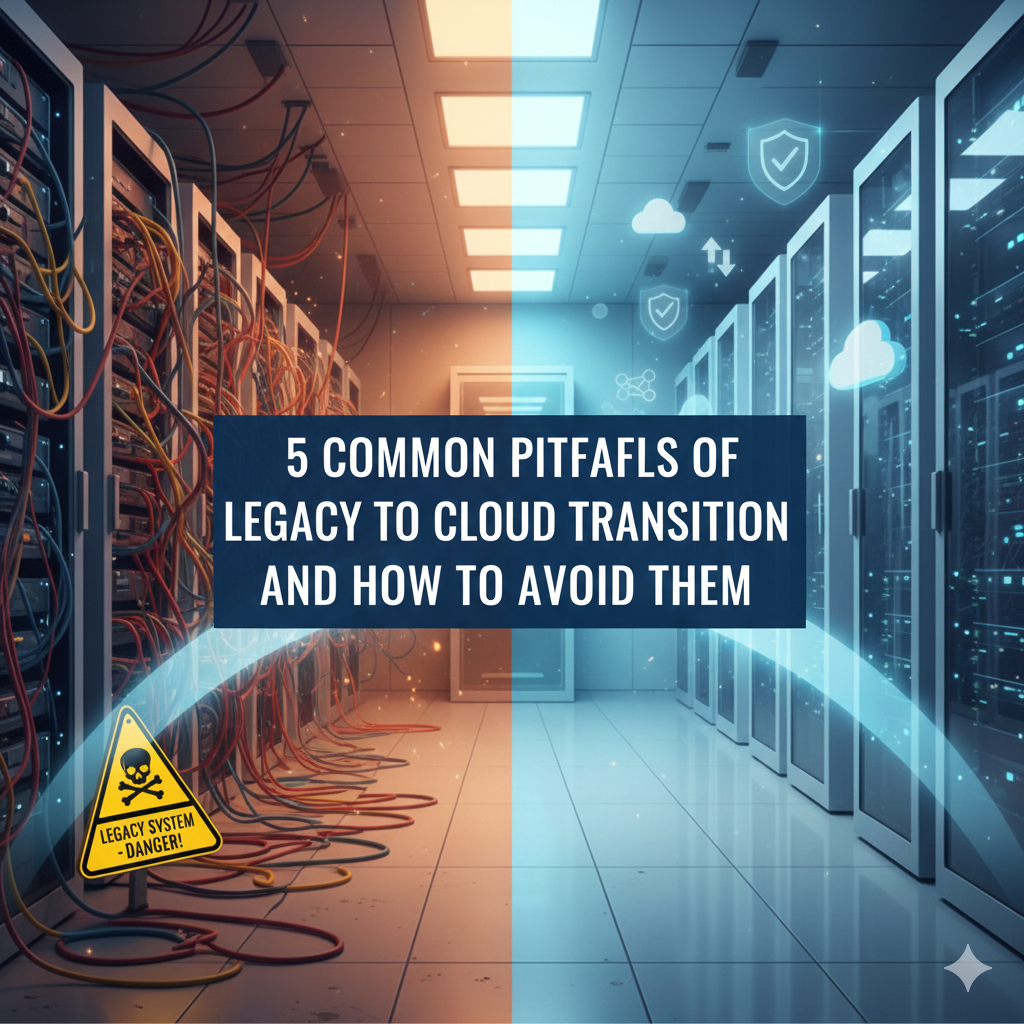
Despite these advantages, many legacy-to-cloud initiatives struggle or stall. Projects may exceed budgets, miss timelines, or fail to deliver measurable business value. In some cases, applications are migrated without optimization, resulting in cloud environments that replicate on-premise inefficiencies. These challenges are rarely caused by the cloud itself. More often, they stem from inadequate planning, architectural misalignment, and overlooked operational risks.
What this article covers and who it is for
This article examines the most common pitfalls organizations face during legacy to cloud transition, starting with strategy, architecture, and security. It is designed for enterprise leaders, IT decision-makers, architects, and transformation teams who want to avoid costly mistakes and approach cloud migration as a structured business transformation rather than a simple infrastructure shift.
Pitfall 1: No Clear Cloud Migration Strategy
What This Pitfall Looks Like
When a clear strategy is absent, cloud migration efforts become reactive rather than deliberate. Teams make ad hoc decisions driven by immediate pressures instead of long-term objectives. Uncertainty around which applications should be migrated first creates confusion and delays. As a result, project timelines slip, budgets expand, and scope changes repeatedly during execution. Although migration may begin, progress often feels fragmented and difficult to control.
Why Organizations Fall Into This Trap
This challenge often stems from limited visibility into the existing application landscape. Many organizations do not maintain a complete inventory of applications, dependencies, and usage patterns. In parallel, business priorities may be unclear or poorly communicated, making it difficult to align technical decisions with strategic outcomes. Migration is frequently treated as a technical task rather than a broader transformation that affects operations, people, and customer experience.
How to Avoid It
A successful cloud migration begins with clearly defined business objectives and measurable success criteria. Organizations should develop a phased, application-centric roadmap that prioritizes workloads based on business value, risk, and complexity. Dependency mapping and risk assessments must be conducted early, before execution begins. Using structured planning and orchestration tools helps coordinate teams, monitor progress, and ensure the migration remains aligned with strategic goals.
Pitfall 2: Compatibility and Architecture Issues
What This Pitfall Looks Like
Following migration, some applications may fail or perform below expectations. Others may technically operate in the cloud but struggle to integrate effectively with cloud-native services. Despite moving to an elastic infrastructure, scalability can remain constrained. These problems often become apparent only after workloads are live, at which point remediation is costly and disruptive.
Why Organizations Fall Into This Trap
Many legacy applications were developed using outdated frameworks and architectural assumptions that do not align with modern cloud environments. Tight coupling between system components limits flexibility, making it difficult to scale or modify individual services independently. An excessive reliance on lift-and-shift strategies often transfers existing inefficiencies to a new platform without resolving fundamental architectural limitations.
How to Avoid It
Organizations should begin with comprehensive technical and architectural assessments to evaluate how each application functions and what adjustments are required for cloud compatibility. Based on these findings, teams can determine whether rehosting, replatforming, or refactoring is the most appropriate migration approach. Where feasible, introducing containers and microservices enhances flexibility and scalability. Proactively addressing technical debt before large-scale migration reduces long-term risk and supports improved performance.
Pitfall 3: Security and Compliance Gaps
What This Pitfall Looks Like
Security weaknesses often surface during or shortly after migration. Data may be exposed while systems are in transit, and identity or access controls can remain inconsistent or poorly enforced. In regulated industries, compliance issues arise when cloud environments fail to meet required standards. These gaps can undermine trust and lead to significant legal, financial, and reputational consequences.
Why Organizations Fall Into This Trap
Legacy systems often lack modern security capabilities, and these deficiencies persist if they are not addressed early in the migration process. Many teams misunderstand the cloud’s shared responsibility model, assuming that providers manage more aspects of security than they actually do. In addition, security planning is frequently deferred until after migration, when remediating vulnerabilities becomes more complex and expensive.
How to Avoid It
Security and compliance should be integrated into migration planning from the outset. Encryption, identity management, and access controls must be implemented early and applied consistently across environments. Using Infrastructure as Code enables teams to define secure baselines and enforce them repeatedly. Continuous compliance monitoring and regular vulnerability assessments help maintain a strong security posture as cloud environments evolve.
Pitfall 4: Unexpected and Uncontrolled Cloud Costs
What This Pitfall Looks Like
One of the earliest warning signs is an increase in cloud spending without a corresponding rise in usage or business activity. Teams often migrate workloads expecting cost savings, only to see monthly cloud bills grow steadily over time.
Another common indicator is the accumulation of idle or overprovisioned resources. Virtual machines sized for peak legacy workloads continue running continuously, storage consumption expands unchecked, and test or development environments consume budget long after they are no longer needed.
Over time, these inefficiencies create a third challenge: difficulty explaining cloud costs to stakeholders. Finance teams struggle to attribute expenses to specific business units or initiatives, while leadership questions why cloud operations appear more expensive than the on-premise infrastructure they were intended to replace.
Why Organizations Fall Into This Trap
The underlying issue often begins during the planning stage with inaccurate cost estimation. Many migration initiatives prioritize technical feasibility while underestimating ongoing operational expenses such as storage growth, data transfer, backups, and managed services.
A further contributor is the use of legacy workloads that are not optimized for cloud pricing models. Applications designed for fixed infrastructure fail to leverage elasticity, auto-scaling, or consumption-based pricing, resulting in persistent resource overuse.
In addition, many organizations lack effective cost visibility and governance. Without standardized tagging, clear ownership models, or cost controls, cloud spending becomes fragmented and difficult to analyze, making optimization reactive rather than strategic.
How to Avoid It
Effective cost management should begin before the first workload is migrated. Organizations should establish budgets, cost allocation tags, and automated alerts early to ensure that every resource can be traced to a specific team, project, or business function.
Once migration is underway, spending should be monitored continuously rather than reviewed only at month-end. Real-time visibility enables teams to identify inefficiencies quickly and take corrective action before costs escalate.
After migration, attention should shift to ongoing optimization. This includes right-sizing compute resources, shutting down unused assets, and committing to reserved capacity where workloads are predictable.
At the organizational level, adopting FinOps practices aligns finance, engineering, and leadership around shared accountability. This ensures that cloud spending is consistently linked to business value rather than growing unchecked.
Pitfall 5: Downtime and Business Disruption Risks
What This Pitfall Looks Like
The most visible failure during cloud migration is unplanned application downtime during cutover. Systems may remain offline longer than expected, disrupting users, customers, and revenue-generating operations. Even major providers are not immune. Amazon Web Services experienced a significant outage in October 2025, and Cloudflare faced a widespread disruption in November 2025, highlighting how failures can cascade across dependent systems.
In other cases, services remain live but encounter data synchronization issues. Inconsistencies between legacy and cloud environments can lead to errors, lost transactions, and inaccurate reporting, particularly during hybrid migration phases.
When disruptions occur, organizations often uncover another gap: ineffective rollback processes. Without a tested path to restore a stable state, downtime can quickly extend from minutes to hours or longer.
Why Organizations Fall Into This Trap
One of the primary causes is insufficient testing. Migration efforts are frequently validated in isolated environments rather than under real-world conditions, such as production traffic, full data volumes, and failure scenarios.
Time pressure further increases risk. Aggressive migration timelines can lead to rushed cutovers, leaving little opportunity for thorough validation, rehearsal, or contingency planning.
Risk is amplified during hybrid migration phases. Applications that continue to depend on on-premise systems, third-party services, or shared databases introduce complex dependencies that often surface only during live migration.
How to Avoid It
Downtime risks can be significantly reduced through phased migration strategies and pilot workloads. Migrating smaller, lower-risk systems first allows teams to validate tools, processes, and assumptions before transitioning critical applications.
For production environments, blue-green or parallel deployment strategies enable new systems to operate alongside existing ones. This approach supports controlled traffic shifts and provides a rapid fallback option if issues arise.
Equally important is thorough testing of rollback and disaster recovery plans. Rollback procedures should be rehearsed regularly, automated where possible, and treated as a core requirement rather than an afterthought.
During the transition period, maintaining hybrid operations may be necessary. Running legacy and cloud environments in parallel helps preserve stability while dependencies are resolved and operational confidence is established.
Cloud Migration Readiness Checklist
Before initiating a legacy-to-cloud transition, enterprises should assess their readiness across several critical dimensions to reduce risk and ensure a controlled migration.
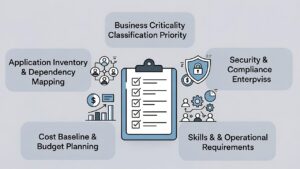
- Application inventory and dependency mapping Create a complete inventory of applications and map dependencies to understand technical complexity and system interrelationships.
- Business criticality classification
Define the importance of each workload to prioritize migration order and manage operational risk effectively. - Security and compliance requirements
Identify regulatory, data protection, and security obligations early to ensure cloud environments meet compliance standards. - Cost baseline and budget planning Establish current cost benchmarks and define budget frameworks to set realistic financial expectations and avoid unexpected overruns.
- Skills and operational readiness
Evaluate internal capabilities, training needs, and operational processes to ensure teams can support and manage cloud environments after migration.
This checklist helps prevent reactive decision-making and creates a strong foundation for a predictable, well-governed migration process.
Choosing the Right Migration Approach
Selecting the appropriate migration strategy is critical to balancing speed, cost, and long-term value. Each approach serves a different purpose depending on application condition and business objectives.
Lift-and-Shift
When it makes sense
Lift-and-shift is suitable when rapid migration is required, applications are stable, and minimal code changes are feasible. It is often used as an initial step to exit data centers quickly or reduce dependency on physical infrastructure.
Key risks and limitations
Without optimization, lift-and-shift can transfer existing inefficiencies to the cloud. This may limit scalability and cost savings while increasing long-term operational expenses.
Replatforming
Ideal use cases
Replatforming is appropriate when applications require moderate adjustments to better align with cloud services but do not need a complete redesign.
Performance and cost benefits
This approach improves efficiency and scalability while keeping migration effort manageable. It often delivers better performance-to-cost outcomes than lift-and-shift.
Refactoring
When modernization is unavoidable
Refactoring becomes necessary when legacy architectures cannot meet cloud requirements for scalability, resilience, or innovation.
Long-term scalability and innovation advantages
Although more complex initially, refactoring enables full use of cloud-native capabilities, supports faster innovation, and delivers the highest long-term business value.
Legacy to Cloud Migration: A Phased Framework
A structured, phased approach helps organizations reduce risk, control costs, and achieve consistent outcomes. Successful enterprises typically progress through the following stages.
Discovery and Assessment Phase
This phase focuses on establishing visibility. Organizations inventory applications, map dependencies, assess technical debt, and identify compliance requirements to determine cloud suitability.
Planning and Prioritization Phase
Insights gathered during discovery are translated into action. Applications are categorized by business criticality, migration complexity, and risk. A phased roadmap is created to align technical priorities with business objectives, budgets, and timelines.
Pilot Migration Phase
Low-risk or non-critical workloads are migrated first. This phase validates tools, processes, security controls, and cost assumptions. Lessons learned here inform standards and best practices for broader migration.
Full-Scale Migration Phase
With validated methods in place, organizations migrate core systems in planned waves. Dependencies are carefully managed, downtime risks are minimized, and governance controls are enforced to maintain stability and predictability.
Optimization and Modernization Phase
Migration does not end at cutover. Workloads are continuously optimized for performance and cost, legacy inefficiencies are removed, and applications are modernized to leverage cloud-native services. This phase delivers sustained, long-term value.
Common Cloud Migration Myths to Avoid
Moving to the cloud automatically reduces costs
While cloud adoption can reduce capital expenditure, operating costs may increase without proper optimization. Meaningful savings come from strong governance, right-sizing resources, and aligning architecture with usage patterns, not from migration alone.
Lift-and-shift is the fastest path to success
Lift-and-shift can deliver speed in the short term, but it often postpones modernization and drives higher long-term costs. Prioritizing speed without strategy frequently results in rework and missed value.
Security is the cloud provider’s responsibility
Cloud providers secure the underlying platform, but customers remain responsible for configuration, access control, and data protection. Misunderstanding this shared responsibility model introduces significant security and compliance risk.
When to Involve a Cloud Migration Partner
Signs Internal Teams Need External Expertise
Organizations may benefit from external support when they face limited experience with large-scale cloud migrations, skills gaps in security, architecture, or cost governance, or when migration timelines begin to slip and risks increase. Partner involvement is also advisable when workloads have a high business impact and allow little to no tolerance for failure.
What to Look for in a Migration Partner
An effective migration partner brings proven methodologies, deep cloud-native expertise, and strong knowledge of security and compliance requirements. Experience across similar enterprise environments, transparent communication, disciplined governance, and a focus on measurable outcomes are critical evaluation criteria.
How Partners Reduce Risk and Accelerate Outcomes
Migration partners apply tested patterns, automate repeatable processes, and identify risks before they materialize. This approach shortens timelines, reduces costly errors, and enables internal teams to focus on strategic priorities rather than reactive problem-solving.
Conclusion:
Legacy-to-cloud initiatives most often fail due to predictable issues, including unclear strategy, architectural misalignment, security gaps, uncontrolled costs, and downtime risks. Each of these challenges can be avoided with disciplined planning and execution.
Successful organizations invest in early assessment, phased implementation, and continuous optimization. They approach cloud migration as a business transformation rather than a simple infrastructure shift.
The core takeaway is clear: cloud migration is a strategic journey, not a one-time event. Enterprises that adopt a long-term perspective, supported by governance and operational rigor, can convert legacy constraints into sustained competitive advantage.