The Backbone of Tactical Security: A Guide for Defense Vehicle Kit Suppliers
In the global defense market, the shift from selling complete vehicles to providing modular Defense Vehicle Kits has changed the industry. Today, governments and security firms often look for “kits” that can be integrated into existing fleets or civilian chassis to provide mission-specific protection.
For a supplier, the challenge isn’t just about providing steel; it’s about providing a ready-to-install ecosystem of parts that guarantee survivability.
What Makes a High-Performance Defense Kit?
A modern defense kit (or armoring kit) is much more than just a set of metal plates. It is a comprehensive package of engineered components designed to work in harmony. At Captain Engineering, we focus on the four pillars of kit manufacturing:
1. Precision-Cut Ballistic Steel Sets
The core of any kit is the protective shell. Using Large-Format Laser Cutting, we produce full-body sets including side panels, roofs, and flooring. By using laser technology, we can cut sheets up to 80mm thick with absolute accuracy. This ensures that when the kit arrives at the assembly point even in a remote location the pieces fit together with zero gaps, maintaining the vehicle’s ballistic rating.
2. Specialized CNC-Bent Armor Capsules
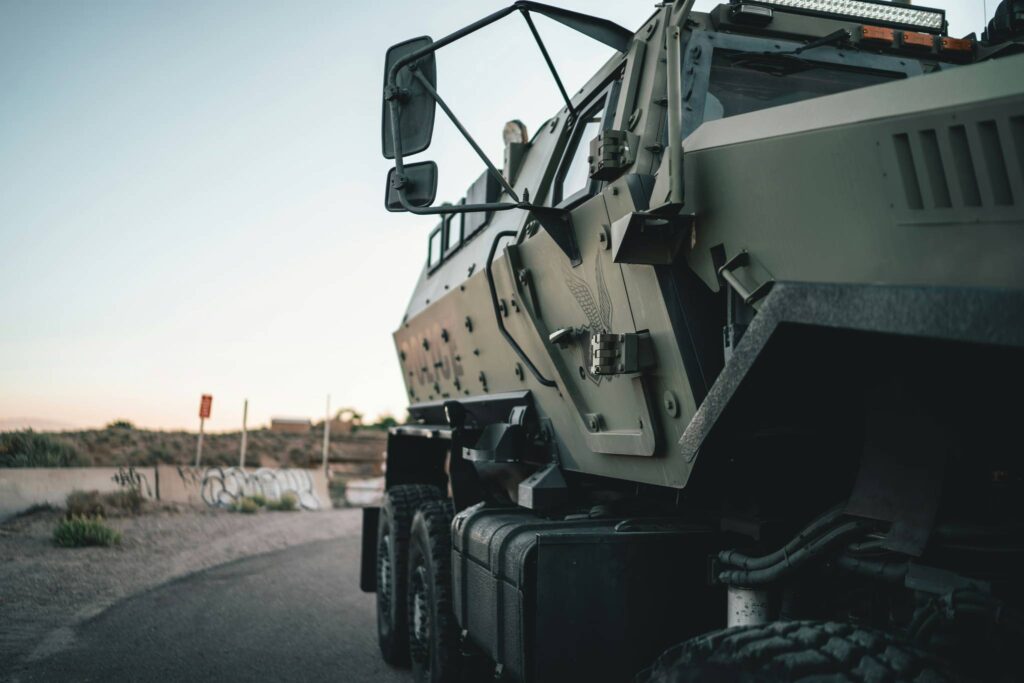
A key trend in 2026 is reducing the “weld count.” Welds are natural weak points. By utilizing Advanced CNC Bending, we create single-piece armored “capsules” or cabins. Bending high-grade armored steel and aluminum requires massive force and precise calculation to ensure the metal doesn’t crack or lose its temper. A kit that features bent panels rather than welded seams is lighter, stronger, and more resistant to IED blasts.
3. Heavy-Duty Machined Components
A defense vehicle is only as good as its moving parts. A standard vehicle hinge cannot support a door that weighs 200kg due to armor. Therefore, a complete kit must include:
-
Heavy-Duty Door Hinges: CNC-machined to handle extreme weight.
-
Gun Mounts & Turret Rings: Precision-milled for smooth operation under fire.
-
Armored Fuel Tank & Battery Protection: Customized brackets and enclosures.
-
Run-flat Systems: Ensuring the vehicle can escape even with destroyed tires.
4. Thermal-Safe Fabrication (Waterjet Cutting)
For kits requiring composite materials or armor that is sensitive to heat, Waterjet Cutting is the standard. This “cold-cutting” process ensures that the ballistic “DNA” of the material is never compromised. It is ideal for cutting thick bullet-resistant glass and multi-layered composite plates that are often included in high-level (B6/B7) security kits.
Why the UAE is the Hub for Kit Suppliers
Location matters. Being based in the UAE, specifically with the capabilities of Captain Engineering, allows suppliers to reach global conflict and security zones quickly. Our “one-stop-shop” model where we cut, bend, and machine every part under one roof eliminates the supply chain delays that often plague defense contracts.
Conclusion: Engineering as a Service
The role of a Defense Vehicle Kit Supplier has evolved. You are no longer just a parts provider; you are a safety partner. By providing kits that are easy to assemble, technically superior, and rigorously tested, you provide more than just armor you provide confidence.