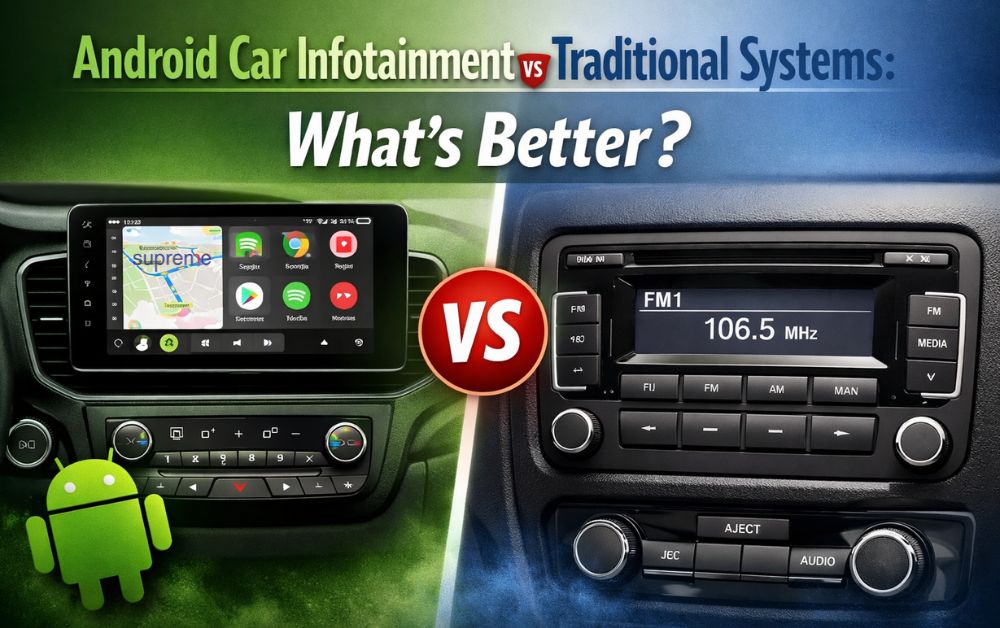
Remember when you first used a basic music player- AM / FM radio, perhaps having a CD slot and a handful of preset buttons, driving a car? It did the job. Jump to the current day, and the dashboard is more of a smartphone center than a stereo panel. The evolution of the car infotainment system has transformed the driving experience, but it also raises an important question: should you stick with a traditional setup or upgrade to Android-based technology?
Let’s break it down.
The Foundation: Traditional Car Infotainment Systems
Traditional systems were made with ease of mind. A standard Bluetooth car stereo allowed hands-free calling and basic audio streaming. Others also had USB provision, equalizers, and physical controls that were convenient to use without a hassle.
This is a simple and efficient system for many drivers. As software complexities reduce, there are fewer updates, and the cost is generally lower. A traditional system also performs its duties well, in case all you want to do is listen to music and make phone calls.
Nonetheless, with the rising vehicle intelligence, the demand increases.
The Rise of Android Car Infotainment
Enter Android car infotainment–a system that brings smartphone-like capabilities directly to your dashboard. These systems are based on the Android operating system through which you can download apps, use Google Maps, music streaming services, and voice assistants.
Unlike traditional setups, Android units often feature a large touchscreen car stereo interface. Navigation is made easier, playlists are less cumbersome to use and real-time traffic notifications help in maximizing your route. Now it is not only about entertainment, but it is also about connection and convenience.
User Experience: Buttons vs Touchscreens
Conventional systems are quite physical, using buttons and small screens. Although the ability to feel controls is comforting, it reduces functionality. In contrast, a touchscreen car stereo offers swipe-based navigation, customizable layouts, and faster access to multiple features.
As an example, an Android unit can be changed between music and navigation effortlessly. In the case of older systems, it may need to switch between menu with little display feedback. That disparity is felt on long drives or in high traffic in the cities.
Connectivity and Smart Integration
Android systems have their strong points in connectivity. A modern car infotainment system powered by Android integrates with smartphones, supports Wi-Fi hotspots, and enables app-based features. When parked, you can reflect the screen of your phone, navigate in the cloud, or stream even videos.
Traditional Bluetooth car stereo setups, while dependable, generally stop at audio streaming and hands-free calls. They do not have app ecosystems and over-the-air updates, and therefore, they are limited in terms of scalability.
Performance and Hardware Considerations
Naturally, not everything is made in Android. The performance will be determined by the speed of the processor, the RAM, and the quality of the screen. An inadequately designed system will slow down, malfunction, or distract the driver. That’s why choosing the best car infotainment system involves evaluating hardware reliability as much as software features.
Honorable brands such as Supreme India are more concerned about the combination of performance and longevity. An Android infotainment unit must have a fast touch response since information processing must be prompt, and no multitasking is to be postponed under any circumstances.
Cost vs Value
The traditional systems tend to be less expensive and less challenging to install. There is little they do not work, and this is older drivers or vehicles, which tend to be minimalistic. Android system in turn is more expensive upfront but have more capabilities.
Price is not the real issue, but value. Android infotainment can bring a quantifiable level of convenience to everyday driving you use it to access navigation applications and streaming audio or video, and to enable smart connectivity.
Safety and Practical Use
Advanced systems can be a concern to some drivers since they are concerned that they will cause more distraction. As a matter of fact, the Android interface, which has a voice control feature, would allow you to drive without necessarily touching your phone. A steering-mounted control, hands-free calling, and voice navigation make driving a safer place in responsible use. The older systems are less complex, but they may need work with the phone to navigate or use complex functions that may disrupt concentration.
So, What’s Better?
Whether it will or not depends on how you drive. If you want basic music and calls, a traditional Bluetooth car stereo remains practical. But if you’re looking for a connected, app-driven experience with smart navigation and customization, Android car infotainment clearly leads the way.
The vehicles are becoming modern, and so are the expectations of the drivers. Investing in the best car infotainment system ensures your dashboard keeps pace with your lifestyle. Trusted providers such as Supreme India can provide you with good solutions, and then it is quite easy to upgrade your driving experience.
As soon as your car gets smarter, all your journeys will be more intuitive. The actual decision is not old or new; it is functional and future-proofed.