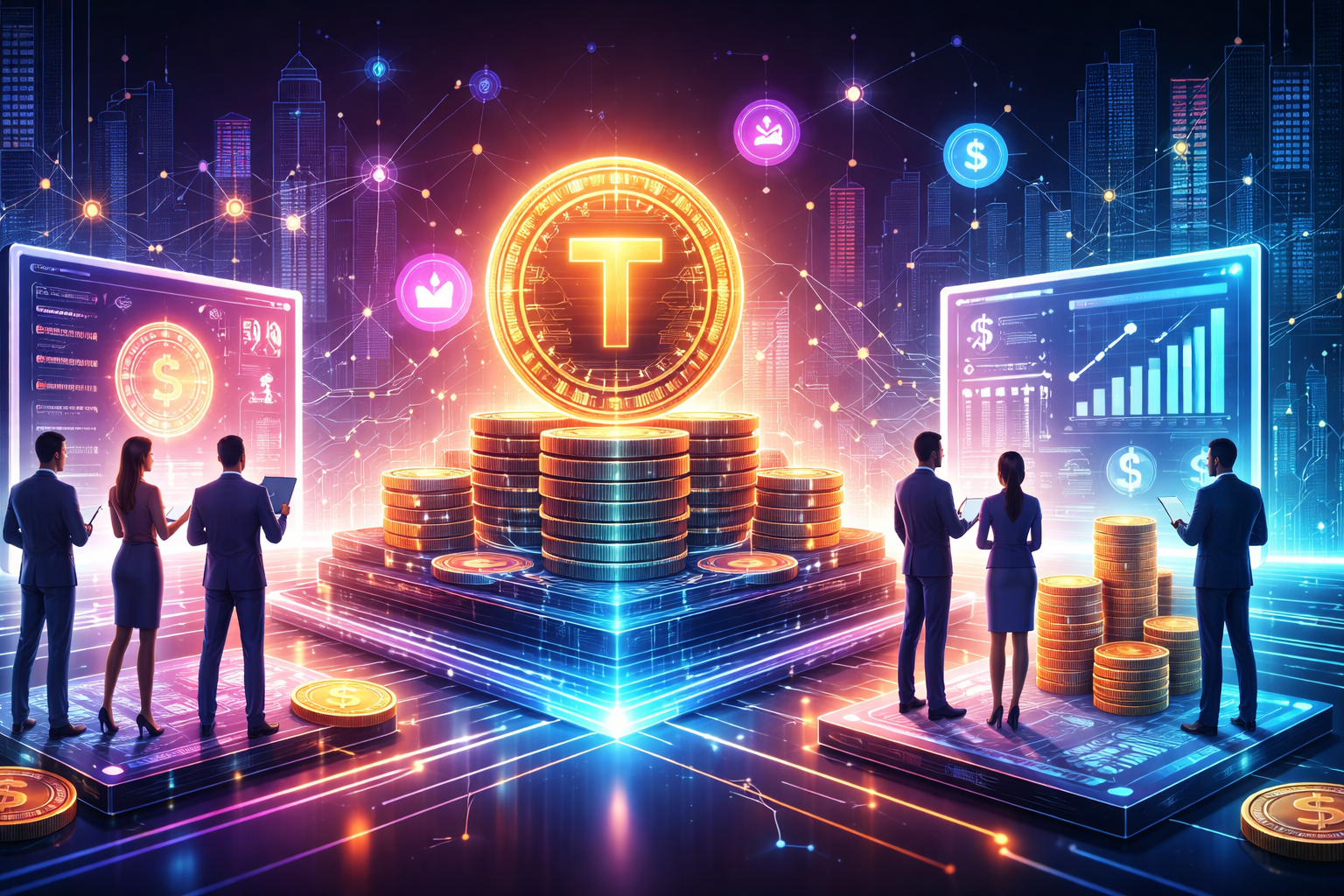
For the past 10 years we’ve seen startups attacking customary business models with cloud native platforms, platform economies and now decentralized token based economies. Initially explored in blockchain native communities, the token model is now a serious calculated consideration for early stage startups across all industries. In token-based ecosystems, founders ask about the unique benefits tokens provide, not whether tokens can be used.
Today, in 2026, blockchain infrastructure has matured to a point, there is a clearer regulatory framework in most of the world’s large markets, and there is a large number of Web3-native users. Early-stage startups commonly choose token-native ecosystems as a powerful business model. In this article we analyze whether startups are choosing tokens over customary business models, the reasons behind that, and what this means for the future of innovation, capital, and user engagement.
Understanding Token-Based Ecosystems vs Traditional Startup Models
Startups customarily depend on centralized ownership and equity incentives, whereby the user pays for a product or service, and investors provide subsequent rounds of capital in exchange for equity in the firm. Value is transferred via the company balance sheet. Growth depends on scale of users, revenue, efficiency, under a centralized governance model.
On the contrary, token-based ecosystems are external to the product. They launch programmable digital tokens which represent utility, access, governance rights or stake in a decentralized or semi-decentralized ecosystem. Value creation and capture is usually decentralized within those ecosystems. Token ecosystems are more than a payment mechanism; they are economic coordination devices that are baked into the product architecture.
This is a key difference. Token-based ecosystems are built around participation, incentive alignment and long-term ecosystem health where customary owner models are designed to concentrate ownership and extract value from ownership.
Why Startups Are Reconsidering Traditional Models
The limitations of customary startup structures have caused founders to seek alternatives.
Second, customer acquisition costs in digital markets are rising: paid advertising, platform fees, and competitive saturation all make it harder for companies to scale in early stages. Token-based ecosystems, on the other hand, enable startups to immediately start rewarding users for their participation, and turn them into stakeholders.
Second, existing equity-based incentives favor mostly founders, early employees, and investors. However, individuals who add indirect value as content creators, governance participants, and beneficiaries of network effects are often left empty-handed. This leads to weak community loyalty and short-term participation.
Third, recursive centralized governance structures inhibit innovation because decision-making is distributed through hierarchy. Token-based governance models are still somewhat centralized and have their drawbacks, but may allow startups to decentralize decision-making and iterate faster through community interactions.
The Rise of Token-Based Ecosystems in Startup Strategy
Token-based ecosystems have expanded beyond just crypto-native companies, to other sectors like gaming and fintech and creator economies, supply chain, and digital identity. This illustrates that people increasingly accept tokens. People can utilize the tokens as building blocks for core infrastructure and systems instead of only investing with the tokens.
In decentralized ecosystems, tokens coordinate behavior at scale, allocate resources, and align interests. Utility tokens are used to access services. Many decentralized platforms use governance tokens to give the community decision-making power, and hybrid models combine utility and governance tokens for sustainability.
This trend is particularly strong among early Web3 companies, where tokens, business model and product-market fit are intentionally joined-up from the outset, with token economics embedded into new products rather than being bolted onto existing products retroactively.
Token Economics as a Competitive Advantage
One of the biggest advantages of the token economy, and the reason many startups are building them, is that tokenomics can provide the right incentives to encourage specific behavior in the network, unlike fixed pricing or subscription services.
Tokens can also be used to reward early adopters and participants, disincentivize negative behavior through slashing or reduced privileges, and create a mutually reinforcing ecosystem in which growth and stability are not at odds.
Token-based funding models are seen as more capital efficient, allowing startups to reduce their reliance on venture capital. Token issuance remains a dominant fundraising method, and is often employed to distribute value across an ecosystem.
Community Ownership and Network Effects
While customary startups lack real user buy-in to build community, token-based ecosystems fundamentally transform the dynamics of how community is built.
In this model, having a stake in the token from a financial perspective renders the user more of a concerned stakeholder in the platform than a typical consumer. Token holders are thus incentivized to promote the platform, provide suggestions and support long term developments as they are part of the ecosystem.
The network effects of this model are larger since the utility of tokens approaches its maximum value as it scales, as opposed to other models that tend to result in increased cost and complexity without proportional engagement from the community.
Governance: Centralized Control vs Decentralized Decision-Making
Governance is one of the most prominent philosophical differences between customary and token-based models.
Customary startups leave decision-making to founders and boards without user input. Although this model is faster and clearer, it reduces community participation and slows innovation on larger scales.
Token governance lets token holders decide because they sometimes vote in proposal structures on-chain. Some governance decisions are not decentralized a startup might allow holders to vote on protocol upgrades features or treasury.
This creates transparency and accountability, but it also can cause voter apathy, governance capture, and complicated decision-making. Smart startups know that decentralized governance does not eliminate leaders, but distributes leaders among others.
Real-World Examples of Token-Based Startup Models
Several large startups show that ecosystems designed around tokens can outperform more customary models.
In DeFi, the token replaces centralized intermediaries, and aligns user incentives, liquidity provider incentives and developer incentives. In blockchain games, when players earn and own assets, they could better align the incentives of game producers and players than when they purchase in-app or view ads.
Outside fully decentralized solutions, some hybrid startups are also utilizing tokenized loyalty programs, gated access rights, and governance features to enable user retention and monetization.
These examples suggest that tokens do not tend to succeed because of novelty; they also tend to succeed by helping resolve real coordination and incentive problems.
Challenges and Risks of Token-Based Ecosystems
Token-based ecosystems still have risks, and startups must learn to navigate these risks.
Another concern exists with regulatory uncertainty yet legal frameworks begin to appear now for regulatory-compliant tokens. Tokens need to be designed around regulatory concerns in mind, especially around securities classification and consumer protection.
Economic design failures manifest as tokenomics where the inflation rate, a speculative bubble, or ecosystem collapse make the network unsustainable. In contrast with many pricing errors, there is no way to reverse these changes when a token has been created and is actively being used.
Additionally, technical aspects become complex, security becomes risky, and those items require specialized knowledge, and smart contracts become vulnerable, governance gets exploited, economic forces attack, and those actions can cause a rapid loss of value.
Cost Considerations: Are Tokens Still a Barrier for Startups?
Viewed initially as too costly and difficult for creation and deployment, infrastructure improvements, modular support and standardized tooling have reduced the barriers to launching new tokens by 2026.
Token creation costs vary based on complexity, compliance, and ecosystem design. Token-based ecosystems are more complex and require deeper expertise than customary payment solutions, but the gap is narrowing.
For most early-stage startups today, the question is no longer whether tokens are affordable, but whether the startup is missing out without tokens.
Traditional Models Still Matter, But They’re Evolving
While it is incorrect to say that the token-based ecosystem is fully replacing everything that a customary startup is, many have adopted hybrid structures with equity and a token.
Even customary, centralized businesses with few network effects are utilizing tokenized features for loyalty, access, and retention.
This evolution illustrates that tokenized ecosystems are not a rejection of these business models, but a reimagining of how value is generated and allocated.
The Strategic Outlook for Startups in 2026 and Beyond
With improvements in blockchain building blocks and the expansion of Web3 adoption, building token-based economies has become the default approach for startups in digital-native markets.
Founders also increasingly view tokens as an economic architecture that enables long-term growth, rather than a tool simply for fundraising, and allows for the design of incentives, governance, and ecosystem participation.
In other words, the most successful startups will not be the ones that follow the token, but those that ask themselves if tokenization is right for their product, their users, and their regulators.
Conclusion
So, are the startups, to some extent and in some cases, being truthful in saying that they are building token-based ecosystems? Startups are coming to realize with the maturation of token development that crypto tokens are not just speculative products, but a business approach that can change value creation as we know it.
Token-based ecosystems are an improvement in alignment of incentives, community ownership and governance at scale. If developers practice token development paired with regulatory compliance and develop utility tokens systematically, they have potential for overcoming the historical drawbacks of token-based growth. While existing models are still valuable inside centralized or regulated contexts particularly, the number of founders building their own tokens to create more participatory and resilient platforms is growing.
In 2026 and beyond, startups that work alongside experts to develop tokens and provide structured token development services will likely thrive as they develop sustainable economic models that benefit users, contributors, and stakeholders at scale. Be it a crypto token for business expansion or a funding mechanism to drive a thriving decentralized protocol ecosystem, the planned importance of tokens cannot be ignored anymore.
The future does not belong to one model over the other but to startups that know when and how to use crypto token creation the right way. As development services companies continue to work on scalable and compliant frameworks for this, token ecosystems will become a long-term architectural strategy.