In a world driven by rapid innovation and constant disruption, organizations generate more data than ever before. Yet, data alone does not create value. Without structure, strategy, and analysis, it remains an untapped asset. This is why Business Intelligence Consulting Services have become essential for companies that want to compete effectively in today’s digital economy.
Modern businesses face shifting customer expectations, economic uncertainty, and growing competitive pressure. Leaders can no longer rely on intuition or disconnected spreadsheets. They need clear, real-time insights that guide smarter decisions. Business intelligence bridges the gap between raw information and strategic action—transforming data into a powerful driver of growth, efficiency, and innovation.
What Are Business Intelligence Consulting Services?
Business Intelligence Consulting Services focus on helping organizations build a structured, scalable, and insight-driven data ecosystem. Rather than simply generating reports, consultants design comprehensive frameworks that collect, organize, analyze, and visualize data in ways that directly support business goals.
These services typically include:
- Integrating data from multiple internal and external sources
- Designing centralized reporting systems
- Developing interactive dashboards and visual analytics tools
- Implementing predictive and descriptive analytics models
- Enabling self-service analytics for business teams
Unlike basic analytics software deployment, BI consulting takes a strategic view. Consultants collaborate with leadership teams to understand performance objectives, operational challenges, and long-term vision. The result is a tailored intelligence framework that delivers measurable business impact.
The Importance of a Strong Data Foundation
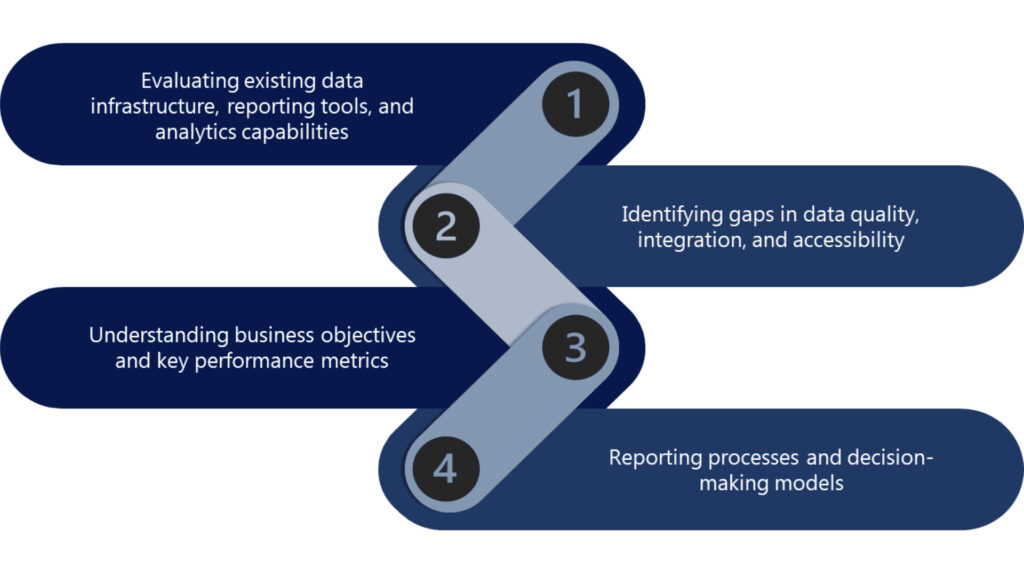
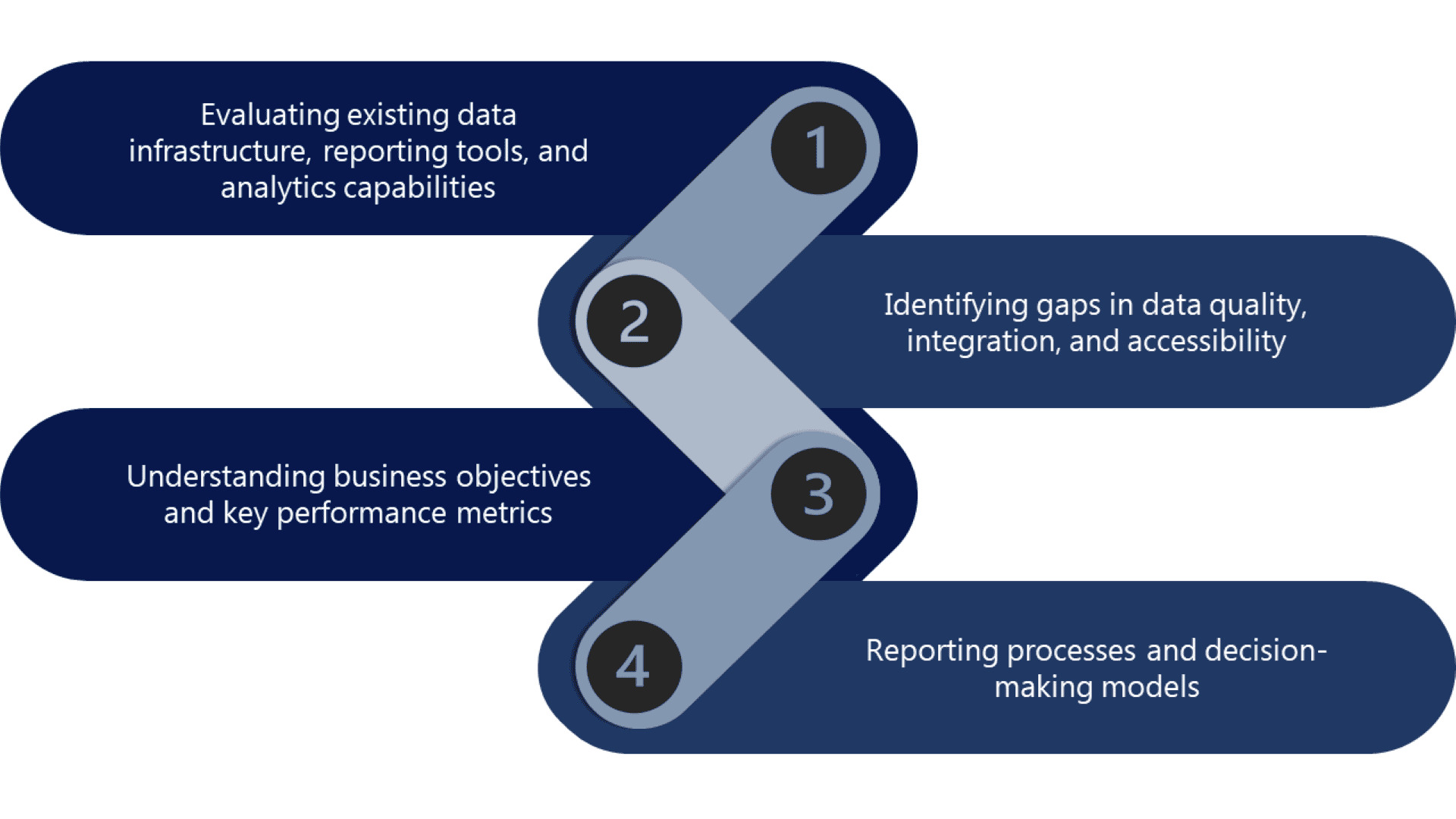
Before implementing any analytics platform, companies must evaluate the health of their data infrastructure. Many organizations operate with fragmented systems—where finance, marketing, operations, and sales data exist in separate environments. This lack of integration leads to reporting inconsistencies, duplication of effort, and unreliable insights.
Through professional Data management services, businesses can establish a single, trusted source of truth. This process involves:
- Cleaning and validating data
- Standardizing definitions and metrics
- Integrating systems across departments
- Automating data pipelines
- Strengthening governance and compliance
A well-structured data foundation ensures that insights generated later are accurate and actionable. Without proper data management, even the most advanced analytics tools can produce misleading results.
Aligning Business Intelligence with Strategic Goals
Technology alone does not create competitive advantage—strategy does. One of the most valuable aspects of BI consulting solutions is their ability to align analytics initiatives with broader organizational objectives.
Consultants work closely with stakeholders to identify key performance indicators (KPIs) that reflect real business priorities. For example:
- A retail company may prioritize customer lifetime value and inventory turnover.
- A manufacturing organization may focus on production efficiency and supply chain optimization.
- A service-based business may emphasize customer satisfaction and retention metrics.
By connecting analytics to tangible outcomes, Business Intelligence Consulting Services ensure that every dashboard, report, and model supports decision-making that drives growth.
Implementing BI Consulting Solutions Effectively
A successful BI implementation requires careful planning and execution. Consultants typically follow a structured roadmap that includes assessment, design, deployment, and optimization.
Core components often include:
1. Centralized Data Warehousing
Data from various systems is consolidated into a unified platform, allowing seamless reporting and cross-functional visibility.
2. Automated Data Integration
Automated workflows reduce manual reporting tasks and ensure consistent, real-time updates.
3. Role-Based Dashboards
Executives, managers, and analysts each receive customized dashboards tailored to their responsibilities and decision-making needs.
4. Self-Service Reporting
Empowering teams with user-friendly tools increases adoption and encourages a culture of data-driven decision-making.
When executed properly, BI consulting solutions eliminate reporting bottlenecks, improve operational transparency, and free teams to focus on strategy rather than manual data compilation.
The Role of Data Analytics Consulting
While business intelligence focuses on reporting and visualization, Data analytics consulting dives deeper into advanced analysis and predictive modeling. It helps organizations uncover patterns, forecast outcomes, and identify hidden opportunities.
Through advanced techniques such as:
- Predictive forecasting
- Trend analysis
- Scenario modeling
- Risk assessment
- Customer segmentation
Data analytics consulting enhances decision-making accuracy and prepares organizations for future challenges. Combined with strong BI systems, advanced analytics allows leaders to move from reactive problem-solving to proactive strategy development.
Turning Data into Clear Visual Insights
Complex data is only valuable when it is easy to understand. Data visualization plays a crucial role in making analytics accessible to decision-makers at every level.
Well-designed dashboards:
- Highlight trends and anomalies
- Provide real-time performance snapshots
- Enable faster comparison across metrics
- Improve collaboration between departments
Clear visual representation ensures that insights are not buried in spreadsheets but are instead presented in a way that encourages action.
Continuous Improvement and Scalability
Business environments evolve quickly, and analytics systems must evolve with them. Business Intelligence Consulting Services do not end with implementation—they include ongoing optimization and refinement.
Continuous improvement may involve:
- Updating KPIs as business priorities change
- Enhancing predictive models for improved accuracy
- Monitoring user engagement with dashboards
- Strengthening data governance policies
- Integrating new data sources as the company grows
Scalable BI frameworks allow businesses to expand capabilities without disrupting existing systems. This flexibility ensures long-term return on investment.
How BI Consulting Drives Digital Transformation
Business intelligence is often at the heart of digital transformation initiatives. It connects people, processes, and technology through unified data platforms.
Professional consultants contribute expertise across several domains:
- Strategic advisory for aligning analytics with vision
- Data architecture design for scalability and security
- Advanced modeling for forecasting and optimization
- Governance frameworks for compliance and data integrity
- Change management to ensure adoption across teams
By combining technical depth with business insight, Business Intelligence Consulting Services help organizations build a culture centered on evidence-based decision-making.
Related Blogs:-
Business Intelligence Services Give You the Power to Make Better Decisions
Frequently Asked Questions (FAQs)
1. What are Business Intelligence Consulting Services?
Business Intelligence Consulting Services help organizations design and implement systems that collect, organize, analyze, and visualize data to support strategic decision-making and operational efficiency.
2. How do Data management services support BI initiatives?
Data management services ensure that data is accurate, consistent, and properly integrated across systems. A strong data foundation improves reporting reliability and enhances overall analytics performance.
3. What is the difference between Data analytics consulting and BI consulting solutions?
Data analytics consulting focuses on advanced modeling, forecasting, and in-depth analysis. BI consulting solutions cover the broader ecosystem, including data integration, reporting frameworks, visualization, and strategy alignment.
4. How long does it take to implement BI consulting solutions?
Implementation timelines depend on organizational complexity, data maturity, and business objectives. Projects may range from several weeks to a few months, including assessment, development, and deployment phases.
5. Can Business Intelligence Consulting Services scale with business growth?
Yes. Modern BI platforms and consulting strategies are designed to scale. Organizations can integrate additional data sources, expand user access, and enhance analytics capabilities as they grow.
Conclusion
Data has become one of the most valuable assets in the modern business landscape—but only when used effectively. Business Intelligence Consulting Services transform disconnected information into structured, actionable insights that drive measurable results.
By combining strong Data management services, advanced Data analytics consulting, and tailored BI consulting solutions, organizations gain clarity, improve operational performance, and make confident strategic decisions. Companies that invest in intelligent data frameworks not only respond faster to market changes but also build a sustainable foundation for long-term growth.
Get connected with us today to learn how to turn your data into decisions and your decisions into success!