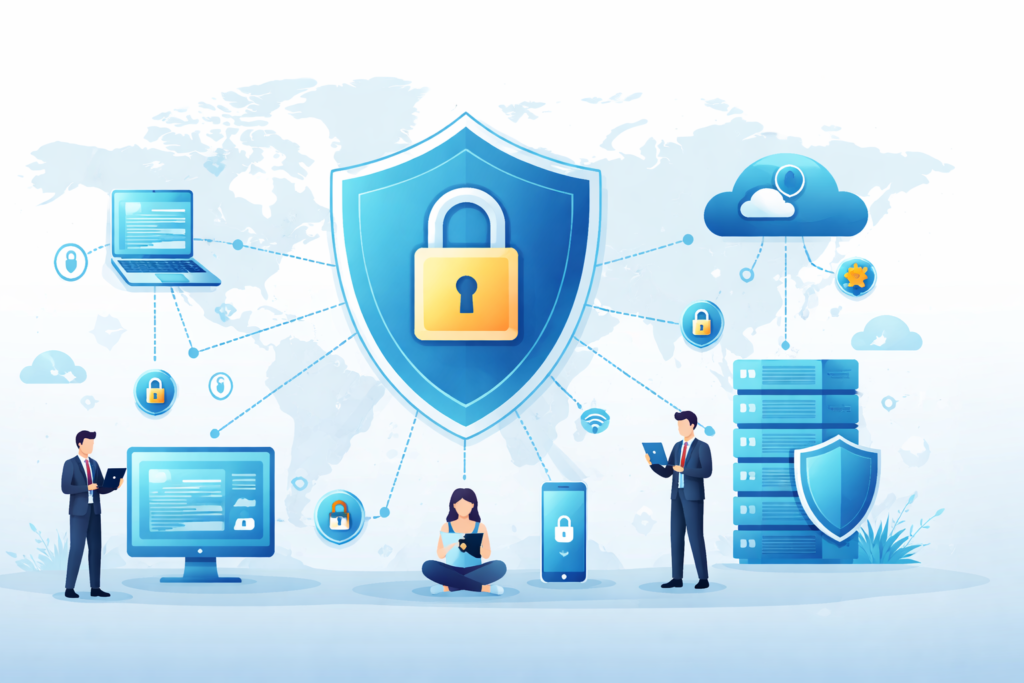
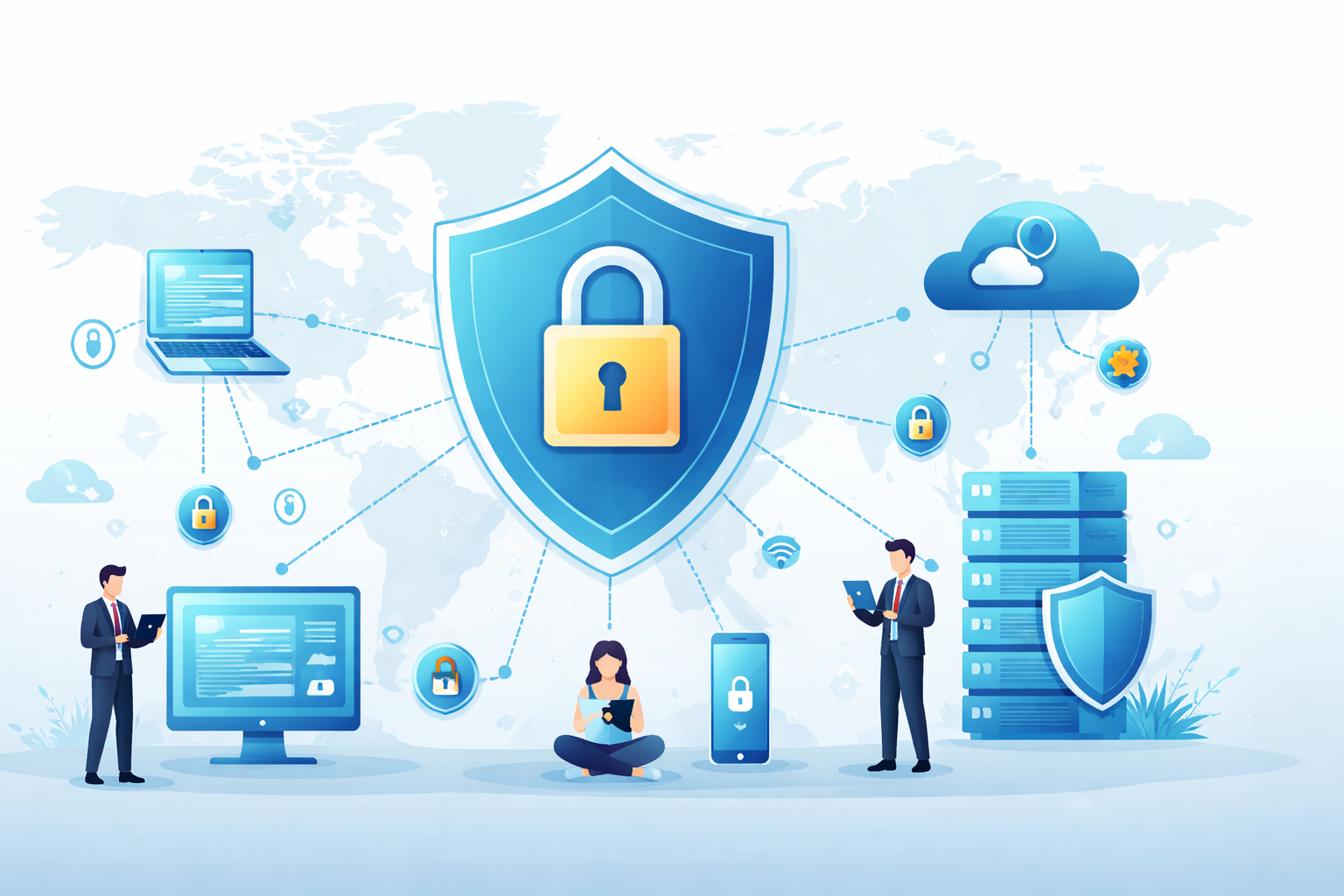
Modern companies operate in an environment where information moves constantly. Employees access dashboards from home, leadership reviews reports while traveling, and teams collaborate across multiple locations. This level of connectivity keeps businesses competitive, but it also increases the risk of data exposure.
Corporate VPN solutions help organizations manage this risk by securing how information travels between users and company systems. Instead of relying on open internet connections, businesses can create encrypted pathways that keep sensitive material private.
If you are new to the concept, this guide explains it in straightforward terms.
Understanding Corporate VPN Solutions
A corporate VPN is a technology that establishes a secure connection between an employee’s device and the company network. It encrypts data before it leaves the device and decrypts it only when it reaches its intended destination.
You can think of it as sending documents inside a locked briefcase rather than carrying loose papers through a crowded street. Even if someone tries to intercept the information, they cannot read it.
Organizations typically use VPN technology to:
-
Protect confidential files
-
Allow safe access to internal tools
-
Connect branch offices
-
Support secure communication
As businesses rely more on digital platforms, these protections become increasingly important.
Why Businesses Are Prioritizing Secure Access
Cyber threats are no longer limited to large corporations. Smaller companies are also targeted because attackers often assume their defenses are weaker.
At the same time, work habits have changed. Employees frequently connect through home networks or public Wi-Fi, both of which can be vulnerable.
Corporate VPN solutions reduce these risks by verifying users and encrypting every session. This means only authorized individuals can enter the network.
Consider a sales director reviewing pricing strategies from an airport lounge. Without protection, that information could potentially be captured on an unsecured network. With a VPN active, the connection remains private.
Security becomes part of daily operations rather than an afterthought.
Corporate VPN vs. Enterprise VPN
The terms corporate VPN and enterprise VPN are often used together, but they usually reflect different levels of scale.
An enterprise VPN is built for larger environments that require advanced control. It often includes centralized management, detailed permission settings, and support for thousands of users.
Corporate setups may start smaller but still provide strong protection. The key difference is how much complexity the system is designed to handle.
For example, a regional accounting firm might initially support a few remote employees. As the firm expands into new cities, an enterprise-grade structure can accommodate the increased demand without requiring a complete overhaul.
Planning for growth helps avoid operational disruptions later.
Supporting Remote Work Without Sacrificing Security
Remote and hybrid work models are now standard across many industries. Companies benefit from broader hiring options and improved flexibility, but they must ensure that convenience does not weaken security.
VPN for business environments create a safe bridge between remote employees and company resources. Staff can log in from anywhere while still operating within a protected network.
Imagine a software development team collaborating on proprietary code from different locations. That code represents significant intellectual property. A secure VPN connection ensures it stays accessible only to approved team members.
This approach allows organizations to stay agile while keeping critical assets protected.
Scalability and Long-Term Stability
Growth often brings new devices, additional software platforms, and expanded teams. Without a scalable security system, managing access can quickly become complicated.
Enterprise VPN technology supports expansion by allowing administrators to add users, adjust permissions, and monitor activity from a central point.
Take the example of a logistics company opening new distribution hubs. Each location needs access to scheduling tools and operational data. A scalable VPN connects them through one secure framework, maintaining consistency across the organization.
This type of preparation helps businesses grow without introducing avoidable vulnerabilities.
What to Evaluate Before Choosing a VPN
Selecting the right solution involves more than comparing features. Leaders should focus on how well the system fits their operational needs.
Important considerations include:
Strong encryption: Ensures that intercepted data cannot be understood.
Ease of management: Allows IT teams to oversee access without excessive manual work.
Reliable performance: Security should support productivity, not slow it down.
Flexible access controls: Employees should only reach the resources relevant to their roles.
Companies researching secure connectivity often explore services like the VPN for business from V3VPN to better understand how managed infrastructure can protect distributed teams while keeping deployment straightforward.
The goal is to implement security that integrates smoothly into everyday workflows.
Real Example: Strengthening Client Confidence
Picture a consulting firm handling sensitive market research for multiple clients. Analysts frequently travel and need access to internal databases.
Before adopting a VPN, the firm relied on basic password protection. Leadership realized that passwords alone were not enough to safeguard high-value information.
After implementing a corporate VPN, every connection became encrypted. Access rules were standardized, and the firm could demonstrate stronger data protection practices to clients.
The result was not just improved security but also greater confidence in the company’s professionalism.
Security as a Foundation for Trust
Reliable security measures do more than prevent breaches. They signal that a business takes responsibility for the information entrusted to it.
Clients, partners, and employees all benefit from knowing that communication channels are protected. Corporate VPN solutions help create that assurance by reducing exposure to common network threats.
They also support continuity. When systems are secure, teams can focus on delivering results instead of dealing with avoidable disruptions.
Conclusion
Corporate VPN solutions provide a practical way for businesses to secure digital communication while supporting modern work habits. From enabling remote access to preparing networks for growth, they form an essential part of responsible operations.
As organizations continue to adopt cloud tools and distributed teams, secure connectivity becomes a strategic necessity rather than a technical upgrade. With the right framework in place, companies can move forward confidently, knowing their data and workflows are protected.