
Cryogenic Equipment Market Size and Forecast 2025–2033
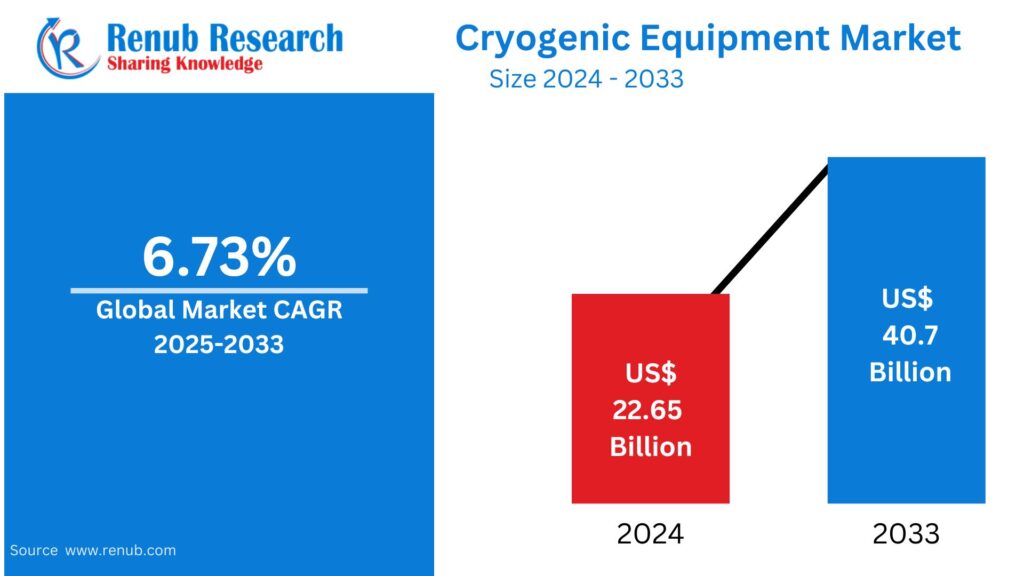
According to Renub Research global cryogenic equipment market is entering a strong growth phase as industries across energy, healthcare, food processing, aerospace, and manufacturing increasingly rely on ultra-low-temperature technologies. The market is projected to rise from USD 22.65 billion in 2024 to USD 40.7 billion by 2033, growing at a CAGR of 6.73 percent from 2025 to 2033. Rising demand for liquefied natural gas (LNG), advancements in healthcare biotechnology, expansion of renewable energy initiatives, and increasing use of industrial gases are among the primary growth catalysts. With industries focusing on sustainability, efficiency, and energy transition, cryogenic technologies are becoming indispensable for safe storage, processing, and transportation of liquefied gases.
Cryogenic Equipment Market Industry Overview
Cryogenic systems operate at extremely low temperatures to handle gases such as LNG, nitrogen, helium, hydrogen, and oxygen in their liquefied states. These systems are critical in applications including energy storage, gas processing, cryopreservation, metal treatment, electronics manufacturing, and food preservation. The global industrial landscape is witnessing surging consumption of natural gas, particularly LNG, driven by its environmentally friendly attributes compared to coal and oil. At the same time, advancements in healthcare applications such as cryotherapy, vaccine storage, and regenerative medicine continue to expand the use of cryogenic solutions.
Technology-driven sectors such as aerospace, electronics, and space exploration are adopting cryogenic equipment due to the need for precision temperature management. Meanwhile, global sustainability efforts and decarbonization initiatives are enabling rapid development of hydrogen economy projects, all of which depend heavily on cryogenic infrastructure for safe handling and long-term storage. With governments supporting energy transition policies and industries investing in infrastructure modernization, the cryogenic equipment market is positioned for sustained expansion.
Download Free Sample Report:https://www.renub.com/request-sample-page.php?gturl=cryogenic-equipment-market-p.php
Key Market Drivers Enhancing Cryogenic Equipment Demand
Rising Demand for Liquefied Natural Gas as a Clean Energy Source
The increasing global shift toward cleaner, more efficient, and sustainable energy fuels the demand for LNG, one of the leading drivers of the cryogenic equipment industry. LNG infrastructure development requires specialized cryogenic tanks, pipelines, pumps, vaporizers, and transportation systems to maintain and manage gases at extremely low temperatures. Nations with large natural gas reserves and strong export capacity are rapidly expanding LNG terminals, storage facilities, and shipping infrastructure. As international energy markets emphasize emission reductions, LNG provides a viable bridge fuel supporting climate objectives. Advancements in insulation technologies are further improving the safety and cost-efficiency of LNG handling, reinforcing its dominance as a growth engine for cryogenic technologies.
Expanding Healthcare and Biotechnology Applications
Healthcare and biotechnology represent one of the fastest-growing segments in the cryogenic equipment market. Cryogenic systems enable storage of biological materials, stem cells, vaccines, blood plasma, genetic samples, and pharmaceutical products at ultra-low temperatures to ensure long-term stability and integrity. Research institutions, laboratories, and biopharmaceutical manufacturers depend on cryogenic refrigerators, dewars, and freezers to support medical innovation. With rising investments in personalized medicine, regenerative treatments, vaccine development, gene therapy, and advanced diagnostic research, demand for reliable cryogenic solutions is escalating. Additionally, cryosurgery, cryotherapy, and minimally invasive procedures further strengthen market adoption across the global healthcare ecosystem.
Technological Advancements and Industrial Expansion
Rapid technological evolution is significantly improving efficiency, automation, and safety of cryogenic equipment. Modern systems integrate IoT-enabled monitoring, automated controls, real-time performance analytics, and enhanced insulation materials, enabling more reliable and cost-optimized operations. Heavy industries such as metallurgy, petrochemicals, chemical processing, and semiconductor manufacturing extensively use cryogenic technologies for gas separation, metal hardening, material testing, and fabrication. Space exploration, aerospace propulsion, superconductivity research, and advanced research facilities rely on precise cryogenic temperature management. As industrial activity and technological sophistication accelerate worldwide, demand for advanced cryogenic pumps, valves, vaporizers, storage tanks, and transportation equipment continues to rise.
Market Challenges and Industry Restraints
High Installation, Operation, and Maintenance Costs
One of the most significant constraints facing the cryogenic equipment market is the high cost associated with system installation, operation, and maintenance. Cryogenic infrastructure requires specialized engineering, durable materials capable of withstanding extreme cold, and precision manufacturing to maintain safety and performance. Initial capital expenditure for tanks, pipelines, storage facilities, and monitoring systems is substantial, with additional recurring costs for skilled technicians and maintenance services. Many small and medium enterprises face budgetary limitations, reducing their capacity to adopt advanced cryogenic technologies. While innovations are gradually improving cost efficiency, price sensitivity remains a challenge, particularly in developing regions with limited industrial budgets.
Stringent Safety Regulations and Technical Complexity
Handling cryogenic gases presents inherent risks, requiring strong regulatory compliance and technical expertise. Manufacturers and operators must adhere to rigorous safety standards to prevent leaks, explosions, or equipment failures. System design, installation procedures, and operational protocols must meet international and regional certifications. Failure to maintain temperature integrity or inadequate insulation can result in severe operational hazards and financial losses. Additionally, technical challenges such as temperature fluctuations, pressure management, and system durability add to operational complexity. The combination of strict regulatory frameworks and highly technical system requirements can slow adoption in regions lacking expertise or regulatory clarity.
Regional Overview of the Cryogenic Equipment Market
North America Cryogenic Equipment Market Outlook
North America, particularly the United States, represents a major revenue-generating region driven by LNG expansion, strong industrial infrastructure, and advanced healthcare biotechnology activities. The country continues to invest in natural gas liquefaction plants, export terminals, and storage facilities, increasing demand for dependable cryogenic technologies. Biomedical research, vaccine preservation, cryosurgery, and pharmaceutical manufacturing further boost the market. Presence of leading cryogenic manufacturers, technological innovation hubs, and stringent sustainability initiatives strengthens North America’s dominant position in the global market.
Europe Cryogenic Equipment Market Outlook
Europe is witnessing consistent growth supported by emission-reduction commitments, hydrogen economy development, and industrial modernization. Countries across the region are investing in renewable energy integration, LNG infrastructure, and advanced laboratory research. Strict environmental policies and technological excellence encourage implementation of energy-efficient cryogenic solutions. The region also benefits from strong collaborations between industry players and research institutions, leading to continuous innovation and high-performance product development.
Asia Pacific Cryogenic Equipment Market Outlook
Asia Pacific is one of the fastest-growing markets, driven by rapid industrialization, energy diversification, manufacturing expansion, and rising healthcare investments. Major economies such as China, Japan, India, and South Korea are increasing LNG consumption and infrastructure capacity. China remains a key manufacturing hub, enhancing domestic production of cryogenic systems while boosting exports. Healthcare advancements, electronics manufacturing, chemical processing, and government-backed hydrogen projects further accelerate demand. Strong infrastructure investments and supportive policy frameworks position Asia Pacific as a crucial growth engine.
Middle East and Africa Cryogenic Equipment Market Outlook
The Middle East is evolving as a strategic hub for LNG and hydrogen infrastructure, supported by energy diversification initiatives and sustainability commitments. Countries such as the United Arab Emirates and Saudi Arabia are investing in advanced cryogenic storage, gas processing facilities, and export capacity. Healthcare modernization, research development, and industrial expansion also contribute to increasing adoption. With growing partnerships between global manufacturers and regional governments, the Middle East is rapidly strengthening its presence in the cryogenic technology landscape.
Latin America Cryogenic Equipment Market Outlook
Latin America is gradually expanding its cryogenic infrastructure driven by energy modernization, industrial development, and rising demand for LNG as a cleaner fuel alternative. Countries such as Brazil, Mexico, and Argentina are focusing on improving storage facilities, transportation pipelines, and industrial gas utilization. The region’s growing healthcare capacity and manufacturing activity further enhance market opportunities, although cost constraints and infrastructure gaps remain key challenges.
Market Segmentation Insights
The cryogenic equipment market is segmented by equipment type, including tanks, pumps, heat exchangers, valves, and other supporting components. By cryogen type, the market encompasses nitrogen, liquefied natural gas, helium, hydrogen, and other industrial gases. In terms of applications, cryogenic technologies are widely used for storage, processing, transportation, and various specialized operations. By end-use industry, major segments include oil and gas, energy and power, food and beverage processing, healthcare, marine and aerospace, chemicals, and multiple industrial sectors. Geographic segmentation spans North America, Europe, Asia Pacific, Latin America, and Middle East and Africa, each exhibiting unique market dynamics and growth potential.
Competitive Landscape and Leading Companies
The cryogenic equipment market is highly competitive, characterized by innovation, technological expertise, and strategic expansion initiatives. Major companies actively shaping the industry include Air Liquide, Flowserve Corporation, Herose GmbH, INOX India Pvt. Ltd., Linde Plc, Air Products and Chemicals Inc., Chart Industries Inc., Emerson Electric Co., Cryofab Inc., and Cryoquip LLC (Nikkiso Co. Ltd.). These organizations focus on enhancing performance reliability, improving energy efficiency, and expanding global manufacturing capabilities. Strategic investments, acquisitions, partnerships, and development of advanced cryogenic technologies continue to define competitive positioning in the global market.
Future Outlook of the Cryogenic Equipment Market
With rising global energy transition, expanding healthcare innovation, accelerating industrialization, and growing demand for advanced gas handling solutions, the cryogenic equipment market is set for sustained long-term growth. Technological advancements will continue to enhance operational efficiency, safety, and automation while supporting broader adoption across emerging and developed economies. As industries emphasize sustainability, LNG development, hydrogen initiatives, and biomedical research, cryogenic equipment will remain a critical pillar supporting innovation, environmental progress, and industrial advancement worldwide.