Europe Electric Scooter Market Size and Forecast 2025–2033
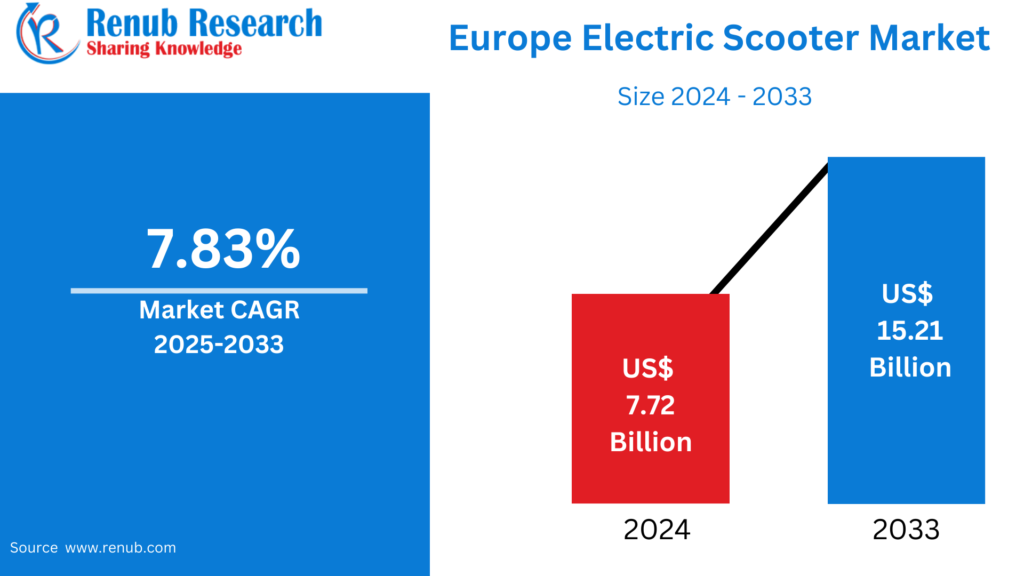
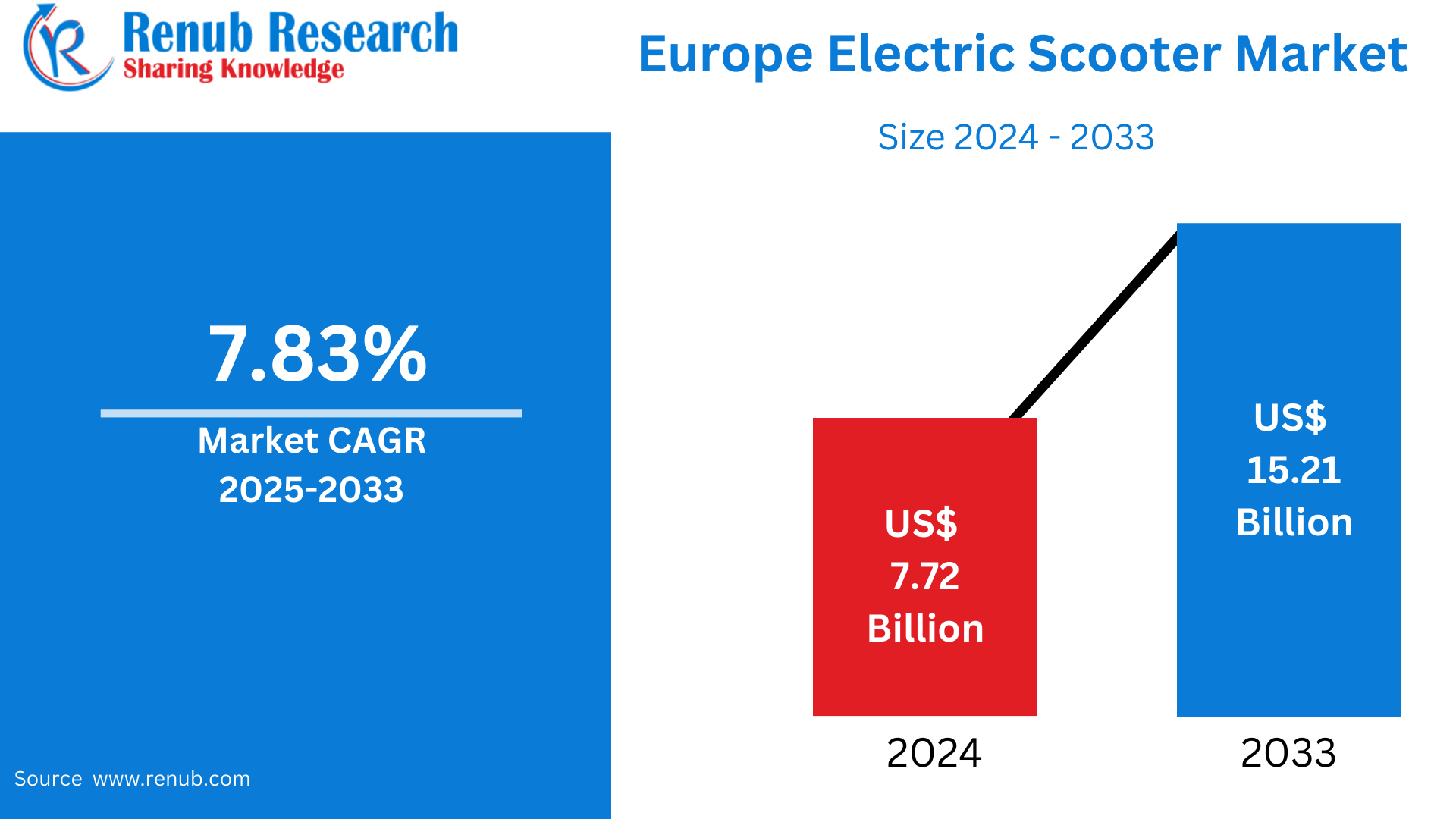
According To Renub Research Europe electric scooter market is projected to grow steadily during the forecast period, supported by rising demand for sustainable mobility solutions and favorable policy frameworks. The market is expected to expand from US$ 7.72 billion in 2024 to US$ 15.21 billion by 2033, registering a compound annual growth rate (CAGR) of 7.83% between 2025 and 2033. Increasing urban congestion, escalating fuel prices, and growing environmental awareness are accelerating the transition toward electric two-wheelers across European cities.
Electric scooters are increasingly recognized as a practical solution for short-distance commuting, particularly in densely populated urban areas. Strong government support for green transportation, coupled with technological advancements and shared mobility expansion, continues to stimulate market adoption. As Europe moves toward low-emission and carbon-neutral transportation systems, electric scooters are expected to play a central role in reshaping urban mobility.
Download Free Sample Report:https://www.renub.com/request-sample-page.php?gturl=europe-electric-scooter-market-p.php
Europe Electric Scooter Market Overview
An electric scooter is a lightweight, two-wheeled vehicle powered by an electric motor and rechargeable battery, primarily designed for short-distance travel. It serves as an efficient, cost-effective, and environmentally friendly alternative to conventional fuel-powered scooters and public transportation. Electric scooters are easy to maneuver, compact in size, and well suited for congested city environments, making them a preferred option for daily commuting and last-mile connectivity.
In Europe, the adoption of electric scooters has grown significantly due to heightened environmental awareness, strict emission regulations, and increasing pressure to reduce traffic congestion. Major metropolitan areas have actively integrated electric scooters into their transport ecosystems, promoting them as a viable solution for sustainable urban mobility. The development of cycling lanes, dedicated scooter paths, and charging infrastructure further supports adoption. Additionally, the widespread availability of app-based scooter-sharing services has made electric scooters accessible to a broad consumer base, reinforcing their role in modern European mobility systems.
Government Support and Green Mobility Initiatives
Government policies and sustainability initiatives are among the most influential growth drivers for the European electric scooter market. European authorities are implementing comprehensive measures to reduce greenhouse gas emissions and promote cleaner transportation alternatives. Policies encouraging electric vehicle adoption include subsidies, tax benefits, purchase incentives, and investments in charging infrastructure.
Urban low-emission zones and restrictions on internal combustion engine vehicles have increased demand for electric scooters as a practical mobility solution. National and regional governments are also supporting micromobility through regulatory frameworks that legitimize electric scooters within city transport systems. These initiatives aim to reduce air pollution, lower noise levels, and promote environmentally responsible commuting. As sustainability goals become more ambitious, government backing is expected to remain a strong foundation for market expansion.
Rising Popularity of Shared Mobility and Urban Commuting
Shared mobility services have significantly contributed to the rapid growth of electric scooters across European cities. Shared e-scooter fleets provide affordable, flexible, and convenient transportation for short urban trips, particularly in areas with high traffic density and limited parking availability.
Electric scooters are increasingly used for last-mile connectivity, complementing public transport systems such as buses, metros, and trains. Integration with digital mobility platforms allows users to locate, unlock, and pay for scooters seamlessly, enhancing convenience and user adoption. As urban populations continue to grow and commuters seek efficient alternatives to private cars, shared and personal electric scooters are gaining prominence as an essential component of urban transportation networks.
Technological Advancements in Battery and Connectivity
Technological progress has played a critical role in improving the performance, safety, and usability of electric scooters. Advancements in lithium-ion battery technology have significantly enhanced range, reduced charging time, and lowered overall weight. These improvements have made electric scooters more reliable and suitable for daily commuting.
In addition to battery enhancements, smart connectivity features such as GPS tracking, mobile app integration, digital dashboards, and anti-theft systems have increased user confidence and functionality. Manufacturers are also introducing modular designs and swappable battery systems to improve maintenance efficiency and extend vehicle usage. These technological developments continue to address earlier limitations and strengthen the appeal of electric scooters across European markets.
Regulatory Uncertainty and Usage Restrictions
Despite strong growth potential, the electric scooter market in Europe faces challenges related to regulatory inconsistency. Rules governing electric scooter usage vary significantly across countries and cities, creating uncertainty for consumers and manufacturers. Regulations related to speed limits, helmet requirements, age restrictions, and designated riding zones differ widely, complicating market expansion.
In some cities, shared electric scooters have faced temporary bans or restrictions due to safety concerns and improper parking. These regulatory variations can limit fleet deployment, disrupt operations, and discourage consumer adoption. Establishing harmonized regulations and clear usage guidelines will be essential to support long-term market growth and ensure rider safety across Europe.
Safety Concerns and Infrastructure Limitations
Safety remains a critical concern for the electric scooter market, with increasing attention on accidents involving riders, pedestrians, and other vehicles. Many European cities lack dedicated scooter infrastructure, such as clearly marked lanes and designated parking zones, leading to conflicts with pedestrians and cyclists.
Poor road conditions, limited lighting, and insufficient rider awareness further contribute to safety risks. These challenges can negatively affect public perception and lead to stricter regulations that may constrain market growth. Addressing safety concerns will require coordinated investments in urban infrastructure, public education campaigns, and enforcement of traffic rules to create safer environments for electric scooter usage.
Europe 36V Electric Scooter Market
The 36V electric scooter segment holds a significant share of the European market due to its balance between affordability and performance. These scooters are ideal for short to medium urban trips, typically offering a range of 20 to 30 kilometers per charge. Their lightweight design and cost efficiency make them particularly attractive to students, young professionals, and casual riders.
36V electric scooters are also widely used in shared mobility fleets because of their lower operational and maintenance costs. Environmentally conscious consumers seeking economical transportation options continue to favor this segment. As urban demand for sustainable and accessible mobility grows, the 36V electric scooter market is expected to maintain steady growth across Europe.
Europe 48V Electric Scooter Market
The 48V electric scooter segment is gaining momentum due to its higher power output, extended range, and superior performance on inclined terrains. These scooters typically offer ranges exceeding 40 kilometers, making them suitable for longer commutes and delivery applications.
48V models appeal to commuters who require enhanced speed and durability, as well as commercial users such as courier and delivery services. Although priced higher than 36V scooters, their performance advantages justify the investment for many users. The segment is expected to grow rapidly, particularly in regions with hilly landscapes and expanding urban delivery services.
Europe Folding Electric Scooter Market
Folding electric scooters are experiencing increasing demand in Europe due to their portability and convenience. These scooters are designed for easy storage and transportation, making them ideal for multimodal commuting that combines public transport with personal mobility.
Urban residents, students, and office professionals favor folding scooters for their compact design and ease of use in crowded environments. Manufacturers continue to innovate with lightweight materials, enhanced folding mechanisms, and improved safety features. As European cities encourage car-free travel and micromobility adoption, the folding electric scooter segment is poised for sustained growth.
Europe Li-ion Electric Scooter Market
Lithium-ion battery-powered electric scooters dominate the European market due to their superior energy efficiency, lightweight design, and fast charging capabilities. Compared to traditional battery technologies, lithium-ion batteries offer longer lifespan, improved performance, and lower maintenance requirements.
These batteries are widely used in both personal and commercial electric scooters, supporting advanced features such as smart connectivity and real-time battery monitoring. Continuous investment in battery innovation is expected to further enhance performance and reduce costs. The lithium-ion segment is anticipated to remain the technological backbone of the European electric scooter market.
Europe Commercial Electric Scooter Market
The commercial electric scooter segment in Europe is expanding rapidly, driven by demand from delivery services, logistics providers, and tourism operators. Electric scooters offer a cost-effective and environmentally friendly solution for last-mile delivery, particularly in cities with emission restrictions.
Food delivery platforms, e-commerce companies, and courier services are increasingly adopting electric scooters to reduce operating costs and improve delivery efficiency. Additionally, electric scooters are being used in campuses, industrial zones, and municipal fleets. The growth of the gig economy and smart city initiatives is expected to support long-term expansion of the commercial electric scooter market across Europe.
France Electric Scooter Market
France represents one of the most significant markets for electric scooters in Europe, with strong adoption driven by urban mobility initiatives and environmental policies. Major cities have invested in cycling infrastructure and micromobility integration, supporting electric scooter usage.
Although regulations for shared scooters have become more stringent, demand for privately owned electric scooters continues to rise. Consumers increasingly seek time-efficient and eco-friendly commuting options, particularly in densely populated urban areas. With supportive infrastructure and strong consumer awareness, France remains a key contributor to market growth.
United Kingdom Electric Scooter Market
The United Kingdom electric scooter market has gained momentum through government-led pilot programs and increasing public interest in micromobility. Rental electric scooter schemes introduced in several cities have improved awareness and acceptance of electric scooters as a legitimate transport option.
While privately owned electric scooters face regulatory limitations on public roads, rising fuel costs and environmental concerns continue to drive demand. As regulatory frameworks evolve, the UK market is expected to experience significant growth in the coming years.
Russia Electric Scooter Market
Russia’s electric scooter market is emerging, particularly in large cities such as Moscow and St. Petersburg. Increasing traffic congestion and environmental awareness are encouraging urban residents to explore alternative transportation options.
Seasonal climate conditions limit year-round usage, but demand increases significantly during warmer months. The market benefits from a young, tech-savvy population and widespread smartphone usage supporting shared mobility platforms. Despite infrastructure and regulatory challenges, Russia holds long-term potential as urban mobility patterns continue to evolve.
Europe Electric Scooter Market Segmentation Overview
The European electric scooter market is segmented by voltage, product type, battery type, end use, and country. Voltage categories include 24V, 36V, 48V, and above 48V. Product types include folding, standing or self-balancing, and retro scooters. Battery types comprise lithium-ion, lead-acid, and other technologies. End-use segmentation covers personal and commercial applications. Country-level analysis spans major European markets, reflecting diverse adoption patterns and regulatory environments.
Competitive Landscape and Key Players Analysis
The European electric scooter market features a competitive landscape with global manufacturers and regional players. Companies are evaluated across multiple dimensions, including business overview, leadership, recent developments, SWOT analysis, and revenue performance. Innovation, strategic partnerships, product diversification, and regulatory compliance remain critical for maintaining competitive advantage in this rapidly evolving market.