Europe Stationery and Supplies Market Size & Forecast 2026–2034
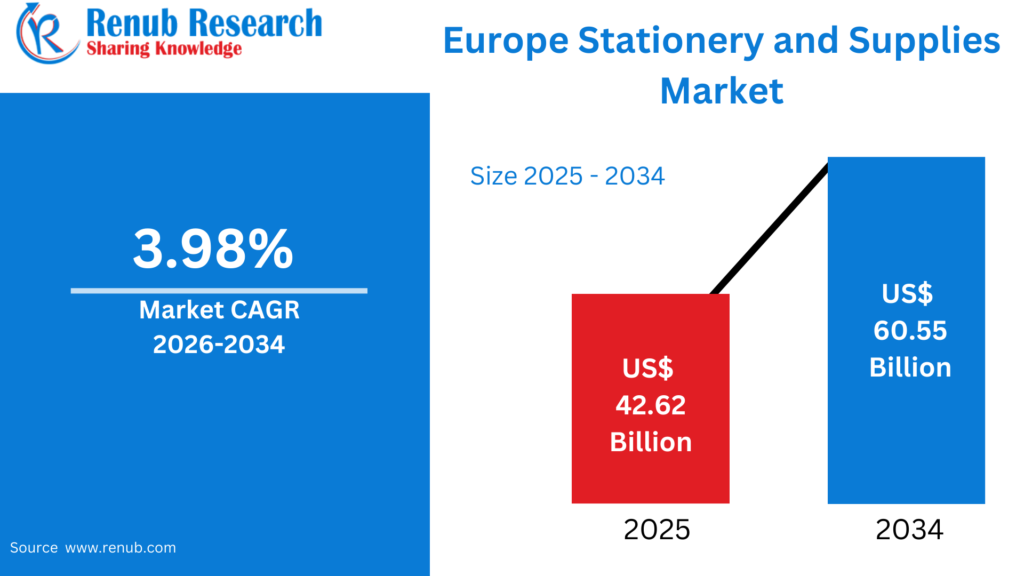
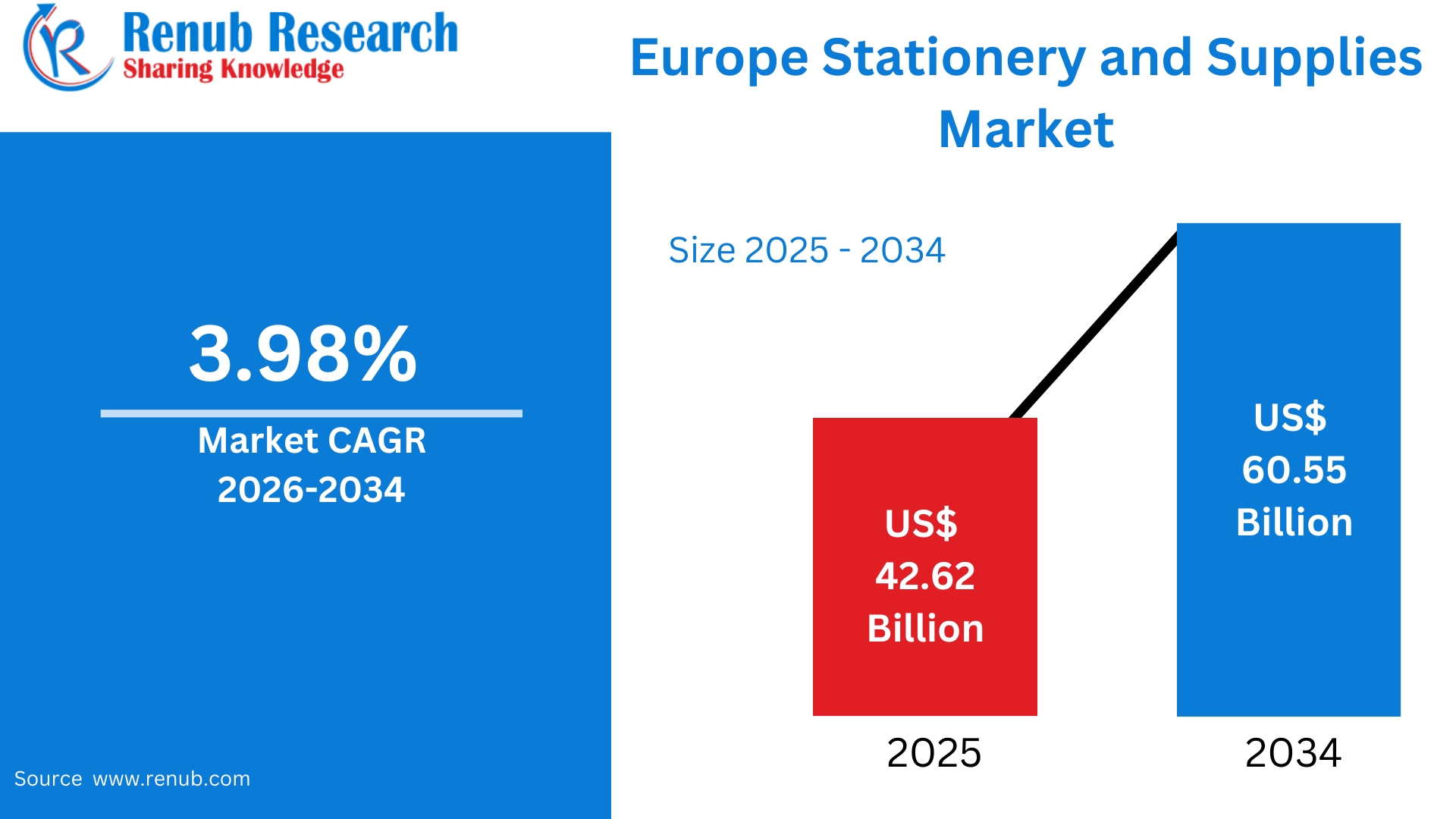
According To Renub Research Europe stationery and supplies market is expected to grow steadily over the forecast period, reflecting the continued relevance of physical writing, learning, and organizational tools across education, corporate, and home-office environments. The market is projected to increase from approximately US$ 42.62 billion in 2025 to about US$ 60.55 billion by 2034, expanding at a compound annual growth rate (CAGR) of 3.98% during 2026–2034. Growth is driven by consistent demand from educational institutions, the normalization of hybrid and remote working models, and the rising preference for premium, eco-friendly, and customized stationery products across Europe.
Despite accelerating digitalization, stationery products maintain a strong foothold in Europe due to regulatory documentation requirements, learning methodologies that emphasize handwriting, and consumer interest in creativity, planning, and productivity tools. Sustainability-focused innovation and omnichannel retail expansion further reinforce market stability and long-term growth potential.
Download Free Sample Report:https://www.renub.com/request-sample-page.php?gturl=europe-stationery-supplies-market-p.php
Europe Stationery and Supplies Market Overview
Stationery and supplies encompass a wide range of products used for writing, organizing, printing, learning, and creative activities in offices, educational institutions, and homes. Core product categories include paper products, notebooks, pens, pencils, markers, envelopes, folders, organizers, printers, inks, and art materials. In addition, stationery also includes creative and learning tools that support artistic expression, productivity, and note-taking.
In Europe, stationery and supplies remain deeply embedded in professional, academic, and cultural practices. Educational institutions continue to rely on physical learning materials, while businesses depend on documentation, planning tools, and branded stationery for compliance and corporate identity. The region’s environmentally conscious consumer base increasingly favors high-quality, sustainable stationery made from recycled materials, FSC-certified paper, and refillable or biodegradable components. The rise of online retail has also improved accessibility, enabling consumers and businesses to source specialized and customized stationery products more easily. As a result, stationery remains a resilient and well-established market segment across Europe.
Continued Demand from Education and Academic Institutions
The education sector remains one of the most important growth drivers for the Europe stationery and supplies market. Millions of students across primary, secondary, and higher education institutions create sustained demand for notebooks, writing instruments, paper products, art materials, and examination supplies. Governments across Europe continue to invest in education infrastructure, inclusive learning programs, and skill development, ensuring consistent consumption of essential stationery items.
Although digital tools are increasingly integrated into classrooms, handwriting, printed materials, and physical learning aids remain central—particularly in early childhood and foundational education. Many educators emphasize the cognitive benefits of writing by hand, which supports ongoing demand for traditional stationery. Consumer behavior studies indicate that a large proportion of European consumers still prefer purchasing stationery from physical stores, reinforcing the role of offline retail in serving schools and families.
Corporate Offices and the Expansion of Hybrid Work Models
The evolution of hybrid and flexible work models has reshaped, rather than reduced, demand for stationery and office supplies in Europe. Corporate offices continue to require high-quality notebooks, planners, folders, printed documents, and branded stationery to support productivity, collaboration, and professional presentation. At the same time, the rise of home offices has expanded demand for personal organizers, printers, and paper supplies among remote workers and freelancers.
Small and medium-sized enterprises, which form the backbone of the European economy, remain consistent buyers of office stationery. Regulatory requirements in sectors such as finance, healthcare, legal services, and manufacturing also sustain demand for printed documentation and record-keeping. Corporate premiumization—through customized, branded, and design-focused stationery—adds value growth beyond pure volume expansion. Strategic acquisitions, such as Hamelin’s acquisition of Pelikan Vertriebsgesellschaft, highlight ongoing consolidation and investment within the sector.
Sustainability and Eco-Friendly Product Innovation
Sustainability has emerged as one of the most influential growth drivers in the European stationery and supplies market. Consumers, educational institutions, and corporations increasingly prioritize environmentally responsible products, driving demand for recycled paper, refillable pens, biodegradable materials, and plastic-free packaging. European environmental regulations and corporate ESG commitments further accelerate this shift.
Manufacturers are responding by launching stationery made from FSC-certified paper, bio-based plastics, plant-based inks, and reusable formats. Sustainable stationery often commands higher price points, supporting improved margins for manufacturers and retailers. Green procurement policies in schools, universities, and corporate offices are transforming sustainability from a niche preference into a mainstream purchasing criterion across Europe.
Digitalization and the Reduction of Conventional Paper Usage
Digital transformation represents one of the most significant challenges for the Europe stationery and supplies market. The widespread use of laptops, tablets, cloud storage, and collaboration software has reduced reliance on physical paper in many professional environments. Businesses increasingly pursue paperless workflows to improve efficiency and meet sustainability goals, while e-learning platforms and digital textbooks reduce the need for printed educational materials.
Although digitalization does not eliminate stationery demand entirely, it places pressure on traditional paper-based product volumes. Manufacturers and retailers must adapt by focusing on value-added, premium, creative, and sustainable stationery categories to offset declining demand for commoditized paper products.
Price Sensitivity and Raw Material Cost Pressures
Rising costs of raw materials—including paper pulp, inks, plastics, and energy—pose ongoing challenges for stationery manufacturers in Europe. Inflationary pressures and supply-chain disruptions increase production costs, while consumers and businesses remain highly price-sensitive. Intense competition among large brands and private-label products further limits pricing flexibility.
To remain competitive, companies must focus on cost optimization, efficient sourcing, inventory management, and value differentiation through design, sustainability, and customization. Failure to manage cost pressures effectively may result in margin erosion across the value chain.
Paper Products Segment in the Europe Stationery Market
Paper products such as notebooks, copier paper, diaries, and folders continue to form the foundation of the European stationery market. While digital tools have reduced overall usage volumes, paper remains essential in education, legal documentation, government administration, and formal corporate processes. Demand is increasingly shifting toward recycled, premium-quality, and environmentally certified paper products.
Students often prefer durable, hardbound notebooks, while corporate users require standardized documentation formats that meet regulatory requirements. Innovation in paper quality, texture, durability, and sustainability presents ongoing opportunities for differentiation within this mature segment.
Europe Art and Craft Supplies Market
The art and craft segment is experiencing steady growth across Europe, driven by increased interest in creativity, hobbies, mental well-being, and DIY activities. Products such as paints, brushes, sketchbooks, markers, and craft kits are widely used for educational, recreational, and professional purposes.
Art education programs, home-based hobbies, and gift-oriented purchases contribute to consistent demand. High-quality art materials command premium pricing and offer attractive margins, making this segment particularly appealing for manufacturers and specialty retailers.
Europe Educational Institutions Stationery and Supplies Market
Educational institutions are among the largest volume purchasers of stationery and supplies in Europe. Schools, colleges, and universities require continuous procurement of writing instruments, paper products, test materials, and learning aids. Government-funded education systems provide stable, long-term demand through centralized procurement and supply contracts.
The expansion of inclusive education and vocational training programs further increases demand for specialized stationery products. Long-term supply agreements with wholesalers and manufacturers ensure predictable revenue streams and market stability.
Europe Corporate Stationery and Supplies Market
Corporate demand for stationery and supplies is driven by functional needs such as documentation, organization, compliance, and branding. Products including folders, planners, business cards, and printed materials remain integral to professional operations. Premiumization and customization trends are especially strong in professional services, consulting, and client-facing industries.
Green procurement policies influence purchasing decisions, with corporations increasingly favoring eco-friendly stationery. While volume growth may be moderate, value growth remains strong due to higher-quality and customized product offerings.
Europe Offline Stationery and Supplies Market
Offline distribution channels—including stationery stores, bookstores, supermarkets, and office-supply retailers—remain highly relevant across Europe. Many consumers prefer to physically inspect stationery products, particularly art materials and premium paper goods, before purchase. Schools and corporate buyers also favor offline procurement for immediate availability and bulk purchasing.
Specialized knowledge and personalized service offered by offline retailers, especially in art and professional stationery categories, continue to support this channel’s importance despite the growth of e-commerce.
Germany Stationery and Supplies Market
Germany represents one of the largest and most stable stationery markets in Europe, supported by a strong education system, extensive corporate sector, and robust industrial base. Demand is driven by schools, universities, vocational institutions, and corporate offices that prioritize quality, precision, and sustainability.
German consumers and businesses show strong preference for recycled paper, durable writing instruments, and environmentally responsible products. Despite rapid digitalization, documentation requirements and professional standards sustain steady demand. A well-developed retail infrastructure and structured B2B procurement systems further support market resilience.
United Kingdom Stationery and Supplies Market
The United Kingdom stationery market is shaped by strong educational demand, widespread hybrid working, and a mature retail ecosystem. Schools and universities remain major buyers, while remote and freelance workers drive demand for home-office stationery and organizers.
UK consumers favor innovative, themed, and branded stationery, particularly among younger demographics. Eco-friendly products, recycled paper, and plastic-free packaging are increasingly important purchasing factors. E-commerce plays a critical role in market growth, offering convenience and access to niche stationery products.
France Stationery and Supplies Market
France’s stationery market is strongly influenced by cultural appreciation for writing, education, and art. The country supports a robust mid-to-premium stationery segment, driven by demand for quality writing tools, notebooks, and art supplies.
Educational institutions, corporate offices, and a vibrant art and craft culture sustain consistent consumption. Growing interest in creativity, design, and DIY activities further boosts demand for specialized paper and art materials. Innovation in sustainable paper products strengthens France’s position as a key market.
Russia Stationery and Supplies Market
The stationery market in Russia is driven by large educational institutions, government administration, and corporate offices. Demand is concentrated on affordable and practical products such as notebooks, pens, folders, and general paper supplies. Public-sector dependence on physical documentation supports continued usage despite increasing digitalization.
Local manufacturing plays an important role in meeting domestic demand and reducing reliance on imports. While digital adoption is growing, traditional stationery remains widely used in education and administration. There is also gradual growth in demand for children’s creative and artistic stationery products.
Europe Stationery and Supplies Market Segmentation
By Product
Paper Products
Writing Instruments
Art and Craft Supplies
Others
By Application
Educational Institutes
Corporates
Others
By Distribution Channel
Offline
Online
By Country
France
Germany
Italy
Spain
United Kingdom
Belgium
Netherlands
Russia
Poland
Greece
Norway
Romania
Portugal
Rest of Europe
Competitive Landscape and Company Analysis
The Europe stationery and supplies market is moderately fragmented, featuring a mix of global brands and regional specialists competing on quality, sustainability, design, and distribution reach. Key players include Faber-Castell, MUJI, Staedtler, Schwan Stabilo, Kokuyo Camlin Ltd, 3M, Typo, Maped, Sakura Color Products Corporation, and Navneet Education Limited.
All companies are evaluated across five viewpoints: company overview, key personnel, recent developments, SWOT analysis, and revenue analysis, providing a comprehensive understanding of competitive positioning and strategic direction.
Conclusion
The Europe stationery and supplies market is set for consistent growth through 2034, supported by education demand, hybrid working trends, sustainability-driven innovation, and resilient consumer behavior. While digitalization and cost pressures present challenges, the market continues to evolve toward premium, eco-friendly, and value-added products. Strong regional diversity, established institutional demand, and ongoing product innovation position the European stationery market for long-term stability and incremental expansion.