In today’s rapidly shifting business environment, organizations have access to more data than ever before. Dashboards track performance in real time, analytics tools forecast trends, and reports measure everything from customer acquisition to operational efficiency. Yet despite this abundance of information, many leaders still struggle with a fundamental challenge: understanding why changes are happening and what strategic action to take next.
This is where Expert Interviews become invaluable.
While quantitative research reveals patterns and performance metrics, it often lacks the depth needed to interpret complex market dynamics. Expert Interviews bridge that gap by delivering context, foresight, and real-world clarity that numbers alone cannot provide.
What Are Expert Interviews?
Expert Interviews are a qualitative research method that involves structured or semi-structured conversations with experienced professionals who possess deep industry knowledge. These individuals may include senior executives, former regulators, consultants, technologists, product leaders, or recognized industry authorities.
Unlike surveys that focus on gathering large volumes of standardized responses, Expert Interviews emphasize depth, experience, and strategic perspective. The objective is not to collect surface-level opinions, but to uncover meaningful insights grounded in real-world practice.
Through thoughtful dialogue, businesses gain access to expert consultation insights that reveal operational realities, competitive pressures, regulatory considerations, and emerging market shifts. This approach allows researchers to ask follow-up questions, explore unexpected themes, and adapt discussions in real time—resulting in richer and more actionable intelligence.
Why Expert Interviews Matter in Modern Market Research
Data can tell you what is happening. Expert Interviews help explain why it is happening—and what could happen next.
Here’s why they are essential in today’s research landscape:
1. They Add Context to Quantitative Data
Market data may show declining growth or shifting customer behavior, but it rarely explains the underlying causes. Industry professionals interpret trends through lived experience. They understand supply chain constraints, adoption barriers, pricing sensitivities, and competitive dynamics.
By integrating Thought leader insights, organizations transform raw data into strategic understanding.
2. They Provide Real-World Practicality
Recommendations derived from Expert Interviews are grounded in current market realities. Experts who actively operate within an industry offer perspectives shaped by hands-on experience—not theoretical assumptions.
This practical lens reduces costly missteps and strengthens business planning.
3. They Deliver Forward-Looking Intelligence
Experts often identify early signals of disruption before they appear in mainstream research. Whether it’s regulatory reform, technological innovation, or evolving consumer sentiment, Expert Interviews help organizations anticipate change rather than react to it.
This proactive awareness supports long-term resilience and competitive positioning.
Key Business Benefits of Expert Interviews
Deeper Market Understanding
Expert Interviews uncover insights into customer expectations, operational challenges, innovation bottlenecks, and competitive behavior. These nuanced perspectives frequently expose blind spots that traditional research methods overlook.
Stronger Strategic Validation
Before launching a product, entering a new market, or adjusting pricing strategy, organizations can test assumptions through direct conversations with knowledgeable professionals. This validation strengthens confidence and refines strategic direction.
Competitive Advantage
Companies that consistently leverage Thought leader insights gain a sharper understanding of industry movement. They can identify underserved segments, anticipate competitor strategies, and respond to market shifts more effectively.
Greater Stakeholder Confidence
When strategic decisions are supported by credible expert consultation insights, they carry more authority. Investors, partners, and executive teams are more likely to trust findings backed by seasoned industry voices.
Faster Decision-Making
Because Expert Interviews provide focused, high-value intelligence, they often shorten research timelines. Rather than conducting prolonged data collection efforts, businesses can gain targeted clarity within weeks.
How to Conduct High-Impact Expert Interviews
To maximize results, Expert Interviews must be executed with structure and purpose.
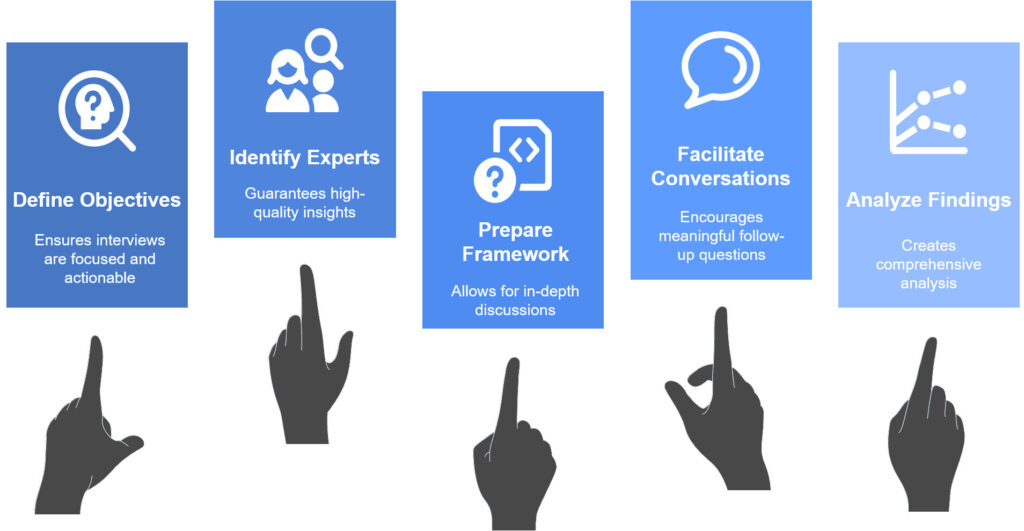
Define Clear Research Objectives
Start with a precise understanding of what you aim to discover. Whether assessing regulatory impact, exploring technology adoption, or evaluating market entry risk, clear goals ensure productive conversations.
Select the Right Experts
The quality of insights depends on the relevance of the expert. Choose professionals whose experience aligns directly with your research objectives. A diverse mix of perspectives—across functions or geographies—can further enrich findings.
Develop Insightful, Open-Ended Questions
Craft questions that encourage detailed responses rather than simple confirmations. Avoid leading prompts and allow room for experts to introduce emerging themes or challenge assumptions.
Establish Trust and Confidentiality
Experts are more candid when they feel secure. Transparency about research intent and confidentiality policies fosters honest, high-value dialogue.
Analyze for Patterns and Strategic Meaning
Post-interview synthesis is critical. Identify recurring themes, contradictions, risks, and opportunities. The real value of Expert Interviews lies in translating qualitative conversations into actionable strategic guidance.
Turning Expert Interviews into Strategic Action
Collecting insights is only the first step. The competitive advantage emerges when organizations apply those insights effectively.
Businesses use Expert Interviews to:
- Identify unmet customer needs
- Evaluate regulatory or policy impacts
- Validate pricing and positioning strategies
- Understand supply chain vulnerabilities
- Assess competitive landscapes
- Explore expansion into new markets
When combined with quantitative research, Expert Interviews create a comprehensive, 360-degree understanding of the market. This balanced approach supports smarter and more resilient strategies.
Identifying Emerging Trends Early
Industry professionals operate close to innovation cycles and regulatory discussions. Their vantage point often reveals early-stage developments before they appear in public reports.
By leveraging Thought leader insights, organizations can detect shifts in technology adoption, evolving customer expectations, or upcoming compliance requirements well ahead of competitors. This early awareness enables proactive planning and protects first-mover advantage.
Driving Innovation Through Expert-Led Intelligence
Beyond validation and forecasting, Expert Interviews frequently spark innovation. Conversations with experienced professionals can reveal overlooked customer segments, partnership opportunities, and operational efficiencies.
Innovation flourishes when businesses combine data-driven analysis with experience-based perspective. Expert consultation insights help organizations refine ideas, strengthen product development, and unlock new growth pathways.
Related Blogs:-
How CAPI Services Improve Field Research in a Digital-First World
CATI: Turning Telephone Conversations into Reliable Research
Frequently Asked Questions (FAQs)
1. How are Expert Interviews different from traditional surveys?
Surveys focus on gathering standardized responses from large audiences, prioritizing statistical measurement. Expert Interviews emphasize depth, strategic context, and experience-driven understanding.
2. Who qualifies as an expert for Expert Interviews?
Experts may include industry veterans, C-level executives, former regulators, consultants, technical specialists, or recognized thought leaders with direct market experience.
3. How long does it take to conduct an Expert Interview study?
Timelines vary depending on scope, but targeted Expert Interviews often deliver meaningful insights within a few weeks.
4. Can Expert Interviews complement quantitative research?
Yes. Combining qualitative expert consultation insights with quantitative data provides both measurable trends and contextual explanation, leading to stronger decisions.
5. What industries benefit most from Expert Interviews?
Industries experiencing rapid change—such as technology, healthcare, energy, finance, and manufacturing—benefit significantly. However, any sector facing uncertainty or competitive pressure can gain value from expert-driven research.
Conclusion
In an era defined by complexity and constant change, relying solely on numerical analysis limits strategic clarity. While data reveals patterns, Expert Interviews provide the context, foresight, and practical intelligence required to act with confidence.
Organizations that integrate Thought leader insights and expert consultation insights into their decision-making processes gain deeper understanding, stronger strategic validation, and sustainable competitive advantage.
By bridging the gap between data and real-world expertise, Expert Interviews transform information into insight—and insight into measurable business success.
Get connected with us today to learn how to turn your data into decisions and your decisions into success!