Global Advertising Market Size and Forecast 2025–2033
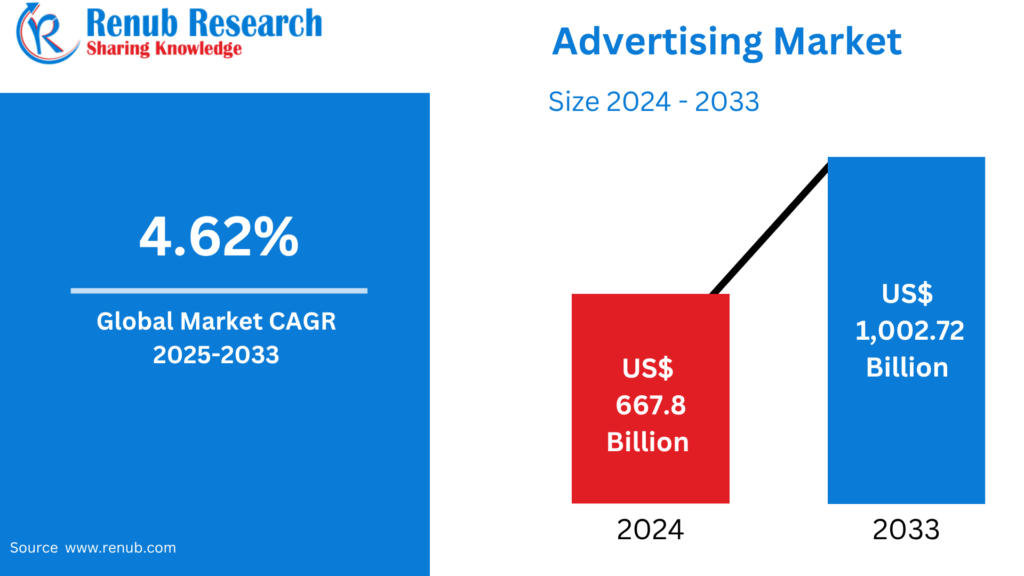
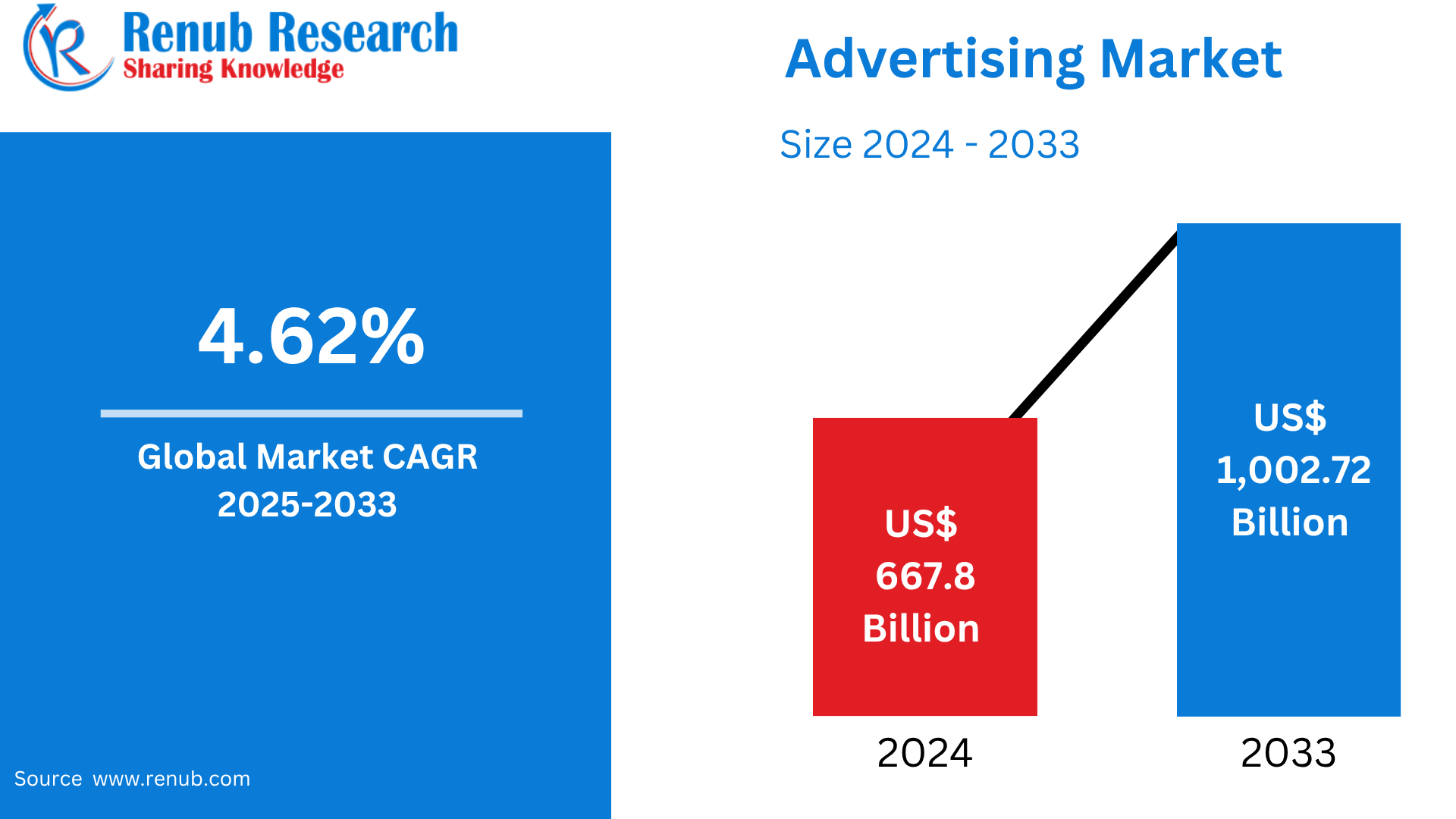
According to Renub Research global advertising market continues to be one of the most influential pillars of the modern economy, supporting brand building, consumer engagement, and commercial growth across industries. In 2024, the market was valued at USD 667.8 billion and is projected to reach USD 1,002.72 billion by 2033, expanding at a CAGR of 4.62% during the forecast period. This steady growth is driven by rapid digitalization, increased mobile and social media usage, rising programmatic advertising adoption, and higher marketing budgets as businesses compete for consumer attention in an increasingly crowded marketplace.
As advertising shifts from traditional mass media to data-driven, personalized, and performance-based models, brands are rethinking how they connect with audiences. Digital platforms, influencer ecosystems, and automation technologies are reshaping the structure of global advertising expenditure and redefining effectiveness metrics.
Global Advertising Market Outlook
Advertising is a structured communication strategy used by businesses, governments, and organizations to promote products, services, ideas, or social causes. It involves paid messaging distributed across multiple media channels, including television, radio, print, digital platforms, social media, outdoor displays, and cinema screens. The fundamental objective of advertising is to influence consumer behavior, build brand awareness, and drive sales or engagement.
In the modern economy, advertising goes beyond commercial promotion. It plays a crucial role in public awareness campaigns, political communication, and social advocacy. With the rise of digital platforms, advertising has become more interactive, measurable, and targeted than ever before. Advertisers now leverage advanced analytics, artificial intelligence, and real-time data to optimize campaigns and reach precise audience segments.
The widespread adoption of online shopping, social commerce, and influencer marketing has transformed advertising into a dynamic and continuously evolving industry. Platforms such as search engines, social networks, and streaming services allow advertisers to connect with users based on interests, demographics, location, and online behavior, making advertising a central driver of global business growth.
Request a free sample copy of the report:https://www.renub.com/request-sample-page.php?gturl=global-advertising-market-p.php
Growth Drivers in the Global Advertising Market
Digital Transformation and Mobile Usage Growth
The rapid expansion of smartphone usage and global internet penetration has accelerated the shift from traditional advertising formats to digital-first strategies. Consumers now spend a significant portion of their time on mobile devices, social networks, streaming platforms, and apps, prompting brands to reallocate budgets toward digital, mobile, and video advertising.
Programmatic advertising, real-time performance measurement, and audience targeting capabilities have made digital advertising highly efficient and cost-effective. Businesses of all sizes, including small and medium enterprises, are increasingly investing in online advertising due to its scalability and measurable returns. Emerging economies such as India and Brazil are also witnessing strong growth in digital ad spending as mobile connectivity expands.
E-commerce Expansion and Performance-Based Advertising
The global rise of e-commerce has intensified demand for performance-driven advertising models that deliver measurable results. Advertisers increasingly rely on pay-per-click advertising, affiliate marketing, and conversion-focused campaigns to directly link advertising spend with revenue generation.
Digital platforms enable advertisers to track return on ad spend with high accuracy, making performance-based advertising particularly attractive during seasonal sales, product launches, and competitive promotional periods. Retailers and marketplaces are also developing proprietary advertising ecosystems to monetize traffic and provide brands with direct access to high-intent consumers.
Content Personalization and Data-Driven Campaigns
Personalization has become a defining feature of modern advertising strategies. Advertisers now use big data, machine learning, and artificial intelligence to deliver tailored messages that resonate with specific audience segments. From personalized ad creatives to predictive targeting, data-driven campaigns enhance engagement, click-through rates, and brand loyalty.
As privacy regulations evolve, first-party data and consent-based targeting are gaining importance. Brands are investing in responsible data practices and contextual advertising approaches to maintain relevance while complying with regulatory standards. Personalization is no longer optional but essential for standing out in saturated media environments.
Challenges in the Global Advertising Market
Ad Fatigue and Consumer Skepticism
One of the most pressing challenges in advertising is consumer ad fatigue. Audiences are exposed to thousands of advertisements daily, leading to reduced attention, banner blindness, and declining engagement rates. Overexposure to repetitive or intrusive ads can negatively impact brand perception and trust.
Younger demographics, particularly Gen Z, are increasingly skeptical of traditional advertising and are more likely to use ad blockers. To address this challenge, advertisers must focus on creativity, authenticity, storytelling, and value-driven messaging that aligns with audience expectations rather than interrupting their experiences.
Privacy Regulations and Data Limitations
Data privacy laws such as the General Data Protection Regulation (GDPR) in Europe and the California Consumer Privacy Act (CCPA) have significantly altered the advertising landscape. Restrictions on data collection, usage, and tracking are reducing the effectiveness of traditional targeting methods, particularly those reliant on third-party cookies.
Advertisers are now shifting toward first-party data strategies, contextual targeting, and privacy-safe measurement solutions. While these changes promote transparency and consumer trust, they also require continuous adaptation, technological investment, and strategic innovation from advertisers and ad-tech providers.
Global Digital Advertising Market
Digital advertising represents the largest and fastest-growing segment of the global advertising market. It includes advertising across search engines, social media platforms, websites, mobile apps, and streaming services. Digital advertising offers unmatched targeting precision, real-time analytics, and global scalability.
Programmatic buying, influencer marketing, and video advertising are reshaping digital strategies across industries. Platforms such as Google, YouTube, Facebook, Instagram, and TikTok enable advertisers to reach highly specific audiences with personalized messaging. Emerging formats such as shoppable videos, augmented reality ads, and AI-driven creative optimization are further expanding digital advertising’s reach and effectiveness.
Global Television Advertising Market
Television advertising remains a powerful medium for mass reach and brand storytelling. It continues to play a significant role in major events such as sports tournaments, award shows, elections, and product launches. Television advertising is especially effective for building brand credibility and emotional connection.
However, the rise of streaming platforms and cord-cutting trends is redirecting a portion of television ad budgets toward connected TV and over-the-top platforms. Advertisers are increasingly integrating traditional TV advertising with digital and second-screen strategies to maximize engagement across devices.
Global Print Advertising Market
Print advertising, including newspapers and magazines, has experienced a gradual decline but continues to hold relevance in specific segments. It remains effective for regional campaigns, premium publications, luxury brands, and B2B marketing due to its perceived credibility and tactile value.
While limited interactivity and declining circulation pose challenges, innovative formats such as QR codes, augmented reality inserts, and print-to-digital integrations are helping revive interest and extend the lifespan of print advertising campaigns.
Global Outdoor Advertising Market
Out-of-home advertising encompasses billboards, transit ads, street furniture, and digital displays in public spaces. It offers consistent visibility and broad reach, making it effective for brand awareness and top-of-mind recall. Digital out-of-home advertising is transforming the segment through dynamic content, real-time updates, and location-based targeting.
As urbanization and smart city initiatives expand, outdoor advertising is becoming an integral part of omnichannel marketing strategies. Its resistance to ad blockers further enhances its appeal in a fragmented media environment.
Global Influencer Advertising Market
Influencer advertising has become a mainstream marketing strategy, particularly for brands targeting Millennials and Gen Z audiences. Influencers provide authentic, relatable content that resonates with niche communities across platforms such as Instagram, TikTok, and YouTube.
Micro-influencers, in particular, offer high engagement rates at relatively lower costs. Influencer campaigns are widely used in lifestyle, beauty, fashion, technology, and fitness categories. Transparency, authenticity, and regulatory compliance are increasingly important as influencer marketing matures.
Global Programmatic Advertising Market
Programmatic advertising uses automated systems and artificial intelligence to buy and sell ad inventory in real time. It enables advertisers to target users based on behavior, context, location, and timing, ensuring efficient and personalized ad delivery at scale.
Programmatic advertising now accounts for more than half of global digital ad spending. Innovations in contextual targeting, fraud prevention, and cookieless solutions are strengthening its role across mobile, video, and connected TV platforms.
United States Advertising Market
The United States is the world’s largest advertising market, supported by a sophisticated digital ecosystem, strong consumer spending, and continuous innovation. Digital advertising dominates spending, with search, social, and connected TV leading growth. Major platforms such as Google, Meta, and Amazon play a central role in shaping advertising trends.
Influencer marketing and programmatic buying are deeply embedded in the U.S. advertising landscape. Seasonal events, political campaigns, and major sporting events drive significant spikes in ad spending.
Germany Advertising Market
Germany represents one of Europe’s most important advertising markets, with strong demand across digital, television, and print media. While traditional media remains influential among older demographics, digital video and mobile advertising are growing rapidly.
Strict data privacy standards influence advertising strategies, encouraging contextual and content-driven campaigns. Automotive, manufacturing, and B2B industries are major advertising spenders, with sustainability and ethical messaging gaining importance.
China Advertising Market
China’s advertising market is expanding rapidly, driven by mobile-first consumers and integrated e-commerce ecosystems. Super apps and short-video platforms dominate advertising strategies, with strong emphasis on influencer-led and livestream commerce models.
Domestic technology giants provide advanced advertising platforms with precise targeting capabilities. Despite regulatory oversight, advertising continues to grow as brands focus on domestic consumption, electric vehicles, fintech, and digital services.
Saudi Arabia Advertising Market
Saudi Arabia’s advertising market is growing steadily, supported by economic diversification initiatives, digital adoption, and a young, tech-savvy population. Online and social media advertising are expanding rapidly, while television and outdoor advertising remain important during cultural and national events.
Large-scale development projects and tourism initiatives are increasing corporate and government advertising expenditure. Localization, cultural sensitivity, and compliance play a critical role in campaign success.
Competitive Landscape of the Global Advertising Market
The global advertising industry is highly competitive, with major agency networks and consulting firms offering integrated marketing solutions. Key players include WPP Group PLC, Omnicom Group Inc., Publicis Groupe, Dentsu Inc., and Accenture Interactive. These companies focus on data-driven creativity, digital transformation, and global client servicing to maintain competitive advantage.
Conclusion
The global advertising market is on a strong growth trajectory, driven by digital innovation, evolving consumer behavior, and expanding e-commerce ecosystems. While challenges such as ad fatigue and privacy regulations persist, ongoing advancements in data analytics, personalization, and automation are reshaping the industry. As brands continue to seek meaningful engagement and measurable outcomes, advertising will remain a critical force in shaping global commerce, culture, and communication through 2033.