
Global Building Materials Market Analysis
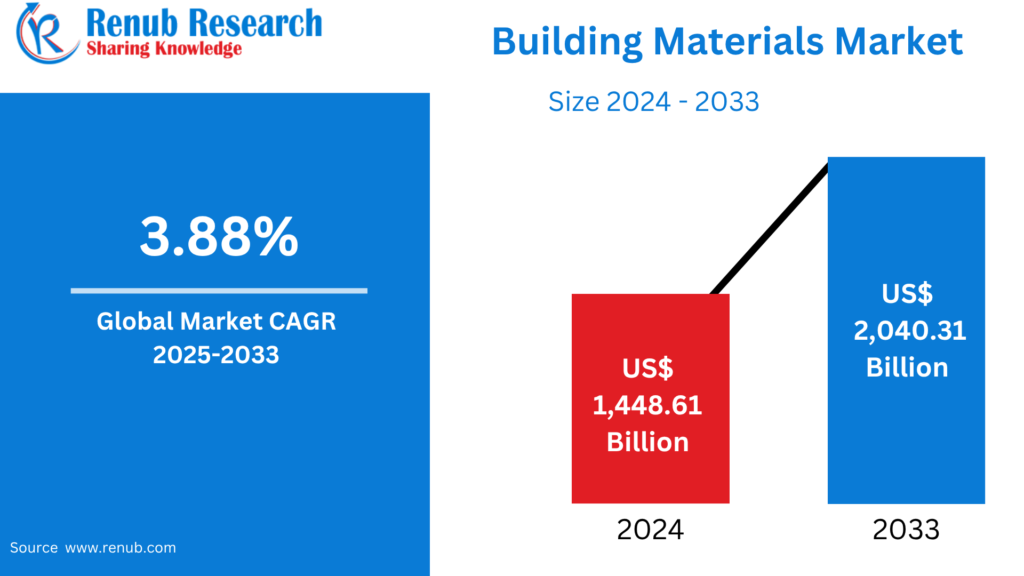
According to Renub Research global building materials market is entering a phase of steady and sustainable expansion, driven by rapid urbanization, large-scale infrastructure investments, and the accelerating shift toward environmentally responsible construction practices. In 2024, the market was valued at US$ 1,448.61 billion and is projected to reach US$ 2,040.31 billion by 2033, growing at a CAGR of 3.88% from 2025 to 2033.
This growth reflects the indispensable role of building materials in residential housing, commercial real estate, industrial facilities, and public infrastructure. As governments and private developers increasingly prioritize sustainability, energy efficiency, and technological integration, demand is shifting toward advanced, durable, and eco-friendly construction materials. Emerging economies, in particular, are acting as major growth engines due to population expansion, urban migration, and ambitious infrastructure development programs.
Request a free sample copy of the report:https://www.renub.com/request-sample-page.php?gturl=building-materials-market-p.php
Global Building Materials Market Outlook
Building materials form the backbone of construction activities worldwide. They include both natural materials such as wood, stone, sand, and clay, and manufactured products such as cement, concrete, steel, bricks, glass, and composites. Modern construction increasingly incorporates green and innovative materials, including recycled metals, engineered wood, insulated panels, and low-carbon alternatives designed to enhance energy efficiency and reduce environmental impact.
The global demand for building materials is expanding in line with rising urban populations, industrial growth, and infrastructure modernization. Emerging markets are witnessing particularly strong demand as housing shortages, transportation needs, and commercial expansion intensify. Simultaneously, the global transition toward sustainable architecture and green building standards is reshaping material preferences. Innovations such as self-healing concrete, modular construction components, and smart insulation systems are gaining traction, reflecting the industry’s evolution toward efficiency, durability, and sustainability.
As environmental regulations tighten and governments promote low-emission construction, advanced and eco-friendly building materials are becoming central to modern construction practices, reinforcing long-term market growth.
Request a free sample copy of the report:https://www.renub.com/request-sample-page.php?gturl=building-materials-market-p.php
Growth Drivers in the Global Building Materials Market
Urbanization and Infrastructure Development
Rapid urbanization is one of the most powerful drivers of the global building materials market. Developing regions across Asia, Africa, and Latin America are experiencing unprecedented urban growth, creating strong demand for residential housing, commercial complexes, and public infrastructure. Investments in roads, railways, airports, energy projects, and smart city initiatives require vast quantities of cement, steel, aggregates, and insulation materials.
Governments worldwide are allocating significant budgets toward infrastructure development to support economic growth and improve living standards. With more than half of the global population already residing in urban areas and this share expected to rise sharply by 2050, sustained demand for construction materials is assured over the long term.
Rising Demand for Sustainable and Green Materials
Environmental sustainability is increasingly influencing material selection in construction projects. Builders, developers, and policymakers are prioritizing materials that reduce carbon emissions, improve energy efficiency, and support circular economy principles. Products such as recycled aggregates, low-carbon cement, bamboo, fly-ash bricks, and insulated wall systems are gaining widespread acceptance.
Green building certifications, including LEED and BREEAM, encourage the adoption of eco-friendly materials, while government regulations and incentives further accelerate this transition. Innovation in sustainable materials is becoming a competitive differentiator for manufacturers, driving research and development investment across the building materials industry.
Technological Advancements in Construction Methods
Technological progress in construction is reshaping how building materials are designed, produced, and utilized. Modular construction, prefabrication, and 3D printing require specialized materials that are lightweight, high-performance, and easy to assemble. Digitalization and automation in manufacturing improve resource efficiency, reduce waste, and enhance quality control.
The growing adoption of smart buildings and AI-driven construction management systems is increasing demand for technologically compatible materials. High-performance insulation, advanced composites, and intelligent structural components are becoming integral to modern construction projects, supporting long-term market expansion.
Challenges in the Global Building Materials Market
Volatility in Raw Material Prices
Price volatility of key raw materials such as cement, steel, sand, and aggregates poses a major challenge for the building materials industry. Global supply chain disruptions, geopolitical tensions, and fluctuating energy prices significantly impact production costs. These fluctuations compress profit margins for manufacturers and increase project costs for developers.
Uncertainty around raw material availability complicates budgeting and long-term planning, particularly for large infrastructure projects. Managing cost volatility while maintaining supply reliability remains a critical challenge for industry participants.
Environmental Regulations and Carbon Emissions
Building materials such as cement and steel are among the largest contributors to global carbon emissions. As climate targets become more stringent, manufacturers face growing pressure to decarbonize operations. Compliance with environmental regulations requires substantial investment in clean technologies, alternative fuels, and process optimization.
While large corporations may adapt through scale and innovation, small and medium-sized enterprises may struggle with compliance costs. Additionally, stricter waste management and recycling regulations add complexity to supply chain planning, further challenging the industry.
Key Segments of the Global Building Materials Market
Global Building Aggregates Market
Aggregates, including sand, gravel, and crushed stone, are essential components of concrete, asphalt, and road construction. Demand is driven by large-scale infrastructure projects, urban development, and transportation expansion. Advances in recycled aggregates and improved processing technologies are enhancing sustainability and performance. Government support for construction waste recycling is further boosting demand for recycled aggregate solutions.
Global Cement Market
Cement remains a cornerstone of the building materials industry, widely used across residential, commercial, and infrastructure projects. Growth is supported by expanding construction activity in developing economies and infrastructure renewal in developed regions. Low-carbon and blended cement products are gaining popularity as manufacturers respond to environmental concerns. Despite emission challenges, ongoing innovation and public investment in housing and infrastructure sustain cement market growth.
Commercial Building Materials Market
The commercial construction segment includes offices, retail spaces, hospitals, hotels, and institutional buildings. Growth is driven by business expansion, tourism development, and urban commercialization. Commercial buildings demand high-quality, energy-efficient, and visually appealing materials. Smart building trends are increasing demand for advanced insulation, glass systems, HVAC-compatible materials, and sustainable interior finishes.
Residential Building Materials Market
Residential construction remains a key growth driver due to population growth, urbanization, and rising homeownership. Demand spans bricks, cement, wood, roofing, flooring, drywall, and plumbing materials. Green housing initiatives are encouraging the use of sustainable products such as insulated concrete blocks and solar roofing solutions. Renovation and remodeling activities in developed economies further support demand for interior and energy-efficient materials.
Regional Analysis of the Building Materials Market
United States Building Materials Market
The United States represents one of the most advanced building materials markets globally, supported by strong infrastructure spending, housing development, and renovation activity. Federal and state investments in transportation and energy infrastructure drive sustained material demand. Sustainability trends are increasing adoption of green building products, while modular construction and smart home technologies influence material selection.
Major investments by leading manufacturers are expanding production capacity to meet rising demand, reinforcing long-term market stability.
Germany Building Materials Market
Germany’s building materials market is characterized by strict efficiency standards, sustainability leadership, and advanced manufacturing capabilities. Strong demand for energy-efficient retrofitting, insulation materials, and eco-cement supports market growth. Government-backed infrastructure development and digital construction initiatives further stimulate demand. Germany’s focus on innovation and environmental responsibility positions it as a key European market.
India Building Materials Market
India is one of the fastest-growing building materials markets, driven by urbanization, industrial expansion, and large-scale government programs such as affordable housing and smart cities. Demand for cement, bricks, steel, and aggregates is robust across both urban and rural areas. While cost sensitivity remains a factor, rising awareness of green construction is gradually shifting demand toward sustainable products. Continued infrastructure investment ensures long-term market expansion.
Saudi Arabia Building Materials Market
Saudi Arabia’s construction sector is undergoing rapid transformation under Vision 2030, with mega-projects such as NEOM and The Line driving unprecedented demand for building materials. Cement, aggregates, glass, and prefabricated components are in high demand. Sustainability and innovation are central themes, with increasing adoption of energy-efficient and green materials. Government-backed housing and tourism infrastructure projects further position Saudi Arabia as a high-growth market.
Market Segmentation Overview
The global building materials market is segmented by type, application, and geography. By type, the market includes aggregates, cement, bricks, metals, and other materials. By application, it covers residential, commercial, and industrial construction. Geographically, the market spans North America, Europe, Asia Pacific, Latin America, and the Middle East & Africa, each exhibiting distinct growth patterns and regulatory environments.
Competitive Landscape and Key Players
The global building materials market is highly competitive, with multinational corporations and regional players competing through capacity expansion, innovation, and sustainability initiatives. Companies are evaluated based on overview, leadership, recent developments, SWOT analysis, and revenue performance.
Key players operating in the market include CEMEX, Boral Limited, Lafarge Holcim, Dyckerhoff AG, Buzzi Unicem SpA, CSR Limited, CRH Plc, Aditya Birla Group, Ambuja Cements, and USG Corporation.
Conclusion
The global building materials market is set for steady growth through 2033, supported by urbanization, infrastructure development, and the accelerating shift toward sustainable construction. While challenges such as raw material price volatility and environmental compliance persist, technological innovation and green material adoption are reshaping the industry. As construction activity expands worldwide and sustainability becomes a core priority, building materials will remain a critical pillar of global economic development, offering long-term opportunities for manufacturers, investors, and policymakers alike.