Concierge Medicine Market Size and Forecast 2025–2033
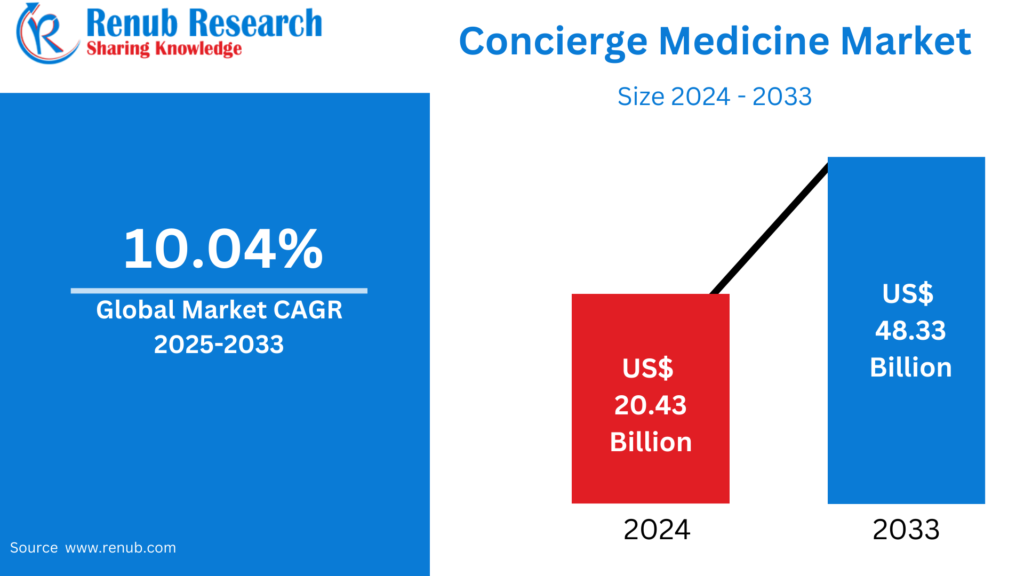
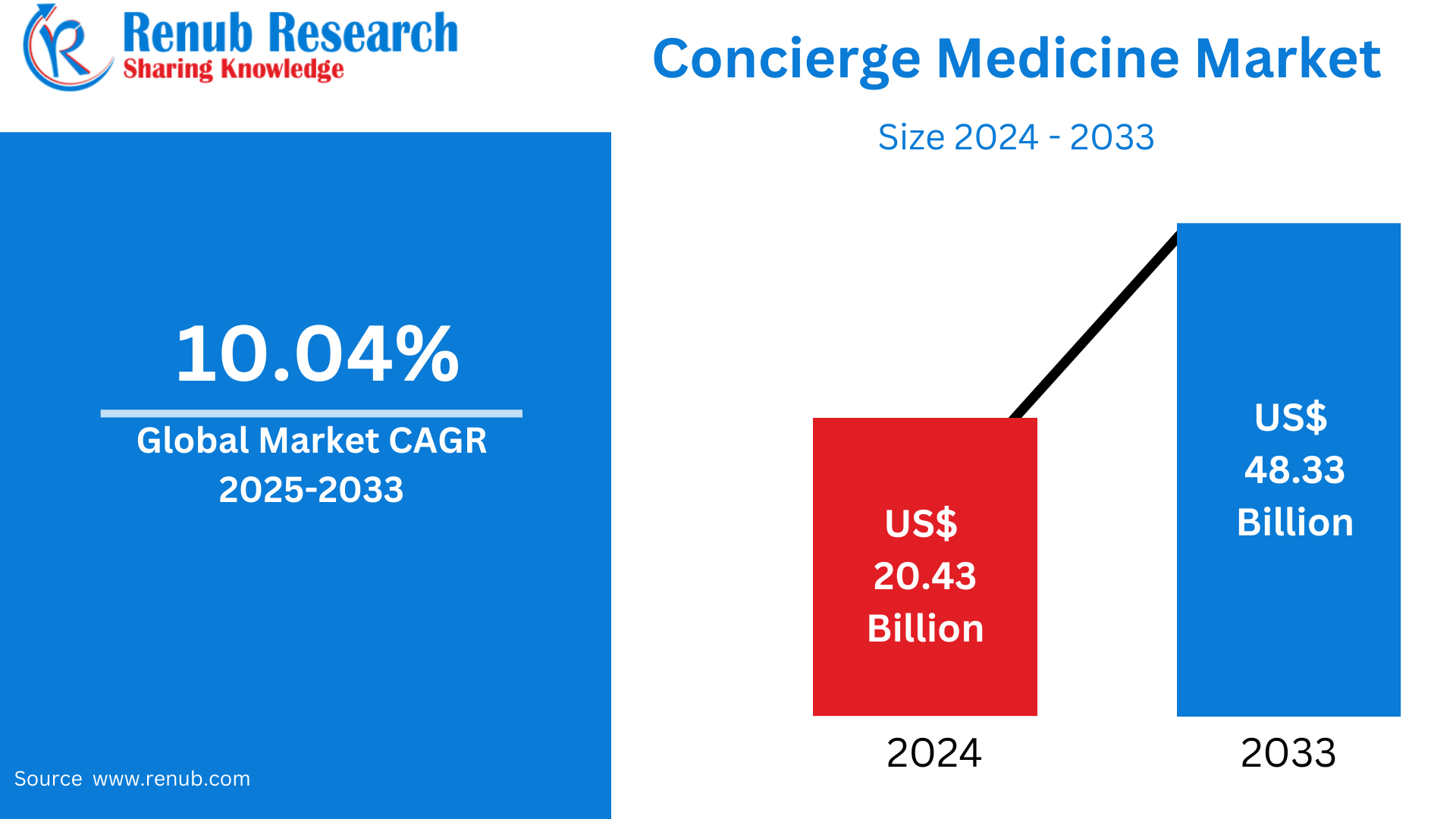
According to Renub Research global concierge medicine market is experiencing rapid and sustained growth as healthcare consumers increasingly seek personalized, accessible, and high-quality medical services. Valued at approximately US$ 20.43 billion in 2024, the market is projected to reach around US$ 48.33 billion by 2033, expanding at a robust compound annual growth rate (CAGR) of 10.04% between 2025 and 2033. This strong growth trajectory is largely driven by rising dissatisfaction with conventional healthcare systems, increasing physician burnout, a growing emphasis on preventive care, and higher willingness among patients to pay for premium healthcare experiences. Concierge medicine, typically offered through membership or retainer-based models, is steadily reshaping healthcare delivery across multiple regions and specialties.
Download Free Sample Report:https://www.renub.com/request-sample-page.php?gturl=concierge-medicine-market-p.php
Global Concierge Medicine Industry Overview
Concierge medicine is a healthcare delivery model in which patients pay a recurring membership or retainer fee in exchange for enhanced access to physicians and more personalized care. These services often include longer appointment times, same-day or next-day visits, 24/7 direct communication with doctors, comprehensive wellness planning, and proactive disease management. The model places a strong emphasis on quality, continuity, and prevention rather than high patient volumes.
Globally, the concierge medicine industry is expanding in response to systemic pressures within traditional healthcare systems. Long wait times, rushed consultations, fragmented care, and administrative complexity have led both patients and physicians to seek alternative models. Concierge medicine addresses these pain points by reducing patient panels and enabling deeper doctor–patient relationships. North America currently dominates the market due to high healthcare spending and a well-established private healthcare ecosystem, while Europe and parts of Asia-Pacific are witnessing steady adoption, particularly among affluent populations and expatriates. Advances in telehealth, remote monitoring, and digital health platforms are further enhancing the scalability and appeal of concierge medicine worldwide.
Growing Need for Preventive and Personalized Medical Care
One of the most important drivers of the concierge medicine market is the growing demand for preventive and personalized healthcare. Patients today are increasingly proactive about their health, seeking early detection of diseases, lifestyle counseling, and ongoing wellness management rather than episodic treatment. Concierge medicine aligns closely with this shift by offering customized care plans, regular health assessments, and continuous monitoring.
Longer consultation times allow physicians to understand patients’ medical histories, risk factors, and personal goals in greater depth. This enables tailored treatment strategies that focus on prevention, chronic disease management, and overall well-being. As healthcare systems globally transition from volume-based to value-based care models, concierge medicine stands out as an approach that prioritizes outcomes, patient satisfaction, and long-term health.
Growing Physician Burnout and Systemic Constraints in Healthcare
Physician burnout is a major structural issue contributing to the expansion of concierge medicine. In traditional healthcare settings, doctors often manage large patient volumes, face extensive administrative burdens, and have limited time for meaningful patient interaction. These pressures negatively impact both care quality and physician well-being.
Concierge medicine offers an alternative practice model by significantly reducing patient panel sizes and administrative complexity. Physicians gain greater autonomy, predictable income through membership fees, and improved work-life balance. This enables them to focus on delivering comprehensive and attentive care. As more healthcare professionals seek sustainable practice models, concierge medicine is increasingly viewed as a viable solution that benefits both providers and patients.
Growth in Health-Conscious and High-Income Populations
The concierge medicine market also benefits from the expansion of health-conscious and high-income populations, particularly in urban centers and developed economies. Rising disposable incomes and heightened awareness of preventive health have increased demand for premium medical services that offer convenience, exclusivity, and continuity of care.
Affluent individuals, busy professionals, and patients with complex or chronic conditions value features such as direct physician access, minimal waiting times, advanced diagnostics, and coordinated care. Time efficiency and personalized attention are key differentiators of concierge medicine for this demographic. As lifestyle-related diseases become more prevalent and wellness becomes a long-term priority, concierge medicine continues to attract patients willing to invest in superior healthcare experiences.
Expensive and Inaccessible Nature of Concierge Medicine
Despite strong growth, the concierge medicine market faces significant challenges related to affordability and accessibility. Membership fees, which can range from several hundred to several thousand dollars annually, are often not covered by insurance. This makes concierge care largely inaccessible to middle- and low-income populations, raising concerns about healthcare equity.
Critics argue that concierge medicine may exacerbate socioeconomic disparities by prioritizing patients based on their ability to pay. In regions with strained public healthcare systems, reduced physician availability due to smaller concierge patient panels may further intensify access issues. Without scalable pricing models, employer-sponsored programs, or partial insurance integration, affordability remains a major barrier to broader market penetration.
Regulatory and Ethical Concerns
Concierge medicine often operates within a complex and evolving regulatory landscape. In many countries, unclear guidelines regarding insurance compatibility, taxation of membership fees, licensing, and patient selection create legal uncertainty for providers. Ethical concerns also arise around prioritizing care for paying members, which may conflict with principles of equitable access to healthcare.
Policymakers and regulators continue to debate how concierge medicine should be integrated into existing healthcare frameworks. Addressing transparency, compliance, and ethical standards will be critical for long-term market acceptance. Clear regulatory structures could help legitimize the model while ensuring patient protection and system-wide balance.
Concierge Medicine Market Overview by Regions
The adoption and growth of concierge medicine vary significantly by region, influenced by healthcare infrastructure, income levels, cultural attitudes, and regulatory environments. North America leads the market, followed by Europe, while Asia-Pacific and the Middle East are emerging as high-potential regions.
United States Concierge Medicine Market
The United States represents the largest and most mature concierge medicine market globally. High healthcare costs, widespread dissatisfaction with traditional care delivery, and a strong private healthcare sector have fueled rapid adoption. Concierge practices are particularly popular among high-income individuals, executives, and patients managing chronic conditions.
Physicians in the U.S. are increasingly transitioning to concierge models to combat burnout and regain control over their practices. While demand is strong, high membership costs and limited insurance coverage remain barriers to widespread adoption. Nevertheless, continued interest from both patients and providers positions the U.S. as the primary growth engine for the global market.
Germany Concierge Medicine Market
Germany’s concierge medicine market is still in a nascent but gradually expanding phase. The country’s robust public healthcare system limits the overall size of the concierge segment, as basic care is widely accessible. However, long wait times and limited appointment availability have driven demand for premium alternatives among affluent individuals.
Concierge services in Germany are mainly concentrated in major cities and often target private insurance holders, executives, and international patients. Cultural emphasis on healthcare equality and regulatory complexity present growth challenges, but rising health awareness and medical tourism support niche market development.
India Concierge Medicine Market
India’s concierge medicine market is emerging, driven by increasing disposable incomes, expanding private healthcare infrastructure, and growing awareness of personalized care. Demand is strongest among affluent urban populations, high-net-worth individuals, and busy professionals in metropolitan areas.
Challenges include limited awareness, affordability constraints, and fragmented regulations. Public healthcare remains the primary option for most citizens, restricting concierge medicine to a relatively small segment. However, India’s rapidly growing digital health ecosystem and rising focus on preventive care create long-term growth opportunities.
Saudi Arabia Concierge Medicine Market
Saudi Arabia’s concierge medicine market is gaining momentum, supported by healthcare reforms under Vision 2030 and rising demand for premium medical services. Affluent citizens and expatriates are increasingly seeking personalized, convenient care, particularly for chronic disease management and wellness.
Concierge services are primarily concentrated in major cities and target high-income populations. While high costs and regulatory hurdles remain challenges, continued government investment in healthcare modernization and private sector participation signal strong future growth potential.
Recent Developments in the Concierge Medicine Industry
The concierge medicine industry continues to evolve through strategic expansions, leadership changes, and increased investment activity. Notable developments include leadership restructuring at One Medical following its acquisition by Amazon, signaling reassessment of concierge strategies. Elite Concierge Medicine’s expansion through new facilities highlights growing demand for membership-based care, while increased healthcare transactions in Asia-Pacific reflect rising investor confidence in premium outpatient and concierge healthcare models.
Market Segmentation by Ownership and Application
The concierge medicine market is segmented by ownership into group practices and standalone practices. Group-based models are gaining traction due to scalability, shared resources, and brand recognition, while standalone practices offer highly personalized, physician-led experiences.
By application, primary care dominates the market, followed by internal medicine, pediatrics, cardiology, psychiatry, osteopathy, and other specialties. Primary care concierge services serve as the foundation for preventive care and chronic disease management, while specialty concierge offerings are expanding to address complex and long-term conditions.
Competitive Landscape and Key Players
The global concierge medicine market features a mix of established providers, specialty firms, and innovative healthcare startups. Key players include MDVIP, SignatureMD, Crossover Health, Castle Connolly Private Health Partners, Concierge Choice Physicians, Specialdocs Consultants, PartnerMD, Sollis Health, One Medical, and Forward.
These companies are evaluated across multiple dimensions, including business overview, leadership, recent developments, SWOT analysis, and revenue performance. Competition is increasingly centered on service quality, geographic expansion, digital integration, and the ability to deliver scalable yet personalized care.
Future Outlook of the Concierge Medicine Market
The concierge medicine market is expected to continue its strong growth through 2033, supported by rising consumer expectations, physician demand for sustainable practice models, and the integration of digital health technologies. While affordability and regulatory challenges remain, innovative pricing structures, employer partnerships, and hybrid care models may broaden accessibility over time.
As healthcare systems worldwide struggle to balance efficiency, quality, and patient satisfaction, concierge medicine is likely to remain a prominent and influential model, particularly in preventive, primary, and specialized care segments.