
Copper Market Size and Forecast
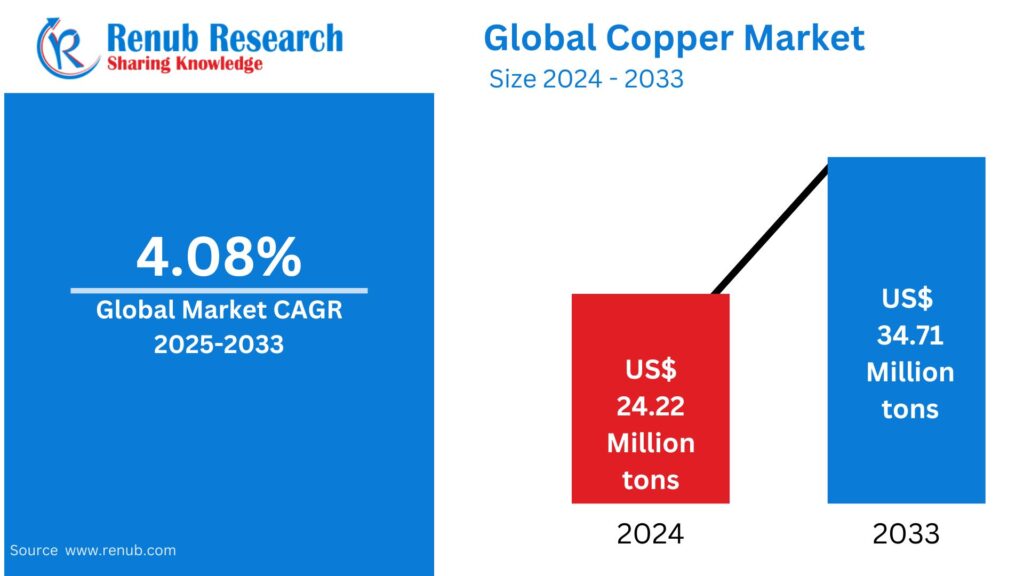
According to Renub Research Copper Market is projected to reach US$ 34.71 million tons by 2033, growing from US$ 24.22 million tons in 2024, at a CAGR of 4.08% between 2025 and 2033. Global demand for copper continues to expand due to its indispensable role in construction, electrical systems, electronics, renewable energy, electric vehicles, and industrial manufacturing. Copper’s exceptional electrical conductivity, durability, and corrosion resistance make it a cornerstone material in modern infrastructure and technological development. With global electrification trends intensifying and countries investing heavily in infrastructure, smart cities, renewable power grids, and transport electrification, the copper market is positioned for sustained, long-term growth.
Copper Industry Overview
The copper industry plays a pivotal role in supporting global industrial progress. Copper is fundamental to power generation, electrical transmission, automotive manufacturing, industrial machinery, telecommunications, HVAC systems, and plumbing. Rapid urbanization, industrialization, and infrastructure development across emerging and developed economies significantly fuel market expansion. Construction remains one of the largest consumers of copper, as residential, commercial, and industrial projects rely extensively on copper wiring, pipes, roofing materials, and heating and cooling systems.
The global transition toward renewable energy systems is another major driver. Solar panels, wind turbines, power storage solutions, and electricity distribution networks require high-performance copper components to maintain efficiency and reliability. Similarly, copper demand is rising sharply in electric vehicles, which require substantially more copper than conventional vehicles, particularly in batteries, charging infrastructure, and motors.
Technological advancements in digitalization, automation, smart manufacturing, and electronics also increase copper utilization. From smartphones and computers to data centers and communication systems, copper is essential for connectivity and performance. While the industry experiences challenges such as price fluctuations, environmental concerns, and mining constraints, innovation in recycling, efficient production, and sustainable mining practices helps support long-term industry stability.
Download Free Sample Report:https://www.renub.com/request-sample-page.php?gturl=copper-market-p.php
Key Factors Driving the Copper Market Growth
Rising Demand in Electrical and Electronics Applications
Copper is the backbone of the global electrical and electronics industry. Its superior electrical conductivity, thermal properties, and reliability make it indispensable for wiring, motors, transformers, circuit boards, power transmission lines, telecommunication networks, and high-performance electronic devices. The rapid expansion of consumer electronics, data centers, smart devices, 5G infrastructure, automation, and digital transformation significantly strengthens copper demand.
Electric vehicles and renewable power installations rely heavily on copper components to maintain highly efficient energy transfer and safe performance. As industries embrace automation and smart technologies, the demand for high-quality copper continues to accelerate. With global electrification initiatives increasing, copper remains irreplaceable in powering modern economies.
Infrastructure Development and Urbanization
Urbanization is reshaping the global demand outlook for copper. Massive infrastructure investments across Asia-Pacific, North America, Europe, Latin America, and the Middle East require copper for commercial buildings, residential housing, public facilities, rail networks, highways, water systems, electrical grids, and smart city infrastructure. In construction, copper is used in plumbing, wiring, roofing, and HVAC systems, offering reliability, longevity, and safety.
Governments worldwide are prioritizing urban development, modernization, and infrastructure upgrades to support economic growth, population expansion, and industrial development. As cities expand and modernize, copper consumption naturally rises, reinforcing the market’s long-term growth potential.
Growth of Renewable Energy and Electric Vehicles
The accelerating global shift toward clean energy, sustainability, and low-carbon technologies is one of the strongest growth drivers for the copper market. Renewable energy infrastructure such as solar power installations, wind farms, grid expansion projects, power storage solutions, charging networks, and microgrids require large amounts of copper due to its efficiency in conducting electricity.
Electric vehicles significantly increase copper demand as they require more copper components than traditional combustion engine vehicles. Copper is extensively used in EV motors, batteries, inverters, wiring, and charging stations, making it a vital material supporting transportation electrification. Strong government incentives, environmental regulations, and consumer adoption trends further elevate copper consumption in the green energy ecosystem.
Challenges in the Copper Market
Price Volatility and Supply Constraints
Copper market prices experience fluctuations due to supply-demand imbalances, geopolitical tensions, economic uncertainty, and production disruptions. Mining strikes, transportation barriers, high production costs, and dependency on a few major producing regions can intensify volatility. Price instability impacts manufacturers, infrastructure planners, and industrial users, influencing profitability and investment decisions. Managing stable copper supply chains remains a critical challenge for the industry.
Environmental and Regulatory Challenges
Copper mining and refining are energy-intensive processes that may contribute to environmental concerns such as pollution, waste generation, and greenhouse gas emissions. Increasingly strict environmental regulations, sustainability expectations, and community pressures require mining companies to adopt greener, safer, and more sustainable practices. Compliance costs, operational delays, and regulatory approvals can affect production output and profitability. However, advancements in eco-friendly mining technologies and strong emphasis on recycling help address these challenges.
Copper Market Overview by Regions
United States Copper Market
The United States represents a major copper consumer driven by construction, infrastructure modernization, electrical systems, manufacturing, renewable energy, and electric vehicles. Federal infrastructure programs, housing development, smart city initiatives, and expanding renewable power installations strengthen copper demand. EV growth, combined with strong industrial production and technological advancements, positions the U.S. as one of the strongest copper markets in North America.
United Kingdom Copper Market
The United Kingdom copper market benefits from increasing infrastructure investments, sustainable building initiatives, electric vehicle adoption, and modernization projects. Copper remains essential for electrical systems, construction applications, telecommunications expansion, and renewable energy projects. With strong focus on sustainability, energy efficiency, and technological innovation, the U.K. continues to generate promising demand prospects for copper producers.
China Copper Market
China is one of the world’s largest consumers and producers of copper, driven by rapid industrialization, urbanization, construction, power infrastructure expansion, manufacturing growth, EV adoption, and renewable energy deployment. Massive investments in smart cities, power grids, transportation, and digital infrastructure significantly fuel copper consumption. Government policies promoting clean energy and advanced manufacturing ensure China remains a key global market contributor.
United Arab Emirates Copper Market
The UAE copper market is experiencing stable growth supported by infrastructure megaprojects, real estate development, industrial expansion, smart buildings, renewable power projects, and electrification initiatives. Copper remains critical for wiring, power systems, plumbing, and energy-efficient construction. The UAE’s growing automotive, electronics, and renewable energy sectors continue to strengthen demand outlook, positioning it as an important Middle Eastern copper hub.
Recent Developments in the Copper Industry
The copper sector continues to witness strategic expansions and partnerships to meet growing global demand. A major milestone includes the development of the world’s largest copper smelter in India, scheduled to begin operations in 2025, enhancing global production capacity and strengthening supply chains. Additionally, leading companies are entering long-term agreements to ensure consistent copper supply, improve recycling efficiency, and support sustainable production to meet industrial demand.
Copper Market Segmentation
By Type
Primary Copper
Secondary Copper
By Product
Wire
Rods, Bars and Sections
Flat Rolled Products
Tube
Foil
By End Use
Industrial Equipment
Transport
Infrastructure
Building and Construction
Consumer and General Products
Others
Regional Outlook
North America (United States, Canada)
Europe (France, Germany, Italy, Spain, United Kingdom, Belgium, Netherlands, Turkey)
Asia Pacific (China, Japan, India, South Korea, Thailand, Malaysia, Indonesia, Australia, New Zealand)
Latin America (Brazil, Mexico, Argentina)
Middle East and Africa (Saudi Arabia, United Arab Emirates, South Africa)
Competitive Landscape and Key Players
The copper market is highly competitive with leading global mining corporations, smelting companies, and suppliers focusing on technological advancement, sustainable production, capacity expansion, and strategic partnerships. Major companies include:
Teck Resources Limited
Jiangxi Copper Corporation
Aurubis AG
KGHM
Rio Tinto
Codelco
Glencore
BHP
Anglo American
Antofagasta plc
Future Outlook of the Copper Market
The global Copper Market outlook remains optimistic as infrastructure growth, renewable energy expansion, industrial automation, EV production, and digital transformation continue to intensify global copper consumption. Increasing investments in sustainable mining, advancements in recycling technologies, and expanding production capabilities will support stable market growth. With electrification trends shaping the future economy, copper will remain one of the most critical industrial materials worldwide, ensuring consistent demand and long-term market opportunities across multiple sectors.