Fiberglass Pipes Market Size and Forecast 2025–2033
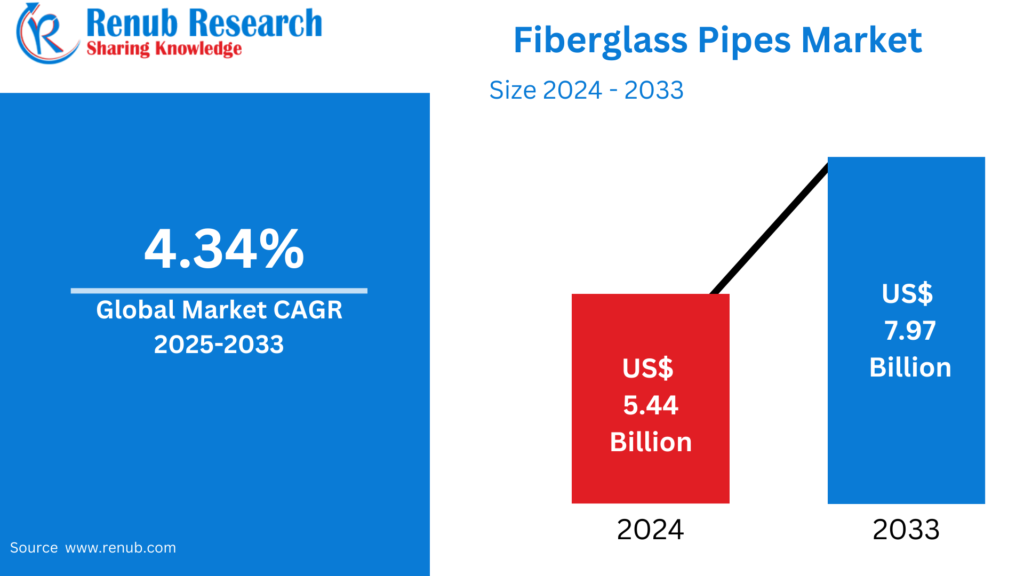
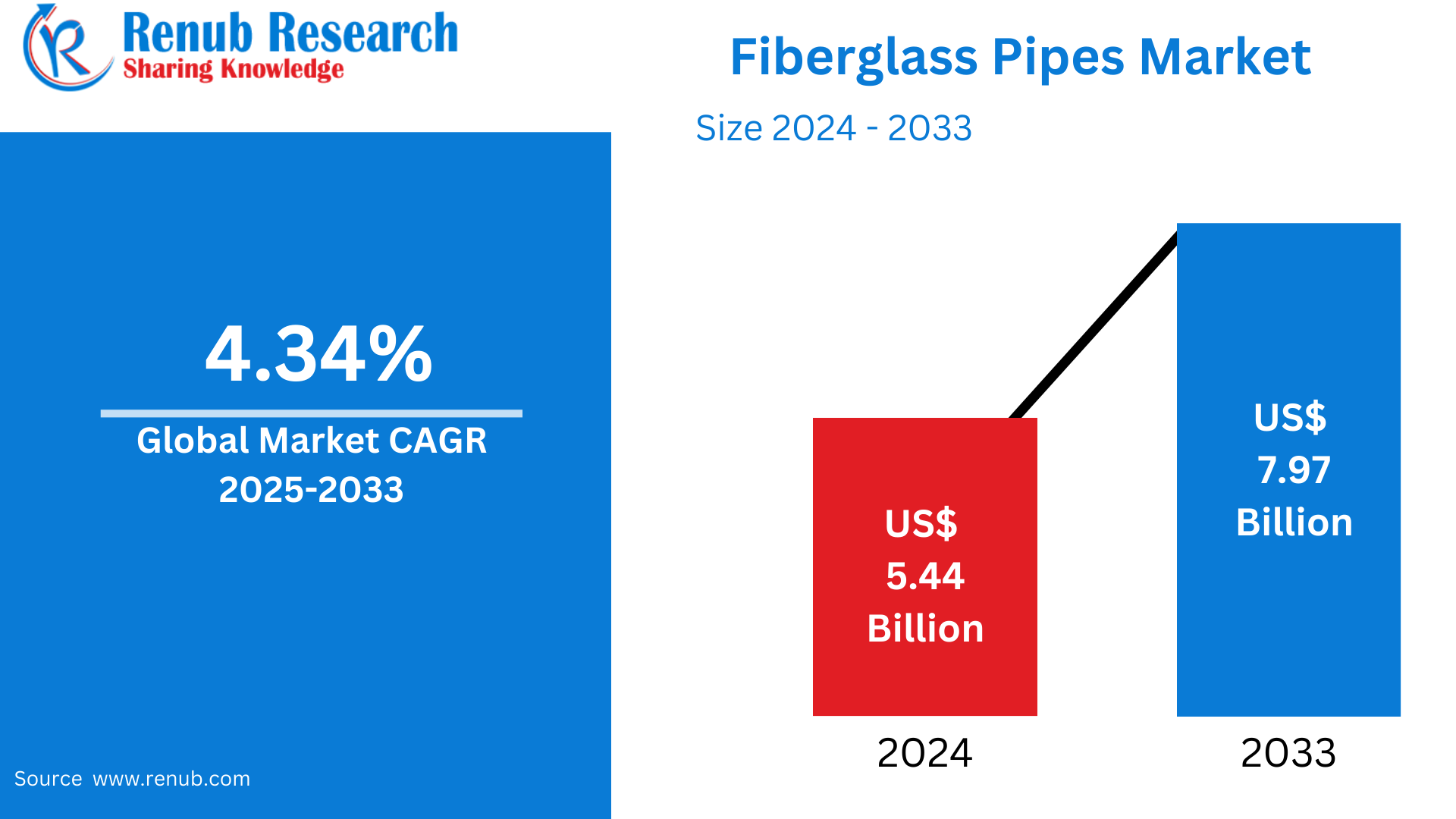
According To Renub Research global fiberglass pipes market is projected to experience steady growth over the forecast period, supported by rising demand from industries that require durable, corrosion-resistant, and lightweight piping solutions. In 2024, the market was valued at approximately US$ 5.44 billion and is expected to reach nearly US$ 7.97 billion by 2033, expanding at a compound annual growth rate of 4.34% between 2025 and 2033. This growth is primarily driven by increasing applications in oil and gas, chemical processing, water and wastewater treatment, and irrigation infrastructure. Compared to traditional metal pipes, fiberglass pipes offer superior performance in harsh operating environments, making them a preferred choice for long-term infrastructure investments.
Global Fiberglass Pipes Market Outlook
Fiberglass pipes, commonly referred to as fiberglass-reinforced plastic (FRP) pipes, are composite structures manufactured using a polymer resin reinforced with glass fibers. Resins such as polyester, vinyl ester, and epoxy are typically used to bind the fibers, resulting in pipes that combine strength, flexibility, and durability. These pipes are widely recognized for their excellent strength-to-weight ratio, resistance to corrosion, and long operational lifespan.
Unlike metal pipes, fiberglass pipes do not rust, pit, or corrode when exposed to aggressive chemicals, moisture, or saline environments. This makes them especially suitable for industries where corrosion-related failures can lead to costly downtime and safety risks. Their lightweight nature also simplifies transportation and installation, reducing overall project costs. As industries focus more on lifecycle cost efficiency rather than just initial investment, fiberglass pipes are increasingly being adopted as a reliable alternative to conventional piping materials.
Download Free Sample Report:https://www.renub.com/request-sample-page.php?gturl=fiberglass-pipes-market-p.php
Applications Across End-Use Industries
Fiberglass pipes are used extensively across a wide range of industries due to their versatility and performance reliability. In the oil and gas sector, they are used to transport corrosive fluids, hydrocarbons, and produced water in both onshore and offshore environments. In chemical processing plants, fiberglass pipes handle aggressive chemicals and high-temperature liquids without degrading over time.
The water and wastewater treatment sector is another major end user, utilizing fiberglass pipes for raw water conveyance, treated water distribution, and sewage systems. Their smooth internal surfaces reduce friction losses and prevent sediment buildup, improving flow efficiency. Fiberglass pipes are also widely used in irrigation systems, marine applications, power generation, and desalination plants, where resistance to corrosion and low maintenance requirements are critical.
Increased Demand from the Oil and Gas Sector
The oil and gas industry remains one of the largest consumers of fiberglass pipes, driven by the need for corrosion-resistant and high-strength piping systems. Fiberglass pipes perform particularly well in environments where exposure to saltwater, chemicals, and extreme temperatures would rapidly degrade steel or other metal pipes. Their use is common in gathering lines, injection lines, produced water pipelines, and offshore platform installations.
Global energy demand continues to rise, leading to increased exploration, drilling, and production activities. This expansion is generating sustained demand for durable pipeline infrastructure that can operate reliably over long periods. Fiberglass pipes offer extended service life and lower maintenance costs, making them a cost-effective solution for oil and gas operators seeking to optimize long-term operational efficiency.
Infrastructure Development in Emerging Economies
Rapid urbanization and infrastructure development in emerging economies are key drivers of growth in the fiberglass pipes market. Countries across Asia-Pacific, the Middle East, and parts of Latin America are investing heavily in water supply systems, sewage networks, industrial facilities, and energy infrastructure. Fiberglass pipes are increasingly preferred in these projects due to their longevity, ease of installation, and resistance to chemical and environmental degradation.
Government initiatives aimed at improving sanitation, clean water access, and industrial capacity are accelerating demand for advanced piping materials. In regions with challenging soil conditions, extreme temperatures, or high salinity, fiberglass pipes provide a reliable solution that reduces long-term maintenance and replacement costs. As infrastructure spending continues to rise, particularly in developing nations, fiberglass pipes are expected to play a vital role in modern construction and utility projects.
Technological Advancements and Product Innovation
Ongoing advancements in manufacturing technology and materials science are enhancing the performance and application range of fiberglass pipes. Innovations have led to the development of specialized products such as Glass Reinforced Epoxy (GRE) and Glass Reinforced Plastic (GRP) pipes, which offer improved pressure resistance, thermal stability, and mechanical strength.
Automation in production processes has improved consistency, reduced defects, and lowered manufacturing costs. At the same time, customization capabilities allow manufacturers to tailor fiberglass pipes to specific industry requirements, including desalination, power generation, and chemical processing. As industries demand smarter and more efficient pipeline systems, continuous product development is expected to further boost adoption of fiberglass piping solutions.
High Initial Cost and Installation Complexity
Despite their long-term advantages, fiberglass pipes face challenges related to higher initial costs compared to traditional materials such as steel, ductile iron, or PVC. The upfront investment required for fiberglass pipes can be a barrier for small-scale projects or cost-sensitive markets, even though lifecycle costs are typically lower due to reduced maintenance and longer service life.
Installation also requires skilled labor and specialized equipment to ensure proper handling, jointing, and alignment. In regions where technical expertise is limited, this can increase project complexity and costs. These factors may slow adoption in certain markets, particularly where short-term cost considerations outweigh long-term performance benefits.
Environmental and Recycling Challenges
While fiberglass pipes offer durability and corrosion resistance, environmental concerns present another challenge for the industry. The manufacturing process involves non-renewable raw materials and can generate volatile organic compound emissions. Additionally, recycling fiberglass pipes is complex due to their composite structure, making end-of-life disposal more challenging compared to single-material products.
As environmental regulations become stricter worldwide, manufacturers are under pressure to adopt more sustainable production practices and develop viable recycling or reuse solutions. Research into alternative resins, cleaner manufacturing processes, and innovative recycling technologies is ongoing, and progress in these areas will be critical for the long-term sustainability of the fiberglass pipes market.
Fiberglass GRE Pipes Market
Glass Reinforced Epoxy pipes represent a high-performance segment within the fiberglass pipes market. GRE pipes are known for their excellent corrosion resistance, high pressure tolerance, and thermal stability, making them ideal for demanding applications in oil and gas, chemical processing, and marine environments.
Their lightweight construction reduces transportation and installation costs, while their mechanical strength ensures reliable operation in harsh conditions. GRE pipes are increasingly favored in offshore installations and high-temperature applications where traditional materials may fail or require frequent maintenance. As industries continue to seek durable solutions for extreme environments, demand for GRE pipes is expected to grow steadily.
E-Glass Fiberglass Pipes Market
E-glass fiberglass pipes utilize electrical-grade glass fibers that provide strong mechanical performance and excellent insulation properties. These pipes are commonly used in applications requiring both chemical resistance and non-conductivity, such as electrical infrastructure, telecommunications, and chemical plants.
The combination of corrosion resistance, strength, and lightweight design makes E-glass fiberglass pipes an attractive alternative to metal piping systems. As industries prioritize efficiency and safety, E-glass-based solutions are gaining wider acceptance across multiple end-use sectors.
Oil and Gas Fiberglass Pipes Market
In oil and gas operations, fiberglass pipes are valued for their resistance to corrosion, low maintenance requirements, and long service life. They are used in gathering systems, injection lines, produced water pipelines, and offshore facilities. The ability to withstand corrosive fluids and harsh environmental conditions makes fiberglass pipes especially suitable for both upstream and downstream operations.
As exploration activities expand into deeper and more challenging environments, the need for high-performance piping solutions continues to rise. Fiberglass pipes meet these requirements while offering cost advantages over the full lifecycle, supporting continued growth in this segment.
Sewage Fiberglass Pipes Market
Sewage and wastewater treatment systems increasingly rely on fiberglass pipes due to their resistance to chemical, biological, and microbial degradation. These pipes maintain structural integrity under continuous flow conditions and varying pH levels, reducing the risk of leaks and failures.
Their smooth internal surfaces improve hydraulic performance and minimize sediment buildup, lowering maintenance costs over time. With growing investments in urban sanitation and wastewater infrastructure, particularly in developing regions, fiberglass pipes are becoming a preferred choice for sewage applications.
Irrigation Fiberglass Pipes Market
Fiberglass pipes are well suited for irrigation systems, especially in agricultural regions that require durable and efficient water distribution networks. Their resistance to fertilizers, chemicals, and ultraviolet radiation ensures reliable long-term performance in outdoor environments.
Lightweight construction simplifies installation across large agricultural areas, while reduced leakage improves water-use efficiency. As global food demand rises and precision agriculture gains traction, fiberglass pipes are expected to play an increasingly important role in modern irrigation infrastructure.
United States Fiberglass Pipes Market
The United States fiberglass pipes market is technologically advanced and well established, with strong demand from oil and gas, chemical processing, water management, and industrial infrastructure sectors. Efforts to replace aging pipelines and promote corrosion-resistant materials are key growth drivers.
Government investment in water and wastewater infrastructure, along with growing interest in sustainable and long-lasting materials, continues to support market expansion. Strong research and development capabilities and the presence of major manufacturers further strengthen the U.S. market outlook.
France Fiberglass Pipes Market
France’s fiberglass pipes market is supported by demand from municipal water supply, wastewater treatment, and energy sectors. The country’s focus on sustainable urban development and environmentally responsible construction is driving adoption of corrosion-resistant and long-life piping systems.
Fiberglass pipes are increasingly used in smart water networks and renewable energy projects, including geothermal and hydropower systems. Regulatory support for green construction and energy efficiency further encourages the use of advanced composite materials.
India Fiberglass Pipes Market
India is emerging as a high-growth market for fiberglass pipes due to rapid urbanization, infrastructure expansion, and agricultural development. Government initiatives focused on water supply, sanitation, and irrigation are generating strong demand for durable and cost-effective piping solutions.
Fiberglass pipes offer advantages in regions with challenging soil and climatic conditions, making them suitable for long-term infrastructure projects. Growing domestic manufacturing capacity and partnerships with global players are improving product availability and affordability, supporting sustained market growth.
Saudi Arabia Fiberglass Pipes Market
Saudi Arabia is a key market for fiberglass pipes, particularly in oil and gas, water infrastructure, and desalination projects. Harsh desert conditions and corrosive environments make fiberglass pipes an ideal choice for long-term reliability.
National development programs focused on industrial diversification and infrastructure expansion are increasing investment in sectors where fiberglass pipes perform well. Growth in domestic production capacity and continued emphasis on reducing maintenance costs further strengthen the market outlook in Saudi Arabia.
Market Segmentation and Competitive Landscape
The fiberglass pipes market is segmented by product type, fiber type, end-use industry, and geography. Product segments include GRE pipes, GRP pipes, and other specialized variants. Fiber types include E-glass, T-glass, S-glass, R-glass, and others. Major end-use industries include oil and gas, chemicals, sewage, irrigation, and additional industrial applications.
The competitive landscape features established global and regional players such as PPG Industries, Inc., Future Pipe Industries, Saudi Arabian Amiantit Co, and Amiblu Holding GmbH. These companies focus on capacity expansion, technological innovation, and strategic partnerships to strengthen their market positions. As demand for durable and corrosion-resistant piping solutions continues to rise, competition in the fiberglass pipes market is expected to intensify, supporting long-term growth and innovation.