Global Lawn Mowers Market Overview
According To Renub Research global lawn mowers market is an essential segment of the broader outdoor power equipment and landscaping industry, supporting the maintenance of residential gardens, public parks, sports fields, golf courses, and commercial landscapes. Lawn mowers are designed to ensure uniform grass cutting, enhance visual appeal, and promote healthy turf growth by preventing overgrowth and weed spread. Over time, these machines have evolved from basic manual tools into advanced, technology-driven systems incorporating automation, electric propulsion, and intelligent navigation.
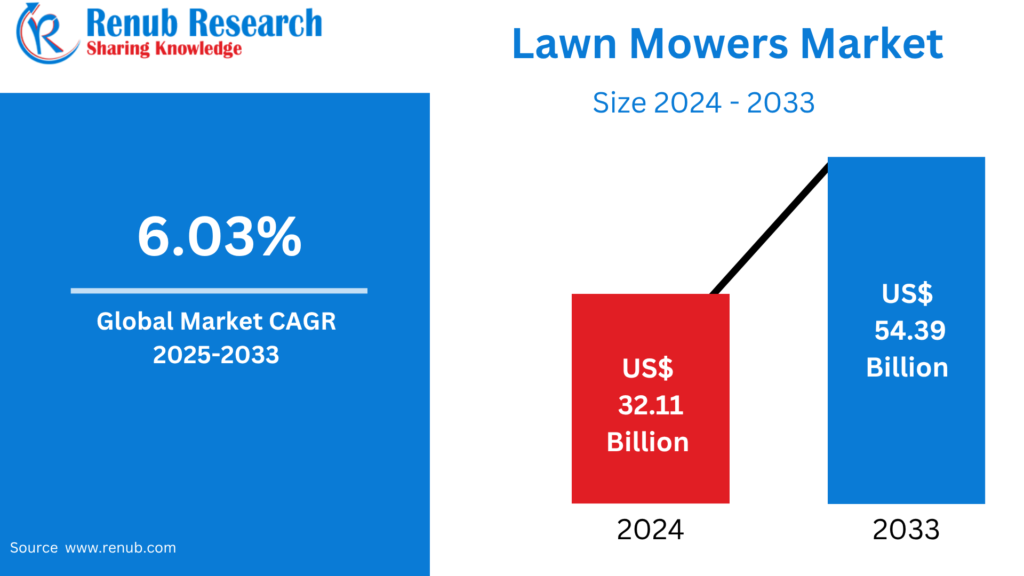
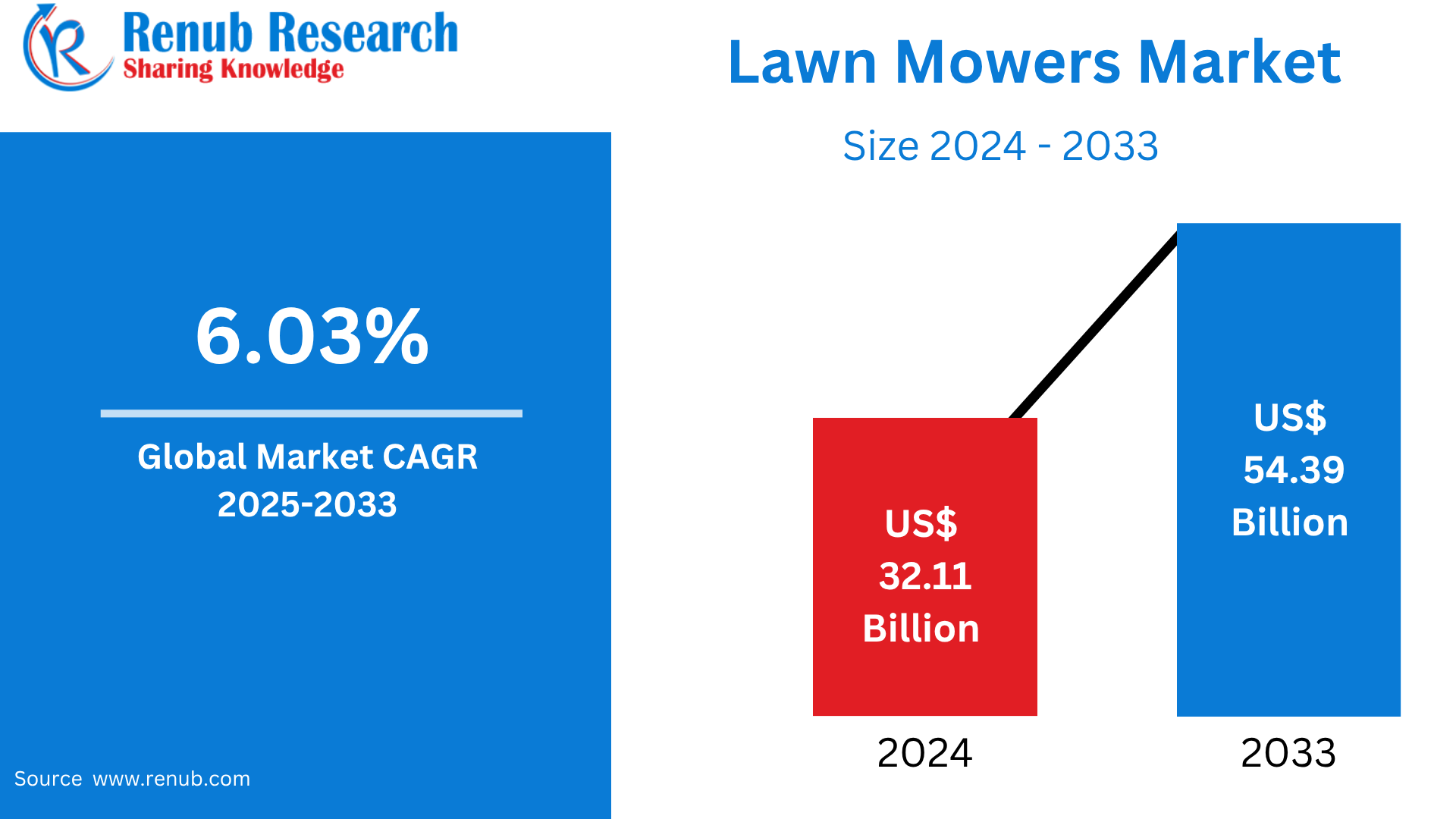
The market is projected to grow from US$ 32.11 billion in 2024 to approximately US$ 54.39 billion by 2033, registering a compound annual growth rate of 6.03 percent between 2025 and 2033. This growth is driven by increasing urbanization, rising interest in home gardening and lawn care, and significant technological advancements in electric and robotic lawn mower solutions. Both residential and commercial landscaping applications are contributing to the expanding global demand.
Importance of Lawn Mowers in Modern Landscaping
Lawn mowers play a crucial role in maintaining green spaces that enhance environmental quality and urban aesthetics. Properly maintained lawns contribute to improved air quality, temperature regulation, and recreational value in urban environments. In residential settings, lawn care is often associated with property value and personal satisfaction, while in commercial and public spaces, it reflects organizational image and community standards.
Modern lawn mowers offer features such as adjustable cutting heights, mulching, grass collection, and energy-efficient operation. These enhancements make lawn maintenance more effective and accessible, even for users with limited technical expertise. As green spaces continue to expand globally, lawn mowers remain indispensable tools for sustainable landscape management.
Download Free Sample Report:https://www.renub.com/request-sample-page.php?gturl=lawn-mowers-market-p.php
Urbanization and Expansion of Green Spaces
Rapid urbanization is a key factor fueling growth in the global lawn mowers market. As cities expand, the development of residential complexes, public parks, corporate campuses, and recreational facilities increases the need for regular lawn maintenance. Urban planners and real estate developers increasingly integrate green spaces into modern infrastructure to improve quality of life and environmental sustainability.
Suburban housing growth, particularly in developed economies, has also increased the number of private lawns requiring routine care. Municipal authorities invest in landscaping equipment to maintain public spaces efficiently, further supporting demand for professional-grade lawn mowers. This ongoing expansion of urban and semi-urban green areas continues to generate consistent market growth.
Rising Interest in Gardening and DIY Lawn Care
The growing popularity of gardening as a hobby has significantly influenced the global lawn mowers market. Homeowners are increasingly interested in maintaining their lawns independently, driven by cost savings, convenience, and personal enjoyment. The do-it-yourself lawn care culture is particularly strong in North America and Europe, where individual homeownership and garden spaces are common.
Social media platforms, home improvement shows, and online tutorials have further encouraged consumers to invest in lawn care equipment. As a result, demand for compact, user-friendly, and affordable lawn mowers has increased. Electric and cordless models, in particular, appeal to DIY users due to their ease of operation and lower maintenance requirements.
Technological Advancements and Automation
Technological innovation is transforming the lawn mowers market, with automation and smart features becoming increasingly prominent. Robotic and autonomous lawn mowers represent one of the fastest-growing segments, offering hands-free operation, precision cutting, and time-saving benefits. These mowers use sensors, GPS, artificial intelligence, and Internet of Things technologies to navigate lawns, avoid obstacles, and optimize cutting patterns.
Battery-powered and electric lawn mowers are also gaining popularity as alternatives to internal combustion engine models. These machines offer quieter operation, reduced emissions, and lower operating costs. Continuous improvements in battery technology are enhancing runtime and performance, making electric mowers suitable for a wider range of lawn sizes and applications.
Environmental Concerns and Sustainability Trends
Environmental awareness is reshaping consumer preferences and regulatory frameworks within the lawn mowers market. Gas-powered mowers face increasing scrutiny due to emissions, fuel consumption, and noise pollution. Governments in several regions have introduced stricter emission standards, encouraging the adoption of cleaner alternatives.
Electric and robotic lawn mowers align well with sustainability goals by reducing carbon footprints and noise levels. Manufacturers are investing in energy-efficient motors, recyclable materials, and eco-friendly designs to meet regulatory requirements and consumer expectations. While the transition involves higher research and development costs, sustainability remains a powerful long-term driver for market evolution.
Seasonal Demand and Market Limitations
Despite strong growth prospects, the lawn mowers market faces challenges related to seasonality and weather dependency. Demand is typically highest during spring and summer, when grass growth peaks. Harsh winters, prolonged droughts, or excessive rainfall can disrupt mowing schedules and impact sales volumes.
In regions with limited lawn areas or arid climates, mowing requirements may be lower, restricting market potential. These factors create fluctuations in revenue for manufacturers and retailers, making inventory management and forecasting more complex. Addressing seasonal variability remains a key operational challenge across the industry.
Global Lawn Mowers Market by Offering
By offering, the market is divided into hardware and software components. Hardware includes essential mechanical and structural elements such as blades, motors, cutting decks, wheels, frames, and power systems. Continuous innovation in materials, including reinforced plastics and corrosion-resistant metals, is improving durability and performance.
Software is becoming increasingly relevant, particularly in robotic lawn mowers. Software solutions enable navigation, scheduling, diagnostics, and integration with smart home systems. As automation advances, software capabilities are expected to play a more significant role in product differentiation and user experience.
Global Lawn Mowers Market by Propulsion Type
Electric lawn mowers are witnessing rapid adoption due to environmental benefits, quieter operation, and reduced maintenance needs. Available in corded and cordless variants, these mowers are ideal for small to medium-sized lawns and are increasingly favored by residential users.
Internal combustion engine lawn mowers continue to hold relevance, especially in regions where large lawns and commercial landscaping require higher power output. However, their market share is gradually declining as electric alternatives become more powerful and cost-effective.
Global Lawn Mowers Market by Type
Riding lawn mowers are designed for large lawns and commercial applications, offering efficiency and operator comfort. These machines are widely used in golf courses, parks, and large estates, where productivity is critical.
Walk-behind lawn mowers dominate the residential segment due to affordability and ease of use. Robotic lawn mowers represent the most technologically advanced category, providing autonomous operation and appealing to users seeking convenience and labor savings.
Global Lawn Mowers Market by Lawn Size and Autonomy
Small and medium lawn segments account for a substantial share of residential demand, driven by urban and suburban housing. Large lawn segments are primarily served by riding and commercial-grade mowers.
Autonomous lawn mowers are gaining traction across all lawn sizes, particularly in developed markets. While initial costs remain high, rising awareness and technological advancements are accelerating adoption globally.
Distribution Channel Trends
Online distribution channels are emerging as a major growth driver in the lawn mowers market. E-commerce platforms offer convenience, extensive product information, competitive pricing, and doorstep delivery. Consumers increasingly rely on online reviews and comparisons when purchasing lawn mowers.
Retail channels, including specialty stores and home improvement outlets, remain important, particularly for consumers who prefer in-person demonstrations and after-sales support. A hybrid distribution approach continues to shape market dynamics.
Residential and Commercial End-Use Analysis
The residential segment accounts for the largest share of global lawn mower sales due to the high number of individual homeowners. Demand is particularly strong in regions with suburban housing and a strong gardening culture.
Commercial demand is driven by landscaping companies, municipalities, and property management firms. These users prioritize durability, efficiency, and advanced features to manage large-scale operations effectively.
United States Lawn Mowers Market
The United States represents one of the most mature and competitive lawn mowers markets globally. A strong culture of lawn maintenance, extensive suburban housing, and high disposable incomes support sustained demand. Consumers increasingly favor electric and robotic mowers, reflecting environmental awareness and convenience-driven purchasing behavior.
Seasonal demand peaks during spring and summer, while innovation continues to shape product offerings in the residential and commercial segments.
Germany Lawn Mowers Market
Germany is a key European market characterized by demand for high-quality, environmentally friendly lawn mowers. Strict emission regulations have accelerated the shift from gas-powered to electric and robotic models. German consumers value durability, efficiency, and advanced technology, driving demand for premium products.
Both residential landscaping and public green space maintenance contribute to steady market growth in the country.
India Lawn Mowers Market
India’s lawn mowers market is gradually expanding, supported by urbanization, growth in luxury housing, and increased landscaping in public and hospitality sectors. While still emerging compared to Western markets, awareness of lawn care equipment is rising.
Electric lawn mowers are gaining popularity in urban areas due to affordability and lower maintenance. Government initiatives focused on urban beautification and smart cities further support market development.
Brazil Lawn Mowers Market
Brazil’s market benefits from a favorable climate, widespread green spaces, and growing investment in landscaping. Municipalities and commercial landscaping services drive significant demand, while rising middle-class incomes support residential purchases.
Electric and push mowers dominate household usage, while riding mowers are commonly used for large commercial properties and public spaces.
Saudi Arabia Lawn Mowers Market
Saudi Arabia’s lawn mowers market is influenced by large-scale landscaping projects in residential complexes, hospitality developments, and government initiatives such as NEOM. While water-efficient and artificial lawns reduce mowing needs in some areas, demand remains strong for urban landscapes and recreational facilities.
Battery-powered and compact mowers are gaining popularity due to their adaptability to varied terrain and high-temperature environments.
Competitive Landscape and Key Players
The global lawn mowers market is moderately competitive, with manufacturers focusing on innovation, sustainability, and geographic expansion. Key players include American Honda Motor Co., Inc., Ariens Company, Briggs Stratton, Deere & Company, Falcon Garden Tools, Fiskars, Husqvarna Group, MTD Products, Robert Bosch GmbH, and Robomow Friendly House.
These companies compete through product innovation, automation technologies, and environmentally friendly designs. Strategic partnerships, product launches, and investments in research and development continue to shape competitive positioning.
Future Outlook of the Global Lawn Mowers Market
The global lawn mowers market is expected to maintain steady growth through 2033, supported by urban expansion, technological innovation, and rising environmental awareness. Electric and robotic lawn mowers will play a central role in shaping future demand, offering sustainable and convenient solutions for both residential and commercial users.
As smart city initiatives, home gardening trends, and automation adoption continue to expand worldwide, lawn mowers will remain essential tools for modern landscape maintenance. The market presents strong long-term opportunities for manufacturers that prioritize innovation, efficiency, and sustainability.