
Global Smart Lock Market Size and Forecast 2025–2033
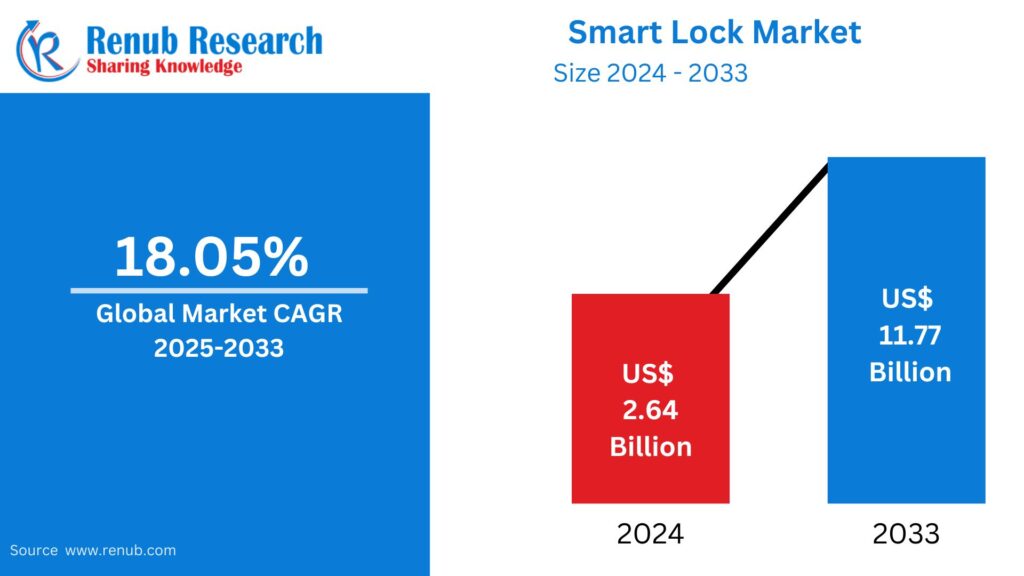
According to Renub Research global smart lock market is on a transformative growth path, projected to surge from US$ 2.64 billion in 2024 to US$ 11.77 billion by 2033, exhibiting an impressive CAGR of 18.05% between 2025 and 2033. This strong expansion is driven by increasing consumer awareness regarding advanced security systems, rapid smart home adoption, and ongoing technological innovations in IoT, AI, cloud platforms, and biometric authentication. Smart locks are reshaping access control across residential, commercial, hospitality, enterprise, and industrial sectors, marking a revolutionary shift from traditional mechanical locking systems to intelligent digital security solutions.
Global Smart Lock Market Analysis
A smart lock is an innovative, digitally controlled locking device that enables keyless entry and remote access through various authentication methods including smartphone apps, PIN codes, Bluetooth, Wi-Fi connectivity, biometrics (fingerprint/face recognition), and touchscreen inputs. Unlike conventional locks, smart locks integrate seamlessly with home automation systems and IoT-enabled devices, offering enhanced convenience, flexibility, and advanced monitoring capabilities. Users can grant temporary access, receive real-time entry logs, automate locking schedules, and manage multiple access points from anywhere globally.
Smart locks have found widespread applicability across residential homes, offices, hotels, co-working facilities, industrial plants, and critical infrastructures. They deliver superior control, minimize security vulnerabilities, and provide digital intelligence that supports smarter, safer living and working environments. As urbanization accelerates and digital lifestyles evolve, smart locks are becoming a core component of modern security ecosystems worldwide.
Download Free Sample Report:https://www.renub.com/request-sample-page.php?gturl=smart-lock-market-p.php
Market Drivers Fueling Smart Lock Growth
Growing Demand for Smart Home Solutions
The rising global inclination toward smart, connected homes is a primary catalyst accelerating smart lock adoption. Consumers are increasingly seeking automation, comfort, remote security management, and voice-controlled home ecosystems. Smart locks complement smart home setups through compatibility with Alexa, Google Assistant, Apple HomeKit, and other intelligent platforms, offering seamless integration with video doorbells, surveillance cameras, and alarm systems.
Increasing urbanization, higher disposable income levels, expanding middle-class populations, and heightened awareness of digital convenience are fostering market growth across both developed and emerging economies. Moreover, smart locks contribute to energy efficiency, sustainability, and modernized lifestyle upgrades, making them a popular upgrade choice among homeowners globally.
Rising Emphasis on Security and Safety
Security concerns across households, enterprises, and public spaces are escalating rapidly. Traditional mechanical locking mechanisms are more susceptible to duplication, physical tampering, and unauthorized access. In contrast, smart locks offer real-time surveillance, encrypted communication, biometric identification, tamper alerts, and digital access authorization.
Industries like hospitality, corporate enterprises, and shared working spaces require flexible yet secured entry systems—smart locks effectively fulfill these needs. Manufacturers continuously enhance cybersecurity features to counter evolving digital threats, strengthening user trust. Launches such as myGate digital smart lock solutions (2024) further validate industry momentum toward secure, intelligent access systems.
Technological Advancements and IoT Integration
Technological evolution is propelling smart lock capabilities to the next level. The integration of IoT, artificial intelligence, cloud computing, Bluetooth Low Energy, NFC, and ultra-wideband (UWB) technology enhances precision, safety, and user experience. Modern smart locks allow voice control management, predictive maintenance alerts, automatic system diagnostics, and advanced data analytics, transforming them into sophisticated digital guardians.
Innovations such as U-tec Ultraloq Bolt Mission UWB + NFC smart lock demonstrate cutting-edge advancements delivering contactless access, stronger encryption, and enhanced convenience, making smart locks more reliable, secure, and user-friendly. Continuous R&D investments are ensuring the market remains adaptive to evolving consumer needs.
Market Challenges Restricting Growth
Cybersecurity and Privacy Concerns
As smart locks connect to the internet and multiple IoT devices, concerns regarding hacking, unauthorized access, malware attacks, and data breaches remain key restraints. Consumers are cautious about potential system vulnerabilities that may compromise personal security. Therefore, manufacturers must invest in high-level encryption standards, secure firmware updates, AI-based intrusion detection, and multi-layer authentication frameworks to ensure robust cybersecurity. Ensuring user trust and privacy protection will be critical to sustaining long-term market growth.
High Installation and Ownership Cost
While prices are gradually declining, smart locks remain relatively expensive compared to traditional locks. Costs associated with hardware purchase, professional installation, connectivity components, and integration with broader smart ecosystems can deter price-sensitive consumers. Additionally, periodic software updates and maintenance may add to ownership expenses. Reducing cost barriers through innovation, mass production, and competitive pricing strategies will be essential for broader market penetration.
North America Smart Lock Market Overview
North America dominates the global smart lock industry, driven by strong technological infrastructure, advanced consumer awareness, high spending capacity, and widespread smart home adoption. The region experiences increasing demand due to rising security concerns, expanding automation ecosystems, and growing voice assistant usage such as Amazon Alexa and Google Assistant. Rapid urban development and modern housing infrastructure further encourage market expansion.
United States Smart Lock Market Share
The United States is the leading smart lock market in North America. Consumers increasingly prefer keyless entry, mobile-controlled security, biometric authentication, and remote access monitoring. Rising security concerns, high acceptance of smart technology innovations, and extensive smart device penetration drive growth. Product launches such as Alfred ML2 Smart Mortise Lock (2024) equipped with Z-Wave long-range technology reflect the nation’s growing commitment to intelligent locking innovations.
Asia Pacific Smart Lock Market Overview
The Asia Pacific region is witnessing the fastest smart lock expansion due to rapid urbanization, growing disposable incomes, smart infrastructure development, and government-led smart city initiatives. Countries including China, Japan, India, South Korea, Thailand, Malaysia, Indonesia, Australia, and New Zealand show increasing demand driven by rising digital lifestyles, enhanced security awareness, and IoT innovation advancements.
Smart Lock Market in India
India’s smart lock market is experiencing robust growth driven by urban modernization, middle-class expansion, rising smart home adoption, and increased security awareness. Integration with mobile apps, biometric systems, IoT devices, and voice assistants fuels demand across residential and commercial sectors. Initiatives such as Godrej Advantis IoT9 smart lock, introduced under national home safety initiatives, underscore the country’s rapidly growing digital security landscape.
Europe Smart Lock Market Outlook
Europe showcases steady smart lock adoption supported by advanced infrastructure, rising concerns over home security, increasing urban lifestyles, and strong IoT integration. Key contributing countries include Germany, France, Italy, Spain, the United Kingdom, Belgium, the Netherlands, and Turkey. The region’s inclination toward energy-efficient, sustainable, and future-ready digital technologies strengthens smart lock integration across households and enterprises.
Germany Smart Lock Market
Germany’s smart lock industry is expanding rapidly due to high technological acceptance, elevated security awareness, and strong smart home penetration. Increasing demand for digital convenience, eco-efficiency, and automation supports market acceleration. Innovations such as Nuki Smart Locks enabling secure parcel deliveries further enhance consumer confidence and adoption trends.
Middle East and Africa Smart Lock Market Overview
The Middle East and Africa smart lock market is accelerating due to vast urban development projects, smart city initiatives, rising income levels, and increasing demand for technologically advanced home and building security solutions. Key growth territories include UAE, Saudi Arabia, and South Africa, supported by high investment in real estate modernization and digital infrastructure.
UAE Smart Lock Market
The UAE stands as a major innovation hub for smart security technology adoption. Strong emphasis on luxury housing, hospitality modernization, digital infrastructure, and smart city development significantly fuels smart lock deployment. Partnerships like ASSA ABLOY and UXE Security Solutions highlight the market’s technological readiness and rising consumer interest in intelligent access systems.
Smart Lock Market Segment Analysis
By Type:
Deadbolt · Lever Handles · Padlock · Others
By Technology:
Bluetooth · Wi-Fi
By Authentication:
Keyboard · Touchscreen · App-Based · Hybrid · Biometric · Others
By Application:
Residential · Hospitality · Enterprise · Critical Infrastructure · Others
By Region:
North America · Europe · Asia Pacific · Latin America · Middle East & Africa
Competitive Landscape and Key Companies
The global smart lock market is moderately competitive, with leading companies focusing on innovation, AI-powered functionality, cloud-based security, biometric advancements, and strategic partnerships. Major players include:
Allegion plc · Avent · ASSA ABLOY · DormaKaba Holding AG · Samsung · Zhejiang Dahua Technology Co. Ltd. · Spectrum Brands Holdings Inc. · Panasonic Corporation
Conclusion and Future Outlook
The global smart lock market is set to witness exponential growth through 2033, backed by expanding smart homes, heightened security priorities, rapid IoT integration, and continuous technological advancements. While cybersecurity risks and cost challenges persist, ongoing innovation, improved affordability, and stronger encryption technologies will shape the industry’s future trajectory. Smart locks are not merely security devices—they represent a foundational pillar of modern intelligent living and digitally secure environments worldwide.