
Global Hempcrete Market Analysis
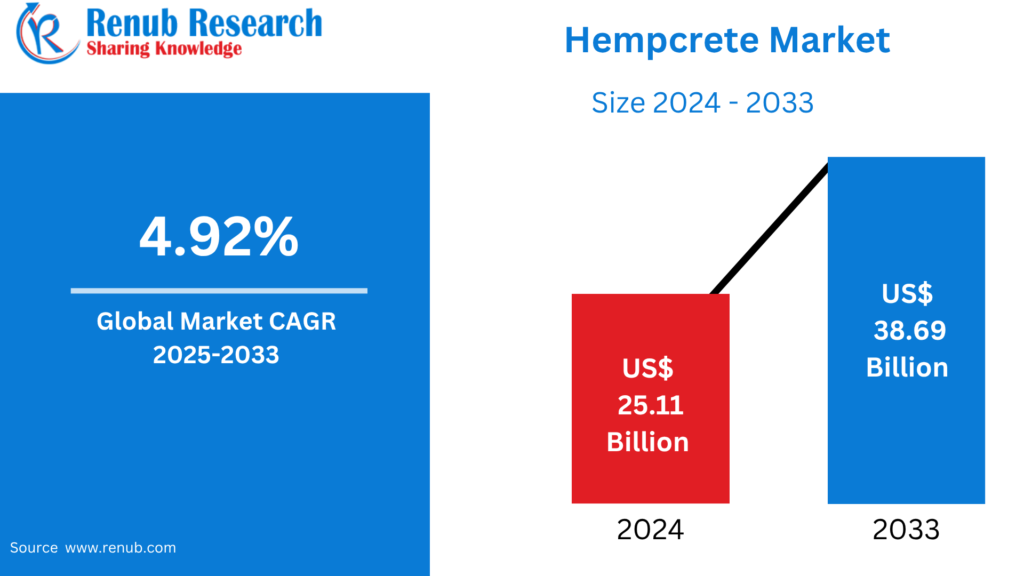
According to Renub Research Global Hempcrete Market is witnessing substantial growth as sustainability becomes a core priority in modern construction. The market is projected to reach US$ 38.69 billion by 2033, rising from US$ 25.11 billion in 2024, with a CAGR of 4.92% between 2025 and 2033. Growing demand for eco-friendly, carbon-negative, energy-efficient building materials is driving adoption across residential and non-residential sectors worldwide. Hempcrete offers natural thermal insulation, breathability, fire resistance, and mold protection, making it an ideal solution for green building applications including walls, floors, and roofs.
Global Hempcrete Market Outlook
Hempcrete is a bio-composite building material created from the hurd of the hemp plant, water, and lime binder. Unlike conventional concrete, hempcrete is lightweight, non-structural, and environmentally sustainable. Its ability to absorb more carbon dioxide than it emits makes it highly valuable in climate-conscious construction. Additionally, its breathability prevents condensation, improves indoor air quality, and enhances building longevity.
Hempcrete is widely used for wall infill, insulation, roof panels, and flooring in low-rise residential and commercial buildings. Although it cannot replace structural concrete, it integrates effectively with timber and steel frames to deliver enhanced performance. Builders favor hempcrete for its excellent acoustic insulation, pest resistance, and natural fire-retardant features.
Globally, markets such as Europe, North America, and Asia-Pacific are leading hempcrete adoption due to progressive sustainability policies and growing eco-construction awareness. Countries like France, Canada, the United Kingdom, and the United States are shaping regulatory frameworks supporting industrial hemp usage, accelerating production and commercialization of hemp-based construction materials. As sustainability becomes a defining pillar of global real estate development, hempcrete continues to position itself as a practical, efficient, and future-ready green building material.
Download Free Sample Report:https://www.renub.com/request-sample-page.php?gturl=global-hempcrete-market-p.php
Key Growth Drivers of the Global Hempcrete Market
Rising Demand for Eco-Friendly and Sustainable Building Materials
The global construction sector is moving toward low-carbon and environmentally responsible materials. Hempcrete’s carbon-negative footprint, biodegradability, and renewable sourcing make it an ideal substitute for environmentally harmful materials like concrete and bricks. Governments worldwide are enforcing green building codes, net-zero targets, and sustainability certifications, all of which strongly favor hempcrete solutions. Increasing preference for sustainable residential and commercial spaces continues to strengthen market expansion.
Superior Thermal Insulation and Energy Efficiency Benefits
Hempcrete delivers excellent natural thermal insulation, significantly reducing heating and cooling energy consumption. This makes it ideal for passive house designs and energy-efficient construction projects. Its capability to regulate indoor humidity and temperature enhances comfort while lowering operational costs. As global energy prices rise and climate policies tighten, builders increasingly prefer hempcrete to meet environmental compliance and energy-efficiency performance benchmarks. Its proven fire-resistant properties also make it suitable for wildfire-prone regions.
Government Support and Favorable Policy Initiatives
Government policies supporting industrial hemp cultivation are significantly boosting raw material availability for hempcrete production. Subsidies, regulatory relaxations, and environmental incentives are strengthening global supply chains. Certifications like LEED and BREEAM recognize hempcrete as a sustainable construction material, helping institutional and commercial projects adopt it more confidently. Public investments in sustainable materials research and climate-smart infrastructure are further accelerating commercial use of hempcrete worldwide.
Challenges Impacting the Global Hempcrete Market
Structural Limitations Restrict Large-Scale Application
Hempcrete’s non-structural nature limits its role to insulation, wall infill, and internal applications only. It cannot replace concrete in high-load or high-rise structures, requiring integration with supporting frameworks like wood or steel. This increases complexity and cost, slowing adoption in large commercial infrastructure projects. Lack of expertise among mainstream developers and limited specialized contractors also remains a challenge.
Limited Availability, Awareness, and Processing Infrastructure
Despite its advantages, hempcrete adoption remains low in several regions due to lack of awareness, unclear industrial hemp regulations, and insufficient processing facilities. In regions where hemp cultivation remains restricted, raw material scarcity leads to higher production costs. Weak supply chains, limited manufacturer presence, and inadequate training among builders further restrict the market’s growth potential.
Global Hempcrete Market by Application
Wall Hempcrete Market Dominates Market Share
Wall applications hold the largest share of the hempcrete market due to superior insulation, breathability, and structural integration benefits. Hempcrete walls provide energy-efficient climatic control while preventing moisture buildup, making them ideal for sustainable residential and commercial developments. With green construction gaining global momentum, hempcrete-based wall systems are expected to witness strong expansion, especially across Europe and North America.
Roof Hempcrete Market Demonstrates Growing Adoption
Roof insulation represents a rapidly growing application segment for hempcrete. Its lightweight, fire-resistant characteristics and ability to stabilize internal temperatures make it highly suitable for sustainable roofing and retrofitting projects. Passive homes, eco-buildings, and green roofing projects increasingly prefer hempcrete solutions.
Global Hempcrete Market by End Use
Residential Hempcrete Market Leads Worldwide Demand
Residential construction dominates the hempcrete market as homeowners seek healthier, environmentally friendly, and energy-efficient living spaces. Hempcrete is widely used in eco-homes, sustainable communities, off-grid housing, and luxury green real estate developments due to its breathable, non-toxic nature.
Non-Residential Hempcrete Market Shows Promising Growth
The non-residential sector, including offices, educational institutions, resorts, and hospitality infrastructure, is adopting hempcrete to achieve environmental certifications and energy-efficiency compliance. While structural limitations exist, hempcrete remains highly suitable for insulation, acoustic performance, and sustainability-driven commercial architecture.
Regional Insights of the Global Hempcrete Market
United States Hempcrete Market
The United States is emerging as a key hempcrete market driven by regulatory support, increasing hemp cultivation, and growing sustainable construction initiatives. States like California and Colorado are witnessing significant uptake due to environmental policies and wildfire safety needs. Testing certifications and government grants continue to enhance credibility and adoption.
France Hempcrete Market
France leads the global hempcrete infrastructure landscape due to strong industrial hemp production, favorable regulations, and established construction expertise. With a mature supply chain and widespread acceptance, France continues to set global benchmarks in hempcrete application and innovation.
India Hempcrete Market
India presents significant long-term growth potential with increasing sustainability awareness and support for industrial hemp cultivation in states such as Uttarakhand and Himachal Pradesh. Hempcrete is gaining traction in eco-tourism, affordable housing, and off-grid projects, with expanding opportunities in coming years.
Brazil and UAE Hempcrete Markets
Brazil is gradually progressing toward hemp legalization, creating future opportunities for hempcrete construction. Meanwhile, the UAE is exploring hempcrete for luxury villas, eco-resorts, and energy-efficient buildings due to its superior thermal performance suitable for extreme climates.
Global Hempcrete Market Segmentation Overview
Application: Walls, Floors, Roofs
End Use: Residential, Non-Residential
Regions: North America, Europe, Asia Pacific, Latin America, Middle East & Africa
Competitive Landscape and Key Players
The global hempcrete market features a competitive landscape with companies focusing on innovation, product testing, partnerships, and sustainability-driven solutions. Prominent market players include:
IsoHemp
Hempcrete Natural Building Ltd.
Americhanvre Cast Hemp
Lime Technology
Just BioFiber Structural Solutions
HempEco Systems
Hempitecture Inc.
Australian Hemp Masonry Company
Hemp Block USA
Dun Agro Hemp Group
These companies are strengthening production capacity, expanding geographical presence, and investing in advanced bio-construction research to support global adoption.
Future Outlook of the Global Hempcrete Market
The Global Hempcrete Market is poised for consistent growth through 2033, driven by sustainability mandates, increasing green building investments, supportive regulations, and rising consumer preference for eco-friendly infrastructure. With advancements in materials engineering, supply chain development, and broader acceptance in mainstream construction, hempcrete is set to play a transformative role in the future of sustainable architecture worldwide.