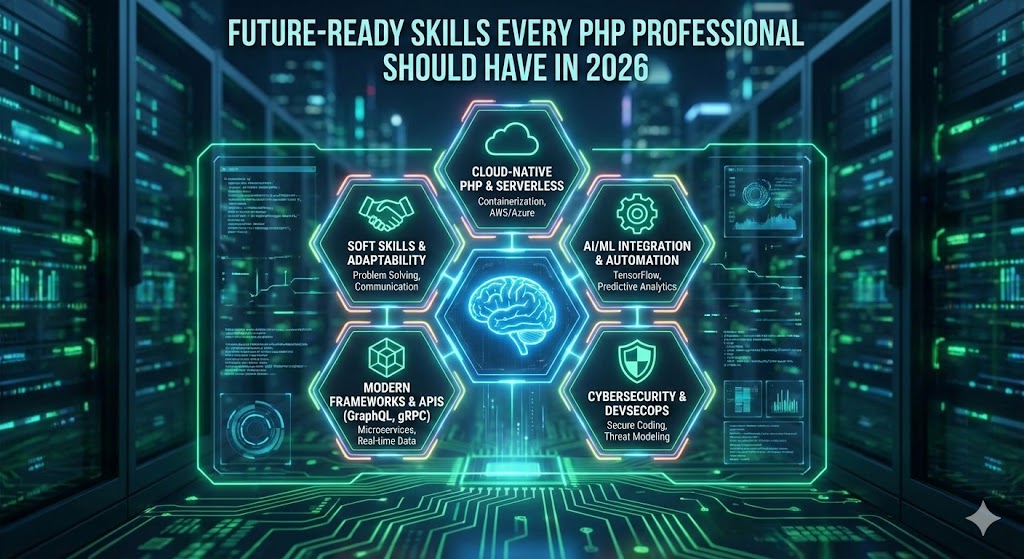
These 2026 skills can help you find and train the right people. If you’re a business leader hiring PHP developers, a tech manager building a team, or a developer wanting to stay ahead, these skills matter. This information is very important for doing well in the digital world of the future.
1. Mastery of Modern PHP Frameworks and Design Patterns
You can’t know basic PHP syntax anymore. As projects grow bigger and more complex, you need to dig deeper. Companies need workers who know modern PHP frameworks by 2026. Some of these are Laravel, Symfony, and Yii2.
Why This Matters
Frameworks simplify development. They help organize code and ensure that developers follow architectural best practices. Laravel is all about having clear syntax and powerful built-in tools. Some of these are Eloquent ORM, queues, and event broadcasting. They help you make applications that can grow and work better and faster.
Developers should know software design patterns. These include MVC (Model-View-Controller), Repository, Service Layer, and Dependency Injection. These patterns organize code in ways that are easy to maintain and test. This is especially important for large teams and long-term projects.
2. Strong Understanding of API Development and Integration
The modern web is deeply interconnected. Applications don’t work in isolation. They must connect with other systems, mobile apps, third-party services, and microservices.
APIs as a Core Skill
PHP professionals should be able to:
- Build RESTful APIs
- Use GraphQL
- Secure endpoints with authentication/authorization methods such as OAuth and JWT
- Understand API versioning and documentation standards using tools like OpenAPI/Swagger
Companies are using headless architectures and cloud services. This is a big plus for developers who know how to use APIs well.
3. Skill in Security Best Practices
Security remains one of the most critical aspects of web development. Digital breaches are in the news, so developers need to protect user data and secure their apps.
Core Security Competencies
Future-ready PHP professionals should prove:
- Avoiding common security holes like SQL Injection, Cross-Site Scripting (XSS), and Cross-Site Request Forgery (CSRF)
- Safe handling of user input, encryption, and hashing (e.g., using bcrypt, Argon2)
- Secure session management and authentication mechanisms
- Familiarity with security standards and compliance
They should go beyond coding defenses. They should integrate tools like code scanning. They must check for dependency vulnerabilities. Also, they need to follow secure deployment practices.
4. Familiarity with DevOps and Deployment Workflows
In 2026, developers will need to collaborate more with DevOps. This teamwork will help ensure smooth and reliable application deployment.
What This Includes
Future‑ready PHP professionals should know:
- Version control systems (especially Git)
- Continuous Integration/Continuous Deployment (CI/CD) pipelines
- Containerization using Docker
- Basic command of orchestration tools like Kubernetes
- Server configuration and deployment basics (whether on traditional VPS, AWS, or container services)
Understanding the path apps take—from development to staging to production—reduces errors. It also speeds up releases and supports better scaling.
5. Database Design, Optimization, and NoSQL Fluency
MySQL, MariaDB, and PostgreSQL are relational databases commonly used by PHP apps. But the needs for data are changing and becoming more diverse.
Why Database Skills Are Critical
A future-ready PHP professional should:
- Design normalized, efficient data models
- Write optimized SQL queries.
- Understand indexing, caching, and query performance tuning.
- NoSQL databases, like MongoDB and Redis, are popular choices. They work well for caching, storing sessions, or when you need a flexible schema.
Picking the right storage solution impacts application speed, scalability, and cost-efficiency.
6. Front-End Interoperability and Modern JS Framework Awareness
Key Front-End Skills
Developers should be comfortable with:
- HTML5 and CSS3 fundamentals
- APIs work with front-end frameworks like React, Vue.js, and Angular. They help connect the user interface with back-end services.
- Ability to debug and optimize front-end performance issues related to API use
This cross-disciplinary awareness makes collaboration smoother and reduces development bottlenecks.
7. Soft Skills: Communication, Adaptability, and Problem-Solving
Technical skills get projects going, but soft skills keep them going. This is very important for teams that work from home or are spread out.
Crucial Soft Skills
A future-ready PHP professional should be able to:
- Talk about complicated things in simple terms
- Collaborate in teams using tools like Slack, Trello, or Jira
- Show adaptability as frameworks, tools, and best practices evolve
- Break down problems and provide structured solutions
These skills often set good developers apart from great ones in real-world business.

Impact and Benefits of These Skills for Businesses
Prioritizing these skills when hiring PHP developers can greatly benefit your business:
✔ Better Code Quality and Maintainability
Developers skilled in modern frameworks and architecture write cleaner, more scalable code. This method cuts down on costs for long-term maintenance.
✔ Enhanced Security and Trust
Developers who know about security keep your systems and user data safe. They lower risks and make customers more likely to trust them.
✔ Faster Time‑to‑Market
Teams that are good at DevOps, APIs, and tools for working together can add features more quickly. They also quickly respond to feedback and make changes that work. This speed is very important in markets where there is a lot of competition.
✔ Improved Performance and Scalability
To speed up your app, optimize your database. Also, use caching and modern deployment methods. This way, it can handle more users and grow quickly.
✔ Future‑Proofed Tech Stack
Knowing about different fields and being open to new ideas will help you keep your tech skills sharp as technology changes in 2026.
Conclusion
As we near 2026, PHP professionals do much more than write server-side scripts. Today’s web apps need solid architecture and strong security awareness. They need strong cross-platform communication skills. They must also adapt to modern development workflows.
Hiring PHP developers with the right skills helps create a strong team. Look for expertise in frameworks, API knowledge, DevOps experience, and good soft skills. This foundation meets your project needs now. It also supports long-term growth, resilience, and innovation.
Knowing these skills helps you assess talent better. This is key when you build internal systems, client products, or big platforms. It also helps developers grow with the industry.