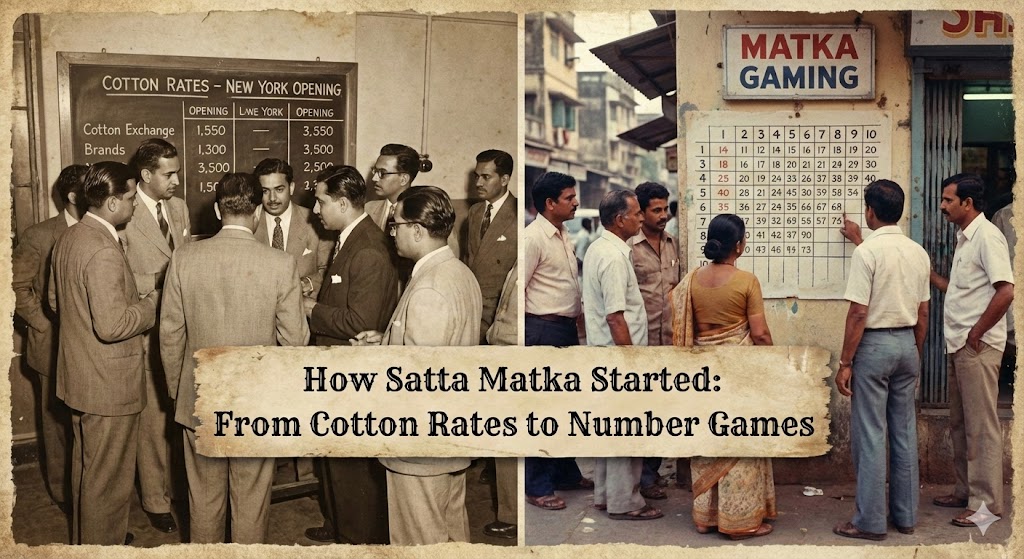
Satta Matka is widely known today as a number-based betting game, but very few people understand its true origins. What began as a simple method of predicting cotton prices during the British era gradually evolved into one of India’s most talked-about underground number games. To fully understand the present-day Matka ecosystem, it is essential to explore how satta matka started, how it transformed over time, and why it became so popular across different regions of India.
This article offers a detailed, factual, and chronological explanation of the origins of Satta Matka—from its roots in cotton trading to the structured number games seen today.
Understanding the Meaning of Satta and Matka
Before diving into history, it is essential to understand the two core terms.
Satta refers to betting or wagering on an outcome.
Matka originally referred to an earthen pot used to draw random numbers.
When combined, Satta Matka came to represent a betting system where numbers were randomly drawn, and players wagered on the outcome.
However, this format did not exist at the beginning. The earliest form of Satta Matka had no numbers, no pots, and no organised draws.
The British-Era Cotton Trade: Where It All Began
To understand how satta matka started, we must go back to the early 1950s, during the final years of British colonial influence in India.
At that time, the New York Cotton Exchange played a significant role in determining global cotton prices. India, being one of the largest cotton producers, was heavily influenced by these rates.
How Cotton Rates Became a Betting Activity
- Cotton traders in Mumbai closely followed daily cotton price fluctuations.
- Rates were transmitted through newspapers and trade bulletins.
- Traders and brokers began informally predicting whether cotton prices would rise or fall.
Over time, this prediction activity shifted from business forecasting to informal betting. People started wagering money on cotton rate movements, turning speculation into a gambling-like activity.
This system became popularly known as “Ankda Satta”, meaning betting on figures.
The Role of Mumbai in Early Satta Culture
Mumbai (then Bombay) was the commercial hub of India. The city attracted traders, dock workers, mill employees, and daily wage earners—all looking for quick income opportunities.
Several factors contributed to the growth of early Satta in Mumbai:
- High population density
- Easy access to trade information
- Cash-based informal economy
- Strong word-of-mouth networks
As cotton price betting grew, it spread beyond traders to the general public.
The Decline of Cotton Rate Betting
The original cotton-based betting system faced a significant disruption in the early 1960s.
Why Cotton Satta Ended
- The New York Cotton Exchange stopped publishing cotton rates accessible to Indian traders.
- International trade regulations changed.
- Information flow became restricted.
With the removal of daily cotton rates, the betting system lost its reference point. However, by this time, the habit of betting had already taken root among participants.
This created the need for a new, independent betting mechanism.
Birth of the Number-Based Satta System
This transition phase marks the most critical milestone in understanding how satta matka started in its modern form.
Introduction of Random Number Draws
Instead of relying on external cotton prices, operators introduced a simple yet effective idea:
- Numbers would be written on slips of paper.
- These slips would be placed inside a matka (earthen pot).
- One slip would be randomly drawn to decide the winning number.
This innovation made the system:
- Independent of external markets
- Easier to organise
- More transparent for players
This is where the term Matka became permanently associated with Satta.
Kalyanji Bhagat: The Pioneer of Modern Matka
One cannot explain how satta matka started without mentioning Kalyanji Bhagat, widely regarded as the founder of modern Matka gambling.
His Contribution
- He formalised number-based betting in the 1960s.
- Introduced structured time slots for results.
- Standardised betting rules and payouts.
- Launched the famous Kalyan Matka market.
Kalyanji Bhagat’s system replaced randomness with predictability in operations, making Matka more organised and scalable.
How Early Matka Games Worked
Early Matka games followed a simple format:
- Numbers from 0 to 9 were written on paper slips.
- Slips were placed in a matka.
- A random draw determined the winning digit.
- Players placed bets before the draw.
- Payouts were distributed manually.
Later, this evolved into three-digit and four-digit combinations, increasing complexity and excitement.
Expansion of Matka Markets Across India
After the success of Kalyan Matka, several other markets emerged:
- Worli Matka
- Main Mumbai Matka
- Rajdhani Day and Night
- Milan Day and Night
Each market had:
- Fixed draw timings
- Unique result patterns
- Dedicated player bases
By the 1970s and 1980s, Matka had spread beyond Mumbai to Maharashtra, Gujarat, Madhya Pradesh, and parts of North India.
The Social Factors Behind Matka’s Popularity
Understanding how satta matka started also requires analysing why it became popular among the masses.
Key Reasons for Growth
- Low entry cost
- Simple rules
- High potential payouts
- Cash-based transactions
- Word-of-mouth trust networks
For many daily wage earners, Matka represented hope for quick financial gain.
Government Crackdowns and Legal Challenges
As Matka expanded, it attracted attention from authorities.
Legal Developments
- Gambling laws tightened in several states.
- Police crackdowns increased during the 1990s.
- Physical Matka dens were shut down in many areas.
However, enforcement remained inconsistent, and the game continued to survive through informal channels.
Transition from Physical to Digital Platforms
Although this article focuses on how satta matka started, its evolution would be incomplete without mentioning the digital shift.
Digital Transformation
- Paper slips replaced by mobile numbers
- Phone calls replaced physical visits
- Later, websites and apps emerged
- Results published online in real time
While the format changed, the core structure developed in the 1960s remained intact.
Difference Between Original Matka and Modern Versions
| Aspect | Early Matka | Modern Matka |
| Number Generation | Earthen pot draw | Algorithm or manual entry |
| Betting Method | In-person | Online / mobile |
| Results | Handwritten | Digital boards |
| Reach | Local | Nationwide |
Despite technological changes, the foundational idea remains unchanged.
Cultural Impact of Satta Matka
Over the decades, Matka has influenced:
- Bollywood storylines
- Street-level economic systems
- Popular slang and terminology
- Informal finance networks
It became more than a game—it became part of urban folklore.
Common Misconceptions About Matka Origins
Many people mistakenly believe:
- Matka was always a number game
- It originated as illegal gambling from the start
- It had no connection to legitimate trade
In reality, how satta matka started is closely tied to commodity price prediction and informal trading behaviour.
Why Understanding Matka History Matters Today
For researchers, developers, and industry observers, understanding the origins helps:
- Analyse user psychology
- Understand market structures
- Build historically accurate content
- Avoid misinformation
History provides context that explains why Matka still holds relevance today.
Final Thoughts: From Cotton Rates to Number Games
The journey of Satta Matka is a clear example of how informal economic activities evolve with time. What began as a cotton price prediction system transformed into a structured number game through innovation, social demand, and adaptability.
To truly understand how satta matka started, one must view it not just as gambling but as a historical outcome of trade, urbanisation, and human behaviour.
From cotton rate speculation to matka number draws, the evolution of Satta Matka reflects decades of change—yet its core principle remains rooted in chance, prediction, and risk.