India Organic Food Market Analysis
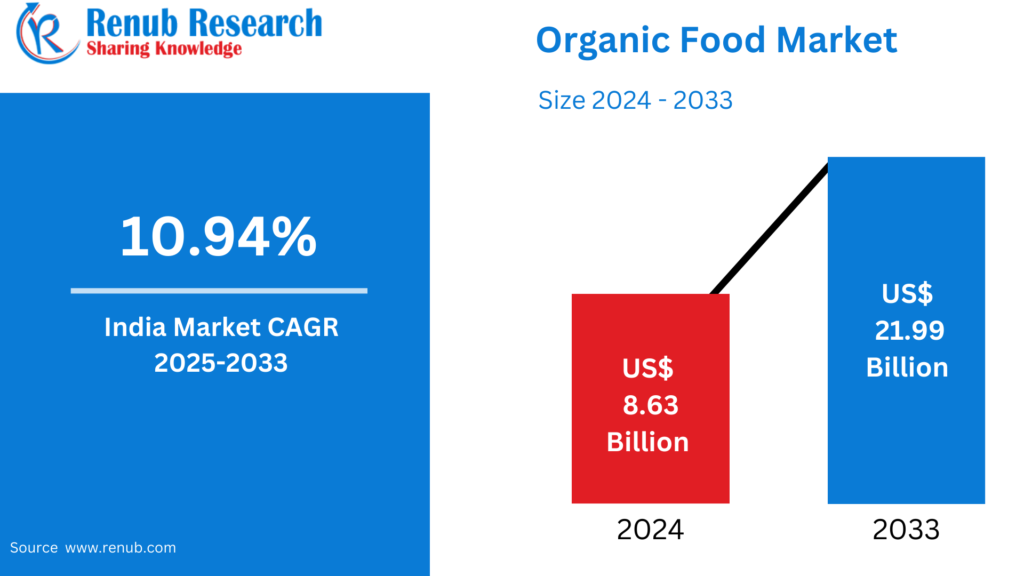
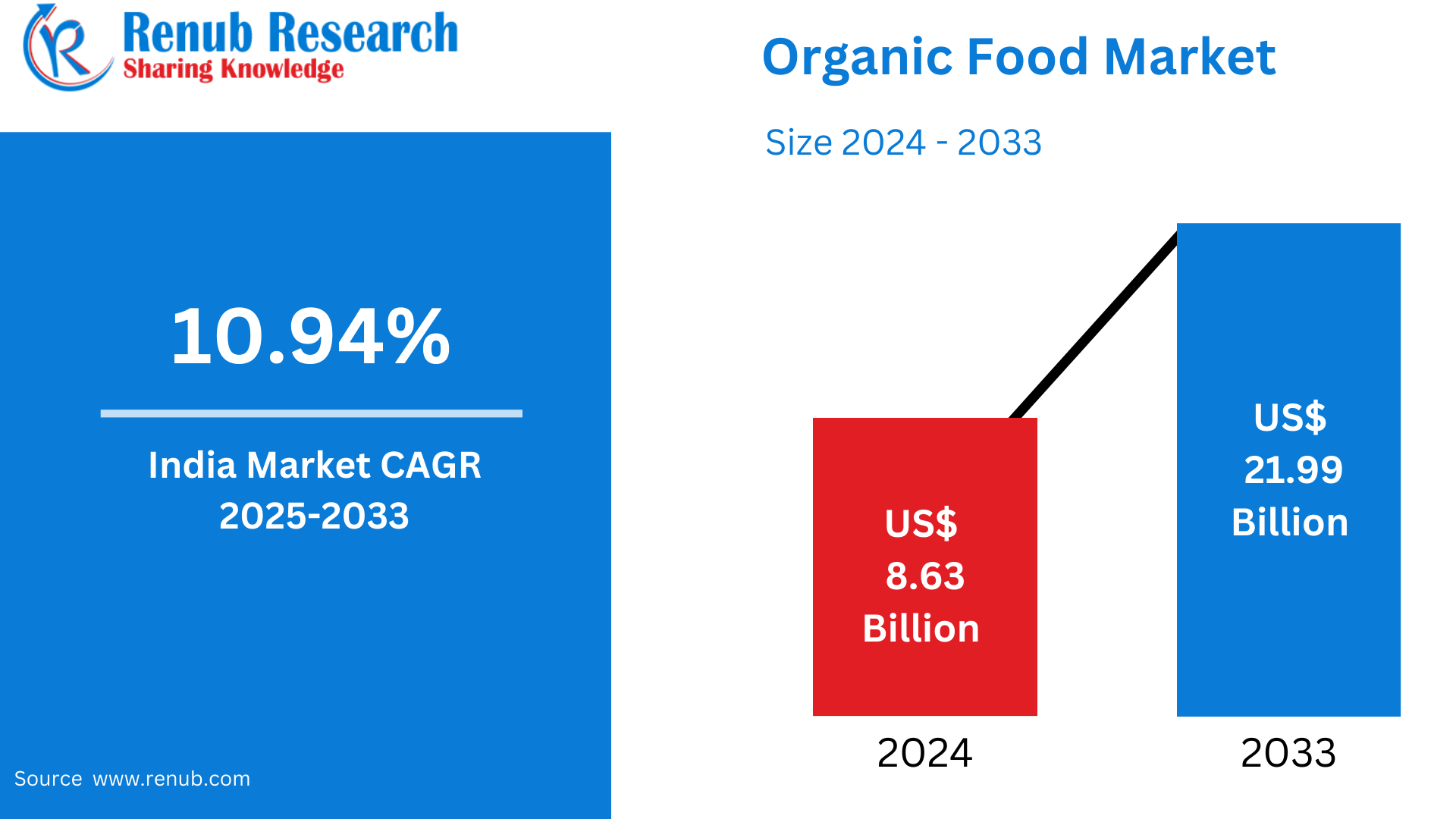
According to Renub Research India organic food market is undergoing rapid expansion, driven by increasing health awareness, environmental concerns, and supportive government policies. The market was valued at US$ 8.63 billion in 2024 and is expected to reach US$ 21.99 billion by 2033, growing at a robust CAGR of 10.94% from 2025 to 2033. This strong growth trajectory reflects a significant shift in consumer preferences toward chemical-free, sustainably produced food products.
Organic food in India includes fruits and vegetables, cereals and grains, dairy products, beverages, processed foods, and bakery items produced without synthetic pesticides, fertilizers, genetically modified organisms (GMOs), or artificial additives. Rising concerns about food safety, lifestyle diseases, and the long-term impact of conventional farming on health and the environment are pushing Indian consumers to adopt organic alternatives. Additionally, increasing investments by Indian corporate firms in agribusinesses, agritech, and organic farming are further strengthening the market outlook.
India Organic Food Market Overview
The India organic food market has experienced substantial growth over the past decade, supported by rising consumer awareness of nutrition, sustainability, and environmental responsibility. Urban consumers, in particular, are showing a strong inclination toward organic food products due to concerns about pesticide residues, soil degradation, and water contamination linked to conventional agriculture.
Government initiatives have played a critical role in accelerating market development. Programs such as the National Programme for Organic Production (NPOP), Paramparagat Krishi Vikas Yojana (PKVY), and support under the National Horticulture Mission (NHM) have encouraged farmers to adopt organic cultivation practices. Under NHM, farmers receive financial incentives of up to ₹10,000 per hectare (up to four hectares) and group certification support of up to ₹5 lakh for 50 hectares, significantly reducing entry barriers.
Urbanization, a growing middle-class population, and improved supply chain infrastructure—including e-commerce and organized retail—have made organic food more accessible across India. As a result, organic food consumption is expanding beyond metropolitan cities into Tier II and Tier III regions.
Request a free sample copy of the report:https://www.renub.com/request-sample-page.php?gturl=india-organic-food-market-p.php
India as a Global Organic Food Exporter
In addition to being a fast-growing domestic market, India is one of the world’s leading exporters of organic food products. The country exports a wide range of certified organic commodities, including tea, spices, oilseeds, cereals, pulses, and medicinal plants. Indian organic products are highly valued in international markets for their quality, purity, and adherence to global standards.
Strict certification systems and compliance with international norms such as USDA Organic and EU Organic have helped strengthen India’s credibility in the global organic trade. Rising global demand for chemical-free and sustainably sourced food has opened new export opportunities, benefiting farmers, processors, and exporters alike. Despite challenges such as higher production costs and complex certification processes, India’s organic food industry is well positioned for long-term export-led growth.
Government Support and Policy Framework
The Indian government actively promotes organic farming through financial incentives, training programs, and regulatory support. Traditional farming practices have resulted in declining soil fertility, pesticide-resistant pests, water pollution, and long-term health issues. Organic farming is increasingly viewed as a sustainable alternative that addresses these challenges.
Supply-side trade policies, subsidies for organic inputs, and certification assistance are expected to positively impact long-term market growth. Regulatory frameworks that support biological and organic farming methods are creating a more favorable ecosystem for both producers and consumers, encouraging wider adoption across the agricultural value chain.
Growth Drivers of the India Organic Food Market
Rural to Urban Transition
India’s ongoing rural-to-urban migration is a major driver of organic food demand. As people move to cities, lifestyle patterns change, with greater emphasis on health, wellness, and sustainability. Urban consumers are generally more informed about nutrition and are willing to pay a premium for high-quality organic food products.
This transition has fueled the expansion of specialty organic stores, supermarkets, and online retail platforms, making organic food more widely available. Educated and higher-income urban populations are increasingly integrating organic food into their daily diets, positioning it as an essential component of a healthy and sustainable lifestyle.
Global Export Opportunities
India’s diverse agro-climatic conditions enable the production of a wide variety of organic food products, many of which are in high demand globally. Organic tea, spices such as turmeric and cumin, oilseeds, and cereals from India are widely recognized for their quality and health benefits.
Government support for organic farming, participation in international trade fairs, and bilateral trade agreements have enhanced India’s export potential. Rising global awareness of organic food benefits continues to strengthen India’s position as a key supplier in the international organic food market, contributing positively to the national economy.
Improved Certification and Quality Standards
The increasing adoption of recognized organic certifications is boosting consumer confidence and market expansion. Certifications such as India Organic, USDA Organic, and EU Organic assure consumers that products meet stringent organic farming and processing standards.
Certified organic products are perceived as safer, healthier, and environmentally friendly, driving both domestic consumption and exports. As consumer awareness grows, demand for certified organic food continues to rise, encouraging producers to comply with standardized regulations and quality benchmarks.
Challenges in the India Organic Food Market
Pest and Disease Management
One of the most significant challenges in organic farming is pest and disease control. Since synthetic pesticides are prohibited, organic farmers rely on natural methods such as crop rotation, biological pest control, and companion planting. While environmentally friendly, these methods are often less effective during severe pest infestations.
Lower yields, higher crop losses, and increased labor costs can impact farm profitability. These risks may discourage some farmers from transitioning to organic farming, potentially limiting market growth if not addressed through research, training, and innovation in organic pest management.
Inconsistent Quality and Standards
Inconsistent implementation of organic standards across regions remains a challenge in India. While certification bodies like NPOP exist, not all farmers have access to certification due to high costs, lack of awareness, or administrative complexity.
Variations in compliance can lead to inconsistent product quality, causing confusion among consumers and reducing trust in organic labels. Strengthening regulatory enforcement, simplifying certification processes, and increasing transparency are essential to maintaining credibility and sustaining market growth.
East India Organic Food Market
The organic food market in East India is witnessing gradual growth, driven by increasing health awareness and government-led initiatives. States such as West Bengal, Odisha, and Bihar are adopting organic farming practices under schemes like PKVY.
Demand for organic vegetables, grains, tea, and spices is rising, particularly in urban centers. However, challenges such as limited certification access, supply chain inefficiencies, and uneven distribution persist. Despite these obstacles, East India offers strong long-term potential as more farmers transition to organic agriculture and consumer awareness continues to improve.
West India Organic Food Market
West India represents one of the most dynamic regions in India’s organic food market. States such as Maharashtra, Gujarat, and Goa, along with major cities like Mumbai, Pune, and Ahmedabad, are key consumption hubs.
Higher disposable incomes, strong retail infrastructure, and a growing preference for premium food products are driving demand for organic fruits, vegetables, dairy, and processed foods. The presence of supermarkets, specialty organic stores, and online platforms has significantly improved product accessibility. Although challenges such as price sensitivity and certification costs remain, West India continues to be a major growth engine for the market.
India Organic Food Market Segmentation by Product Type
The market includes organic fruits and vegetables, organic meat, poultry and dairy products, organic processed foods, organic bread and bakery items, organic beverages, organic cereals and food grains, and other organic products. Fruits, vegetables, and cereals account for a significant share due to high daily consumption.
India Organic Food Market Segmentation by Distribution Channel
Based on distribution, the market is segmented into supermarkets and hypermarkets, specialty stores, convenience stores, online retail platforms, and other channels. Online retail is emerging as a fast-growing segment due to convenience, wider product availability, and increasing digital adoption.
India Organic Food Market Segmentation by Application
Key applications include bakery and confectionery, ready-to-eat food products, breakfast cereals, and other food applications. Rising demand for healthy snacks and packaged organic foods is supporting growth in value-added segments.
Competitive Landscape and Key Players in the India Organic Food Market
The India organic food market is moderately fragmented, with players focusing on product innovation, certifications, and expanding distribution networks. Major companies operating in the market include:
- Suminter India Organics Private Limited
- Nature Bio-Foods Limited
- Organic India Private Limited
- Sresta Natural Bioproducts Pvt. Ltd.
- Phalada Agro Research Foundations Pvt. Ltd.
- Mehrotra Consumer Products Pvt. Ltd.
- Morarka Organic Foods Pvt. Ltd.
- Nature Pearls Pvt Ltd
- Conscious Food Private Limited
- Nourish Organics Foods Pvt Ltd
These companies are expanding through certifications, export strategies, new product launches, and partnerships with retail and e-commerce platforms.
Conclusion
The India organic food market is set for strong and sustained growth through 2033, driven by rising health awareness, supportive government policies, export opportunities, and changing consumer lifestyles. While challenges such as pest management and inconsistent standards remain, continued investment in certification, technology, and supply chain infrastructure is expected to address these issues. As demand for sustainable and chemical-free food continues to rise, India is well positioned to emerge as a global leader in the organic food industry.