Industrial Coatings Market Overview and Forecast
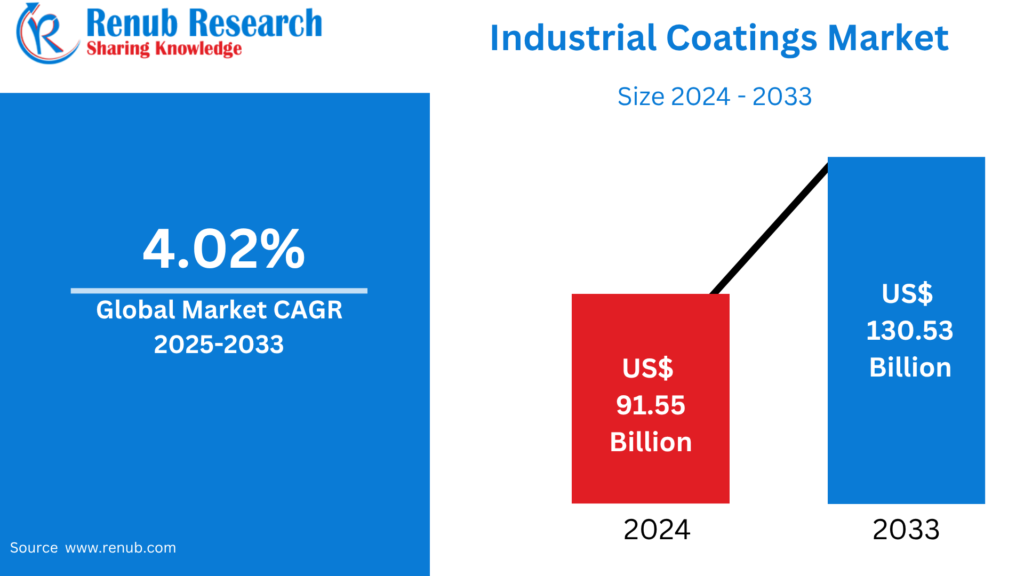
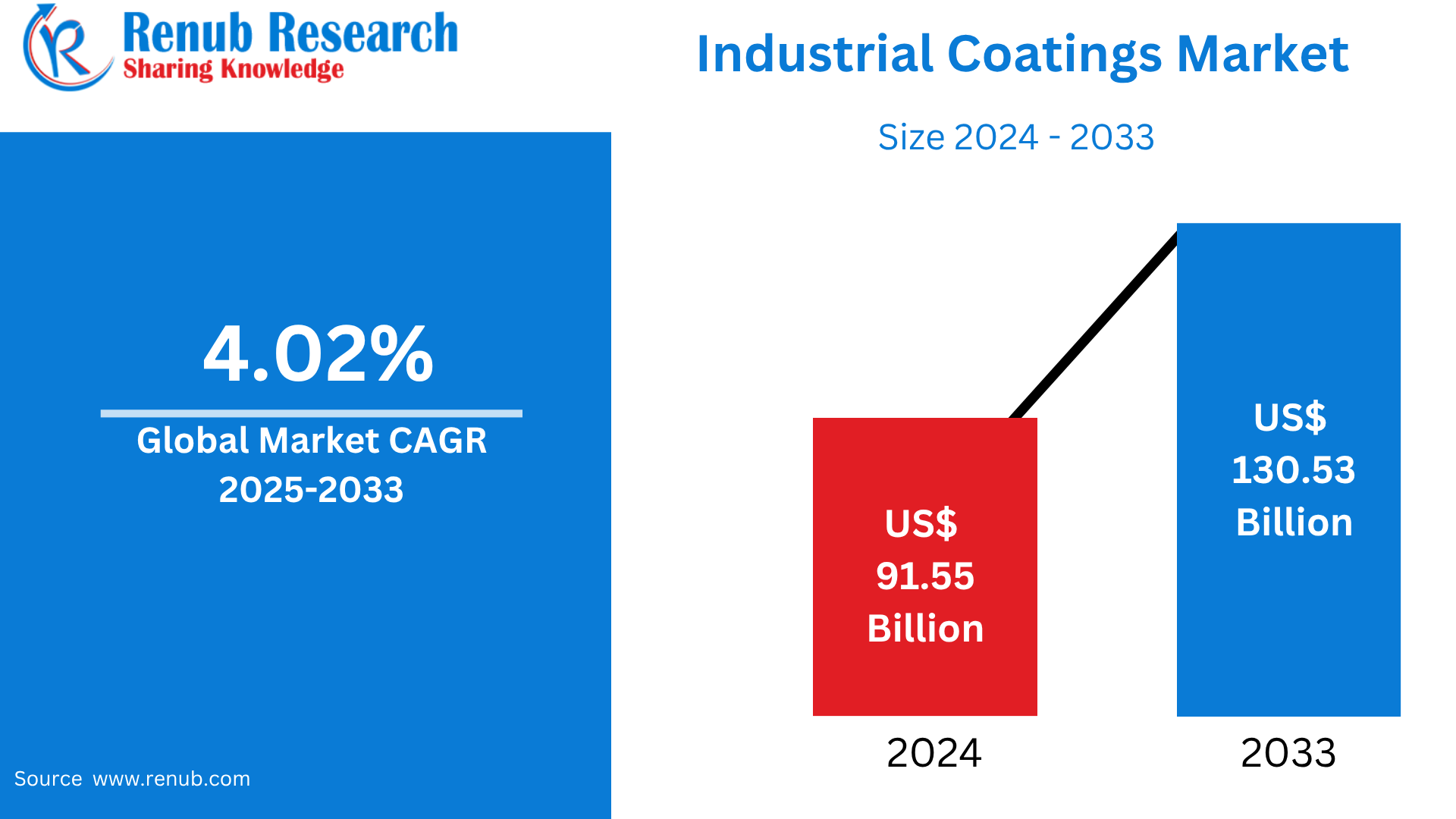
According To Renub Research industrial coatings market represents a critical segment of the global chemicals and materials industry, supporting a wide range of manufacturing and infrastructure activities. Industrial coatings are engineered formulations applied to surfaces to enhance protection, durability, and visual appeal. According to current market projections, the industrial coatings market is expected to grow from approximately US$ 91.55 billion in 2024 to nearly US$ 130.53 billion by 2033, registering a compound annual growth rate of about 4.02% during the period from 2025 to 2033. This growth reflects rising industrial activity, expanding infrastructure development, and continuous innovation in coating technologies.
The market’s expansion is strongly influenced by increasing demand for high-performance coatings that can withstand harsh environments, stringent regulatory frameworks encouraging sustainable solutions, and the adoption of advanced technologies such as smart and antimicrobial coatings. As industries modernize and focus on efficiency, longevity, and environmental responsibility, industrial coatings are becoming an indispensable component across multiple sectors.
Download Free Sample Report:https://www.renub.com/request-sample-page.php?gturl=industrial-coatings-market-p.php
Global Industrial Coatings Industry Landscape
Industrial coatings are widely used in manufacturing and industrial environments to protect substrates from corrosion, abrasion, chemical exposure, and extreme temperatures. These coatings include epoxy, polyurethane, acrylic, alkyd, polyester, and powder-based systems, each designed for specific performance requirements. By forming a protective barrier, industrial coatings extend the lifespan of equipment, machinery, structures, and finished products, thereby reducing maintenance costs and operational downtime.
The industry serves diverse sectors such as automotive, aerospace, marine, electronics, oil and gas, power generation, and general manufacturing. In these sectors, coatings play a vital role in ensuring operational safety, structural integrity, and compliance with industry standards. Beyond protection, industrial coatings also contribute to aesthetics, surface smoothness, and functional enhancements such as electrical insulation or heat resistance.
Global urbanization and large-scale infrastructure projects have significantly increased the need for coatings that protect buildings, bridges, pipelines, and industrial facilities from weathering and mechanical stress. At the same time, the growing focus on hygiene and safety in healthcare environments has led to rising adoption of antimicrobial coatings designed to reduce microbial growth on frequently touched surfaces.
Role of Industrial Coatings in Modern Applications
Industrial coatings are no longer limited to basic protective functions. Modern formulations are increasingly tailored to deliver multifunctional benefits. For example, anti-corrosion coatings are essential in marine and offshore environments where constant exposure to saltwater accelerates material degradation. Similarly, anti-fouling coatings are critical for ships and offshore structures, helping to reduce drag, improve fuel efficiency, and minimize maintenance intervals.
In the renewable energy sector, industrial coatings are used to protect wind turbines, solar panels, and related infrastructure from ultraviolet radiation, moisture, and temperature fluctuations. These coatings help maintain efficiency and reliability over long operational lifespans. In manufacturing facilities, coatings enhance resistance to chemicals, oils, and mechanical wear, ensuring uninterrupted production and safer working conditions.
Key Drivers of Industrial Coatings Market Growth
Several structural and technological factors are driving the growth of the industrial coatings market. Rapid industrialization in emerging economies, increasing investments in infrastructure, and rising demand for durable materials across industries are major contributors. Additionally, heightened awareness regarding asset protection and lifecycle cost reduction is prompting industries to adopt advanced coating solutions.
The healthcare sector has emerged as a notable growth driver due to increasing use of antimicrobial coatings in hospitals, laboratories, and medical device manufacturing. These coatings help maintain sterile environments and reduce the risk of infections. Furthermore, the global shift toward cleaner energy and electric mobility is creating new opportunities for specialized coatings with enhanced performance characteristics.
Digitalization and Smart Coatings
One of the most transformative trends shaping the industrial coatings market is the integration of digitalization and smart technologies. Smart coatings are designed to respond dynamically to external stimuli such as temperature changes, moisture, light, or mechanical stress. This capability enables coatings to provide real-time information about surface conditions, structural health, or damage.
In aerospace and automotive applications, smart coatings are increasingly used to detect cracks, corrosion, or fatigue at an early stage. By providing real-time feedback, these coatings support predictive maintenance strategies, reduce unexpected failures, and enhance safety. Self-healing coatings, another innovation, can automatically repair minor scratches or cracks, extending the service life of coated components and reducing repair costs.
Integration of Advanced Materials and Nanotechnology
The incorporation of advanced materials and nanotechnology has significantly enhanced the performance of industrial coatings. Nanocoatings manipulate particles at the nanoscale to improve hardness, scratch resistance, thermal stability, and corrosion protection. These coatings can form ultra-thin yet highly effective protective layers, making them ideal for applications where weight and precision are critical.
Industries such as electronics, aerospace, and automotive are increasingly adopting nanocoatings due to their superior performance and efficiency. In food processing and healthcare environments, nanocoatings also offer improved hygiene and resistance to microbial contamination. Despite their advantages, the development and commercialization of nanocoatings require substantial investment in research, specialized expertise, and advanced manufacturing capabilities.
Sustainability and Environmental Regulations
Environmental sustainability has become a central theme in the industrial coatings market. Governments and regulatory bodies across the world are enforcing stricter limits on volatile organic compounds and hazardous chemicals used in coating formulations. As a result, manufacturers are shifting toward water-based, powder-based, and low-VOC coatings that minimize environmental impact while maintaining high performance.
Companies are investing heavily in research and development to create eco-friendly coatings that comply with environmental standards without compromising durability or efficiency. Sustainable coatings not only reduce emissions but also improve workplace safety and align with corporate environmental, social, and governance goals. This transition toward greener solutions is expected to remain a key driver of market growth in the coming years.
Challenges Affecting the Industrial Coatings Market
Despite positive growth prospects, the industrial coatings market faces several challenges. One of the most significant issues is the volatility of raw material prices. Key inputs such as resins, solvents, and pigments are subject to fluctuations due to supply chain disruptions, geopolitical tensions, and changing trade policies. These price variations can increase production costs and pressure profit margins for manufacturers.
Supply chain disruptions experienced during global crises have highlighted the vulnerability of the coatings industry to external shocks. Rising costs make it challenging for manufacturers to maintain competitive pricing while adhering to quality and regulatory requirements. Smaller companies, in particular, may struggle to absorb these cost increases.
Technological Complexity and Innovation Barriers
Continuous innovation is essential for meeting the evolving demands of end-user industries. However, developing advanced coatings with features such as self-healing, enhanced corrosion resistance, or multifunctionality involves complex research and high development costs. Scaling up these technologies for commercial production can be difficult, especially for smaller manufacturers with limited resources.
The need for specialized knowledge, skilled labor, and advanced equipment further increases the barriers to entry. While large multinational companies can invest in long-term innovation, smaller players may face competitive disadvantages, potentially leading to market consolidation over time.
Regional Overview of the Industrial Coatings Market
The industrial coatings market exhibits significant regional variation influenced by economic activity, industrial growth, and regulatory frameworks. Asia Pacific holds the largest share of the global market, driven by rapid industrialization, infrastructure development, and strong manufacturing bases in countries such as China and India.
North America and Europe continue to represent substantial markets due to advanced industrial sectors, technological innovation, and strict environmental regulations. Demand in these regions is supported by automotive, aerospace, and infrastructure maintenance activities. Meanwhile, Latin America, the Middle East, and Africa are emerging markets experiencing steady growth due to increasing industrial and construction investments.
United States Industrial Coatings Market
The industrial coatings market in the United States is characterized by a diverse range of applications across manufacturing, automotive, aerospace, and construction sectors. The country has a strong presence of established manufacturers offering solventborne, waterborne, and powder coatings. Environmental regulations play a significant role in shaping market trends, encouraging the adoption of sustainable and low-VOC solutions.
Technological advancements have led to the development of high-performance coatings with improved durability and resistance properties. However, challenges such as labor shortages and fluctuating raw material costs continue to affect production efficiency and pricing strategies.
United Kingdom Industrial Coatings Market
The United Kingdom industrial coatings market serves industries such as manufacturing, automotive, aerospace, and construction. Demand is increasingly driven by sustainability initiatives and compliance with environmental standards. Manufacturers are focusing on waterborne and powder coatings to reduce emissions and improve safety.
Innovation in self-healing and corrosion-resistant coatings is enhancing product performance and longevity. Despite growth opportunities, the market faces challenges related to labor availability and raw material price instability, which can impact operational costs.
India Industrial Coatings Market
India represents one of the fastest-growing industrial coatings markets, supported by rapid industrialization, infrastructure expansion, and a growing manufacturing base. The automotive, construction, and consumer appliance sectors are major contributors to demand for protective and decorative coatings.
Stricter environmental regulations and increased awareness of sustainability are driving the adoption of eco-friendly coating technologies. While the outlook remains positive, issues such as raw material price volatility and workforce constraints continue to influence market dynamics.
Middle East Industrial Coatings Market
The industrial coatings market in the Middle East is benefiting from large-scale infrastructure projects and industrial diversification initiatives. Investments in manufacturing hubs, petrochemical facilities, and mega construction projects are generating strong demand for high-performance coatings.
As environmental standards become more prominent, there is a growing emphasis on sustainable and durable coating solutions that can withstand extreme climatic conditions. The region is expected to witness steady growth as industrial activity continues to expand.
Recent Developments in the Industrial Coatings Industry
Recent years have seen notable developments aimed at improving sustainability and expanding market reach. Manufacturers are increasingly adopting renewable energy sources in production processes to reduce carbon emissions. Strategic acquisitions and partnerships are also being used to strengthen product portfolios and expand into specialized segments such as railway and infrastructure coatings.
These developments highlight the industry’s focus on innovation, sustainability, and long-term growth.
Market Segmentation Analysis
The industrial coatings market is segmented by product type, technology, end-user industry, and region. By product, key categories include acrylic, alkyd, polyurethane, epoxy, polyester, and other specialty coatings. By technology, the market is divided into solventborne, waterborne, powder-based, and other systems.
End-user industries include general industrial manufacturing, marine, automotive and vehicle refinish, electronics, aerospace, oil and gas, mining, power generation, and other specialized sectors. This diverse segmentation reflects the wide applicability of industrial coatings across global industries.
Competitive Landscape and Key Players
The industrial coatings market is highly competitive, with the presence of numerous global and regional players. Companies compete on the basis of product performance, innovation, sustainability, and distribution capabilities. Many leading manufacturers are vertically integrated, allowing them to control production, distribution, and quality across the value chain.
Strategic investments in research and development, along with expansion into emerging markets, remain key strategies for maintaining competitiveness. As demand for advanced and sustainable coatings continues to rise, the competitive landscape is expected to evolve, favoring companies that can balance innovation, cost efficiency, and regulatory compliance.