In an era defined by rapid innovation, digital disruption, and constantly shifting customer expectations, businesses can no longer rely on instinct alone to guide their strategies. Markets evolve quickly, competitors adapt faster than ever, and consumer loyalty depends on delivering precisely what customers need—often before they even articulate it. In this environment, Market Research services are not simply supportive tools; they are strategic necessities.
Organizations that leverage structured, data-driven insights gain a measurable advantage. They can anticipate trends, refine offerings, and make confident decisions backed by evidence rather than assumptions. By transforming complex data into clear direction, market research enables sustainable growth while minimizing costly risks.
Understanding Market Research Services
Market Research services involve the systematic gathering, evaluation, and interpretation of data related to markets, customers, competitors, and broader industry conditions. The goal is to provide reliable insights that support informed business decisions.
Rather than guessing customer preferences or reacting late to industry shifts, businesses use research to understand demand patterns, competitive positioning, pricing dynamics, and regulatory influences. Whether a company is introducing a new product, exploring expansion opportunities, or refining its brand strategy, research provides the clarity required to move forward strategically.
At its core, market research bridges the gap between raw information and practical decision-making. It converts data into actionable intelligence that leadership teams can confidently act upon.
Why Businesses Rely on Market Research Services
Across industries, companies invest in research because it directly strengthens strategy, innovation, and long-term performance.
1. Comprehensive Customer Insights
Understanding customers goes far beyond demographic profiling. Research uncovers purchasing motivations, unmet needs, behavioral triggers, and brand perceptions. These insights enable organizations to design products and experiences that truly resonate with target audiences.
When companies deeply understand what drives customer decisions, they can tailor messaging, pricing, and distribution strategies more effectively.
2. Stronger Competitive Positioning
Modern markets are intensely competitive. Through Competitive intelligence services and Competitor analysis services, businesses gain clarity on rival strategies, product differentiation, pricing models, and expansion activities.
This intelligence allows organizations to:
- Identify market gaps
- Benchmark performance
- Refine unique value propositions
- Anticipate competitor moves
Instead of reacting defensively, companies can proactively shape their competitive advantage.
3. Identification of Growth Opportunities
Market research highlights emerging trends, underserved segments, and new geographic markets with strong potential. Data-backed opportunity assessment ensures resources are directed toward initiatives with the highest probability of success.
Companies that integrate research into strategic planning are better positioned to capitalize on market shifts before competitors do.
4. Risk Mitigation
Every business decision carries uncertainty. From launching a product to adjusting pricing structures, risk is inevitable. However, research significantly reduces that risk by validating assumptions, testing concepts, and forecasting potential outcomes.
Data-driven decisions are more resilient and less vulnerable to costly miscalculations.
The Structured Market Research Process
Effective Market Research services follow a disciplined approach to ensure reliability and relevance:
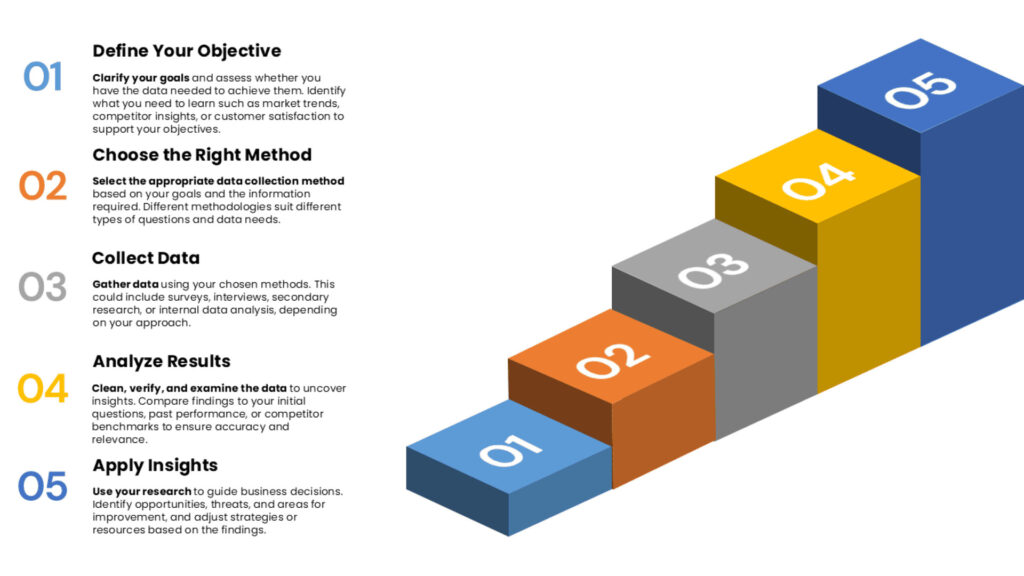
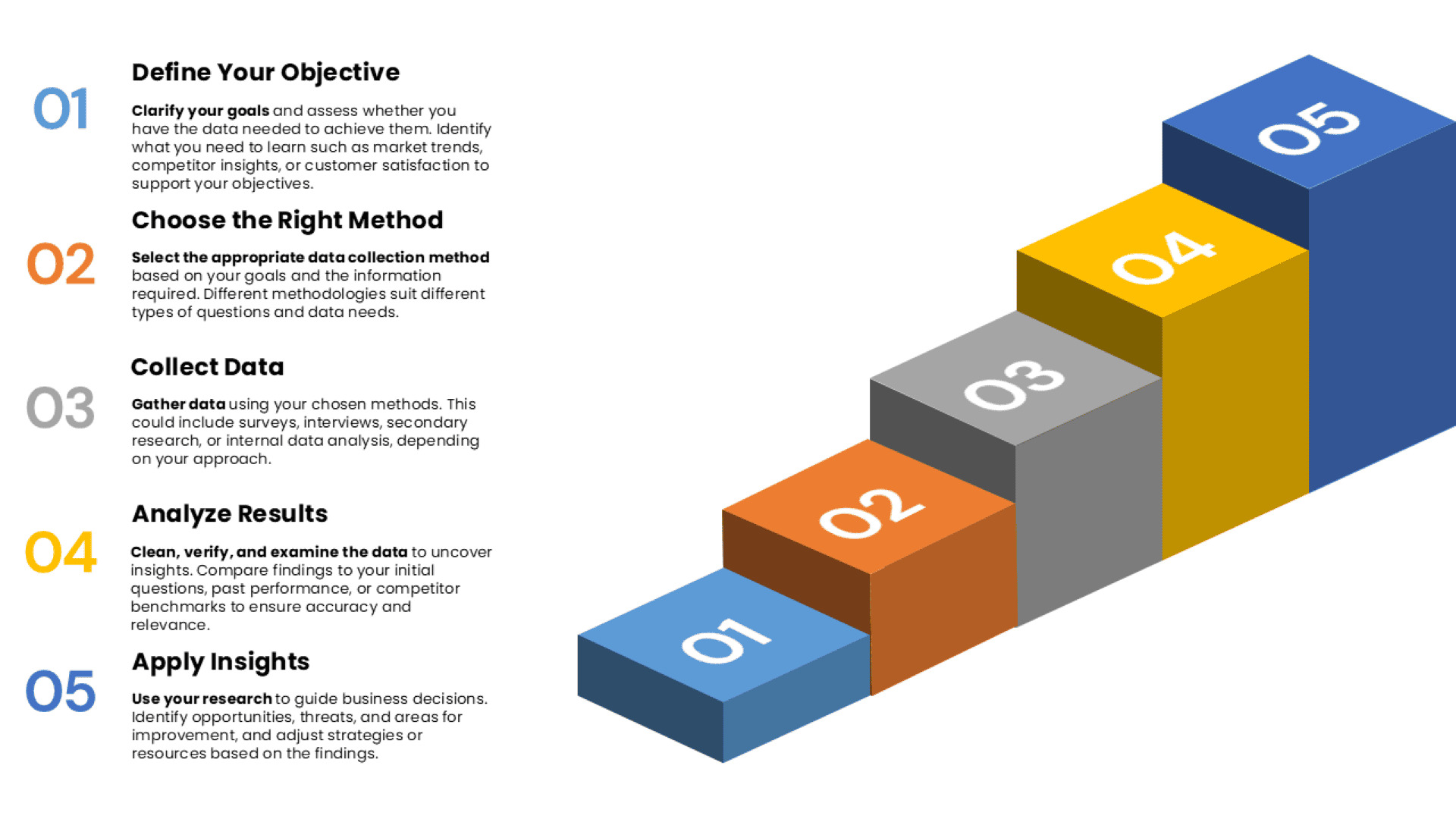
1. Defining Objectives
The process begins with clearly identifying the business challenge or opportunity. Precise objectives ensure the research remains aligned with strategic goals.
2. Research Design
Selecting the appropriate methodology—qualitative, quantitative, or a hybrid approach—is crucial. This stage determines data sources, sampling methods, and tools.
3. Data Collection
Information is gathered through surveys, interviews, focus groups, market databases, and other validated sources.
4. Analysis and Interpretation
Raw data is examined to uncover patterns, correlations, and insights that address the original objectives.
5. Reporting and Strategic Recommendations
Findings are translated into actionable recommendations that support informed decision-making.
This structured framework ensures research outcomes directly contribute to measurable business impact.
Types of Market Research Services
Primary Market Research
Primary research collects firsthand data directly from target audiences. This may include surveys, in-depth interviews, customer panels, and observational studies. Because the data is gathered specifically for the organization’s needs, it provides highly relevant insights.
Primary research is particularly valuable for:
- Product concept validation
- Pricing optimization
- Customer experience improvement
- Brand positioning strategies
Direct feedback helps organizations align offerings with real market demand.
Secondary Market Research
Secondary research involves analyzing existing data from credible sources such as industry publications, financial reports, trade associations, and public databases. It provides a broader market context, including:
- Market size and growth forecasts
- Regulatory frameworks
- Industry benchmarks
- Competitive landscapes
When combined with primary research, secondary analysis offers a comprehensive view of both micro and macro market factors.
Qualitative and Quantitative Research Approaches
High-impact Market Research services integrate both qualitative and quantitative methodologies to create a balanced perspective.
Qualitative Research
Qualitative research explores the “why” behind customer behavior. Through interviews and focus groups, businesses uncover emotional drivers, perceptions, and decision-making influences.
These insights are critical for:
- Understanding brand sentiment
- Exploring customer pain points
- Refining messaging strategies
Quantitative Research
Quantitative research focuses on measurable, numerical data. Surveys and statistical modeling help businesses quantify demand, validate trends, and forecast growth potential.
This approach supports:
- Market sizing
- Demand forecasting
- Performance measurement
- Investment planning
Together, qualitative depth and quantitative precision provide a holistic understanding of market dynamics.
The Role of Competitive Intelligence and Competitor Analysis
Beyond customer insights, organizations increasingly rely on Competitive intelligence services and Competitor analysis services to remain agile.
Competitive intelligence examines broader market movements, including emerging technologies, strategic alliances, and industry shifts. Competitor analysis focuses more directly on rival companies—evaluating strengths, weaknesses, product offerings, and strategic positioning.
By combining these services with core research initiatives, businesses gain 360-degree visibility into their operating environment.
Emerging Trends in Market Research
AI-Driven Analytics
Artificial intelligence and automation have revolutionized how research data is processed. Advanced algorithms can detect patterns and trends across vast datasets with greater speed and accuracy, accelerating insight generation.
Real-Time Market Monitoring
Organizations now leverage real-time analytics to track consumer behavior, brand sentiment, and market fluctuations as they occur. This agility enables faster response times and improved campaign optimization.
Companies that embrace these innovations strengthen their strategic responsiveness and competitive edge.
The Strategic Value of Market Research Services
Strong strategies are built on evidence. Market research empowers leadership teams with clarity regarding demand, competition, and opportunity before significant investments are made.
By validating ideas early and identifying potential barriers, organizations reduce uncertainty and allocate resources more effectively. In unpredictable markets, this strategic foresight becomes a defining advantage.
Businesses that consistently invest in research cultivate resilience, adaptability, and long-term growth.
Related Blogs:-
How Qualitative and Quantitative Research Can Work Together
Desk Research: The Secret Superpower for Better Decisions
Whitespace Research: Reading the Parts of the Market No One Underlines
Geospatial Analysis: Making Maps Useful for Business
Frequently Asked Questions (FAQs)
1. What are Market Research services and why are they important?
Market Research services involve collecting and analyzing market data to guide strategic decisions. They help businesses understand customers, competitors, and industry trends while reducing risk.
2. How do Competitive intelligence services differ from Competitor analysis services?
Competitive intelligence services focus on broader industry trends and strategic movements, while Competitor analysis services specifically evaluate rival companies’ strengths, weaknesses, and positioning.
3. Which industries benefit from Market Research services?
Nearly every industry—including healthcare, technology, manufacturing, retail, finance, and energy—benefits from research-driven insights when making strategic decisions.
4. When should a company conduct market research?
Research should be conducted before launching new products, entering new markets, adjusting pricing strategies, or making major investment decisions.
5. How long does a market research project typically take?
Project timelines vary based on scope and methodology. Some studies may take a few weeks, while comprehensive research initiatives may require several months.
In today’s dynamic business landscape, informed decisions separate industry leaders from the rest. By integrating Market Research services, supported by strong Competitive intelligence services and Competitor analysis services, organizations can move forward with confidence—transforming uncertainty into opportunity and data into lasting growth.
Connect with us today and turn your data into a powerful driver of growth and success.