Neonatal Intensive Care Market Size and Forecast 2025–2033
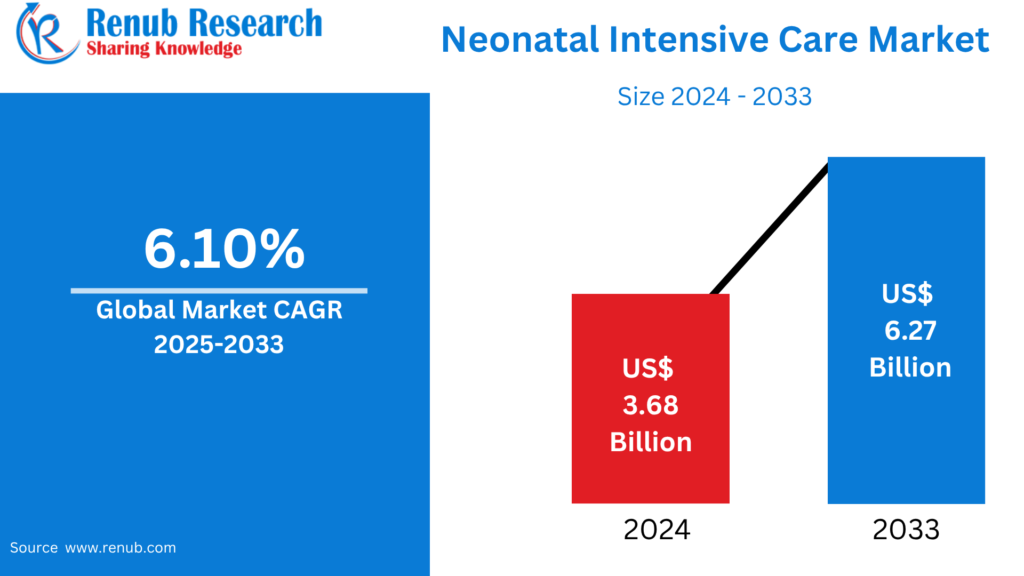
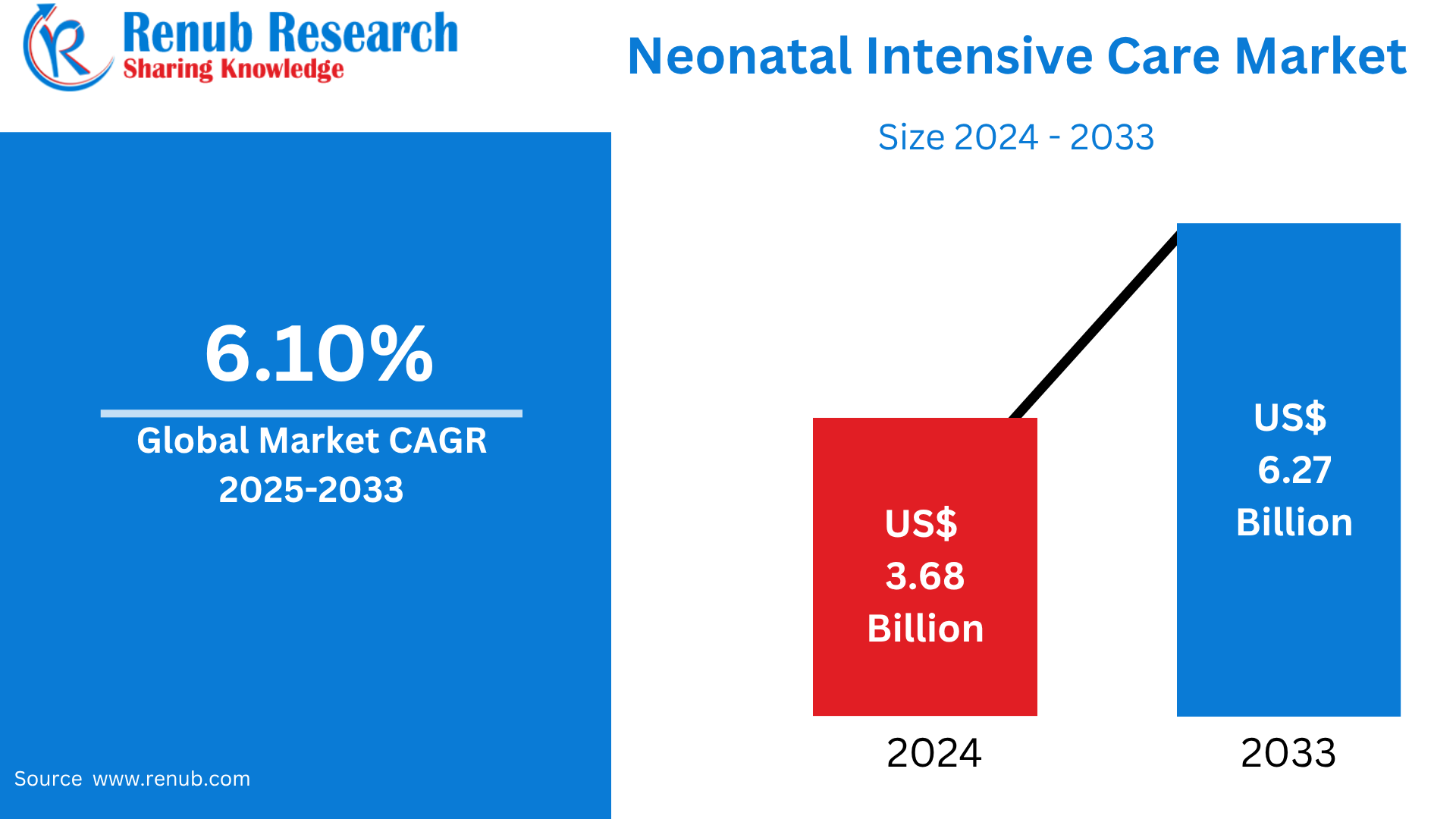
According to Renub Research Global Neonatal Intensive Care Market is valued at US$ 3.68 billion in 2024 and is projected to reach approximately US$ 6.27 billion by 2033, expanding at a CAGR of 6.10% from 2025 to 2033. Market growth is strongly supported by the rising incidence of preterm births, technological advancements in neonatal equipment, improved healthcare accessibility, and increasing global investment in neonatal healthcare infrastructure. Growing awareness of infant survival, government initiatives for maternal and child health, and advancements in medical innovations are strengthening demand for neonatal intensive care services across developed and developing regions.
Overview of the Neonatal Intensive Care Market
Neonatal Intensive Care Units (NICUs) are specialized hospital departments designed to care for newborns requiring critical medical supervision, particularly premature babies, low birth weight infants, and newborns suffering from severe medical complications. These highly specialized units are equipped with state-of-the-art technology, including incubators, ventilators, monitoring systems, and advanced life-support equipment, while being staffed by neonatologists, trained nurses, respiratory therapists, and dedicated support professionals. NICUs provide continuous monitoring, temperature regulation, respiratory assistance, nutrition delivery, and infection management to improve survival outcomes in vulnerable newborns. By offering immediate intervention and advanced clinical support, NICUs play an essential role in reducing infant mortality and safeguarding neonatal health.
Download Free Sample Report:https://www.renub.com/request-sample-page.php?gturl=neonatal-intensive-care-market-p.php
Growing Importance and Applications of NICU Services
NICUs are crucial in managing health complications such as respiratory distress syndrome, congenital heart defects, infections, neurological disorders, developmental delays, and preterm birth-associated complications. Premature infants frequently require support for breathing, feeding, temperature stability, and immune defense due to underdeveloped organs. Highly advanced incubators, ventilation systems, phototherapy equipment, and intravenous nutrition therapy enable hospitals to stabilize critical newborns and enhance survival chances. With increasing healthcare awareness and technological integration, NICUs continue to evolve as indispensable facilities in modern healthcare systems, significantly improving neonatal outcomes worldwide.
Key Market Drivers Fueling Neonatal Intensive Care Market Growth
One of the primary growth drivers is the continuous advancement in neonatal medical technology, contributing to improved treatment outcomes and survival rates. High-resolution imaging, non-invasive monitoring devices, smart incubators, enhanced respiratory support systems, and intelligent alarms help healthcare professionals deliver precise care. Additionally, the global rise in preterm births driven by maternal age factors, lifestyle influences, fertility treatments, and chronic conditions such as hypertension and diabetes further accelerates market demand. Increased awareness, along with government initiatives to support maternal and child healthcare, ensures wider adoption of NICU services.
Technological Advancements Strengthening NICU Efficiency
Rapid advancements in neonatal equipment have significantly improved diagnosis, monitoring, and treatment in NICU environments. Innovations such as AI-integrated monitoring systems, portable incubators, neonatal ventilators, phototherapy devices, and sophisticated life-support units ensure more accurate and responsive neonatal care. These technologies enhance precision while reducing complications, shortening hospital stays, and improving clinical outcomes. Hospitals worldwide are increasingly investing in advanced NICU technologies, upgrading healthcare infrastructure, and adopting digital healthcare solutions to modernize neonatal care services.
Rising Preterm Births Increasing NICU Demand
Preterm births remain one of the key contributors to neonatal admissions globally. Babies born before 37 weeks often require specialized medical support to regulate breathing, nutrition intake, temperature stability, and infection control. Factors such as maternal age advancement, fertility treatments, stress, environmental exposure, and chronic medical conditions contribute to increasing preterm delivery rates. As a result, demand for NICU beds, specialized equipment, and trained healthcare professionals continues to rise, compelling hospitals to expand intensive care capacity and enhance neonatal healthcare capabilities.
Growing Healthcare Accessibility and Awareness Enhancing Market Growth
Improved global healthcare accessibility and awareness of neonatal health are other key contributors to market expansion. Emerging economies are investing significantly in strengthening healthcare infrastructure, establishing NICU facilities, and training medical professionals. Public health campaigns, better maternal healthcare screening, and increased awareness about preterm infant care encourage early diagnosis and timely medical intervention. Government initiatives, hospital expansion programs, and strategic partnerships between private and public healthcare sectors are collectively supporting the widespread adoption of neonatal intensive care services.
Major Challenges in the Neonatal Intensive Care Market
Despite strong growth opportunities, the neonatal intensive care market faces challenges such as high treatment costs and limited skilled workforce availability. NICU treatments require expensive equipment, highly specialized staff, long-term hospitalization, and intensive resource utilization, making neonatal care financially demanding. In countries with limited insurance coverage, affordability becomes a significant obstacle, leading to disparities in healthcare access. Additionally, the global shortage of trained neonatal specialists, nurses, and respiratory therapists poses operational challenges, particularly in rural and developing regions. Addressing workforce shortages through skill development programs and healthcare investments remains critical for sustained market growth.
United States Neonatal Intensive Care Market Outlook
The United States leads the neonatal intensive care market with its highly advanced healthcare infrastructure, strong technological adoption, and high demand for specialized infant medical services. The country witnesses a considerable number of preterm births each year, requiring advanced neonatal care. Hospitals in the U.S. are equipped with world-class NICUs, including cutting-edge ventilators, incubators, and diagnostic systems. Although treatment costs remain high, government programs, Medicaid, and private insurance initiatives help improve accessibility. Continuous technological advancements, strong healthcare policies, and increasing awareness about infant survival ensure steady market growth in the United States.
Germany Neonatal Intensive Care Market Overview
Germany holds a significant position in the European neonatal intensive care market due to its highly developed healthcare infrastructure, strong government support for maternal and child health, and commitment to healthcare innovation. German NICUs are well-equipped with advanced monitoring systems and life-support equipment, enabling efficient management of critical infant cases. Research-driven advancements, high-quality neonatal services, and healthcare modernization initiatives contribute to improved neonatal survival rates. Strong public and private sector investments continue to support the growing NICU market in Germany.
Brazil Neonatal Intensive Care Market Outlook
Brazil represents one of the leading neonatal intensive care markets in Latin America, driven by improvements in healthcare infrastructure and growing government focus on reducing infant mortality rates. Increasing preterm birth rates have intensified demand for specialized neonatal units across urban hospitals. Brazil continues to enhance healthcare accessibility by integrating advanced NICU technologies, strengthening training programs, and expanding neonatal support services. Ongoing healthcare reforms and federal health initiatives further support the growth of neonatal intensive care services in Brazil.
Saudi Arabia Neonatal Intensive Care Market Outlook
Saudi Arabia is experiencing strong growth in the neonatal intensive care sector, fueled by government investments in healthcare modernization and neonatal support systems. The Kingdom actively prioritizes infant health through infrastructure expansion, advanced NICU installations, and national healthcare development initiatives. Rising preterm birth rates and a growing population increase the necessity for upgraded neonatal facilities. Collaboration between public institutions and private healthcare providers ensures rapid technological adoption, improved clinical capabilities, and better neonatal care delivery across Saudi hospitals.
South Africa Neonatal Intensive Care Market Outlook
South Africa remains one of the leading neonatal healthcare markets in Africa due to extensive healthcare development efforts and increased access to specialized neonatal services. Rising preterm birth rates and neonatal mortality challenges have encouraged government and private sector investment in advanced NICU technologies. Modern incubators, ventilators, phototherapy units, and non-invasive monitoring systems are increasingly adopted across hospitals. While rural healthcare disparities persist, continuous improvements in infrastructure and policy support significantly contribute to growing NICU demand.
Product Segmentation and End-User Insights in the Neonatal Intensive Care Market
The neonatal intensive care market is categorized into warmers, incubators, respiratory devices, monitoring systems, phototherapy equipment, and other NICU technologies. End users include hospitals, neonatal pediatric hospitals, pediatric clinics, childcare centers, and specialized healthcare institutions. Demand is particularly strong across hospitals due to increasing NICU installation and expansion. Regionally, North America, Europe, Asia Pacific, Latin America, and Middle East & Africa represent major market territories, with the United States, Germany, Japan, China, India, Brazil, Saudi Arabia, and South Africa demonstrating high growth potential.
Leading Companies in the Neonatal Intensive Care Market
Prominent companies operating in the neonatal intensive care market include Masimo Corporation, 3M Company, Medtronic PLC, Koninklijke Philips N.V., Siemens Healthcare GmbH, Terumo Corporation, AngioDynamics, and Drägerwerk AG & Co. KGaA. These companies focus on technological innovations, product enhancement, strategic partnerships, and healthcare infrastructure collaboration to strengthen their presence and expand global market reach.