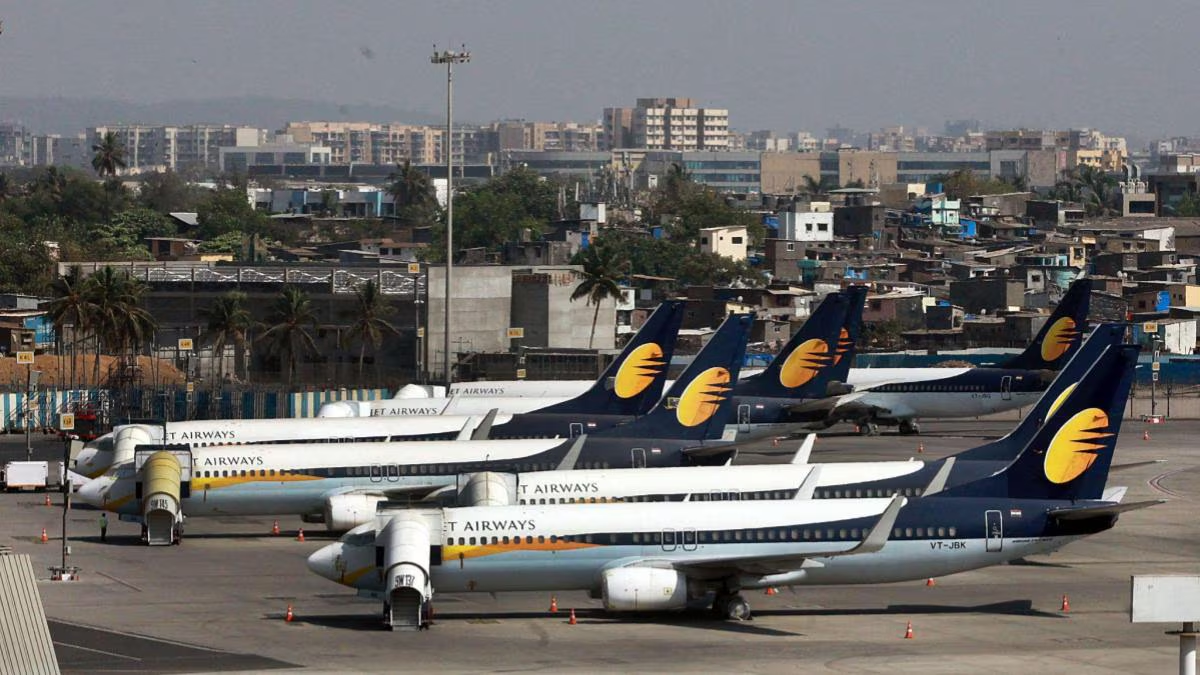
The story of Jet Airways is one of ambition, expansion and then collapse. For many years, Jet stood as one of India’s leading private carriers. But then, things unraveled. In this article, we explore what happened to Jet Airways, look into key causes behind its downfall, examine the question: is Jet Airways closed permanently, and consider the lessons for the Indian aviation sector.
1. The Ascent: From a Private Startup to a Major Carrier
Jet Airways was founded by Naresh Goyal in 1993 and began full operations a couple of years later. At its peak, Jet had a large fleet, a significant domestic and international network, and stood for premium service in India. It grew by acquiring other carriers, expanding internationally and investing in wide-body aircraft.
This period of expansion reflected not only Jet’s ambition but also the optimism of India’s rapidly growing air travel market. Yet behind the success there were already warning signs: rising costs, fuel price volatility, and increasing competition from budget carriers.
2. The Beginning of the End: Financial and Operational Strain
In the years leading up to the collapse, several factors converged:
- Rising fuel costs and weak profitability: Higher global oil prices added pressure.
- Strong competition: Low-cost carriers in India were expanding rapidly and pushing down yields.
- Aggressive fleet expansion and high fixed costs: Jet had made large orders for aircraft just as the market was shifting.
- Debt accumulation: The company borrowed heavily and struggled when cash flows turned negative.
In short: the model that had worked during expansion became less sustainable in a tougher environment. As one analyst put it, what happened to Jet Airways was a mixture of structural and strategic mis-steps.
By March 2019, the crisis had deepened: many aircraft were grounded. On 17 April 2019 Jet suspended all operations after lenders refused further emergency funds.
So when one asks what happened to Jet Airways, this is the core: a once-dominant airline lost its financial footing, the environment changed, and it couldn’t recover.
3. The Big Question: Is Jet Airways Closed Permanently?
The short answer: yes, it is. The decisive point came on 7 November 2024 when the Supreme Court of India ordered the liquidation of Jet Airways under the Insolvency and Bankruptcy Code.
Prior to that, Jet was under a resolution process — driven by the committee of creditors under the Insolvency and Bankruptcy Code, 2016 (IBC). A resolution plan by the consortium of Jalan-Kalrock had been approved earlier but failed to meet its financial obligations, and the lenders challenged it. The Supreme Court found the implementation “not possible to be implemented” and directed liquidation.
Thus, to the keyword question: is Jet Airways closed permanently? Yes. The airline is no longer operational and has been formally liquidated.
4. Timeline of Key Events
Here’s a succinct timeline to frame the sequence:
- 1993-95: Jet starts operations domestically.
- Early 2000s: International expansion begins (2004 onwards) and fleet grows.
- Mid-2010s: Jet is a major player, but costs and competition start to bite.
- 2018-19: Financial trouble becomes acute. In March 2019 many aircraft grounded.
- 17 April 2019: Jet suspends all flights after lenders turn down emergency funding.
- June 2019: Referred to National Company Law Tribunal (NCLT) for insolvency.
- November 2024: Supreme Court orders liquidation — end of the airline.
This timeline clarifies the build-up, collapse and final closure.
5. Analysis: Why Exactly Did Jet Collapse?
Many factors played a role; let’s parse them into internal and external causes.
External causes
- Fuel price volatility: As a major cost component, rising prices harm airlines.
- Competition: Low-cost carriers like IndiGo (and others) expanded aggressively, increasing pressure on fares and yields.
- Economic slowdown or weaker market recovery can hurt demand for premium services.
Internal causes
- Fleet strategy: Rapid expansion and expensive orders — large wide-body aircraft, long-haul network — added cost and complexity. For example, Jet placed large orders for Boeing 737 MAX and 787 Dreamliners just before the downturn.
- Capital structure and debt: Heavy borrowing meant that when cash flow turned negative, the leverage became a major liability.
- Management timing and decisions: Some analysts highlight that Jet grew at a time when the low-cost paradigm was shifting the Indian market, and Jet did not adapt fast enough.
- Delayed resolution: Once in trouble, the resolution process under IBC took time, during which operations could not restart and the brand value dissipated.
In other words, Jet’s collapse was not due to a single event but a combination of strategic misalignment, financial stress and a changing environment.
6. Impacts of the Collapse
The collapse of Jet Airways had wide-ranging implications:
- For employees: Thousands lost jobs or faced uncertainty.
- For creditors and lessors: Jet left behind huge debts (estimated to be several thousand crores of rupees) and grounded aircraft.
- For passengers: Customers faced cancellations and uncertainty; the brand once seen as premium lost trust.
- For the aviation ecosystem: The failure sounded a warning to other carriers about sustainability, risk management and adapting to market shifts.
There’s also the matter of brand value: once-proud brands cannot simply pause and resume without reputational damage. In Jet’s case, the longer the operations remained grounded, the harder revival became.
7. Could Jet Have Been Saved? What Might Have Changed?
Reflecting back, one can imagine a few alternative paths:
- Earlier cost rationalisation: If Jet had slowed expansion, reduced debt earlier and streamlined operations, the balance sheet might have been healthier.
- Shift in fleet strategy: Focusing more on flexible, lower-risk aircraft rather than large wide-body commitments may have eased pressure.
- Adaptation to low-cost competition: Recognising the shift in market preference and adjusting the business model accordingly might have helped.
- Quicker investor infusion or restructuring: The longer the delay in resolving its issues, the more value was lost. A quicker turnaround may have contained damage.
However, all this is speculative. The fact remains: Jet was overtaken by both its own ambitions and external market realities.
8. Why the Formal Liquidation Matters
When one asks is Jet Airways closed permanently, it’s key to understand why the liquidation decision is so significant. Under IBC, once the highest court orders liquidation, the prospect of revival as the original entity is essentially over. The assets are sold, the brand becomes orphaned and the debt slate has to be settled. In Jet’s case:
- The Supreme Court found the approved resolution plan non-viable.
- With liquidation, there is no operational restart under the same corporate entity.
- For stakeholders (shareholders, creditors, employees), recovery becomes about asset realisation rather than a going concern.
In short: liquidation signals the end of the airline as a going business and moves the focus to winding up rather than revival. That underlines the answer to the question about closure.
9. Lessons for the Aviation Sector and Beyond
The story of Jet Airways offers several broad lessons:
- Balance growth with sustainability – Rapid expansion can outpace the resilience needed for downturns.
- Align strategy with market shifts – Industries can change rapidly; carriers must adapt to cost pressures, customer preferences and competition.
- Keep leverage manageable – Too much debt limits flexibility when markets tighten.
- Act decisively when problems emerge – Delay in restructuring can magnify risks and erode value.
- Brand and trust matter – Once the customer confidence erodes, restart becomes harder.
For multinational companies watching India or similar markets, Jet’s case is a reminder that local dynamics, cost structures and regulatory environments demand constant vigilance.
10. Closing Thoughts
To wrap up: what happened to Jet Airways is a cautionary tale of a private carrier that soared high but was brought down by a mix of structural issues, strategic mis-steps and market disruption. And yes is Jet Airways closed permanently? Indeed, it is; following the Supreme Court’s liquidation order, the airline cannot return under the same entity in the same form.
While the Indian aviation market continues to grow and evolve, the fall of Jet invites deeper reflection on how companies manage growth, debt and the pace of change. In a globalised world, ambition is valuable but only if anchored to resilience, cost discipline and strategic clarity.