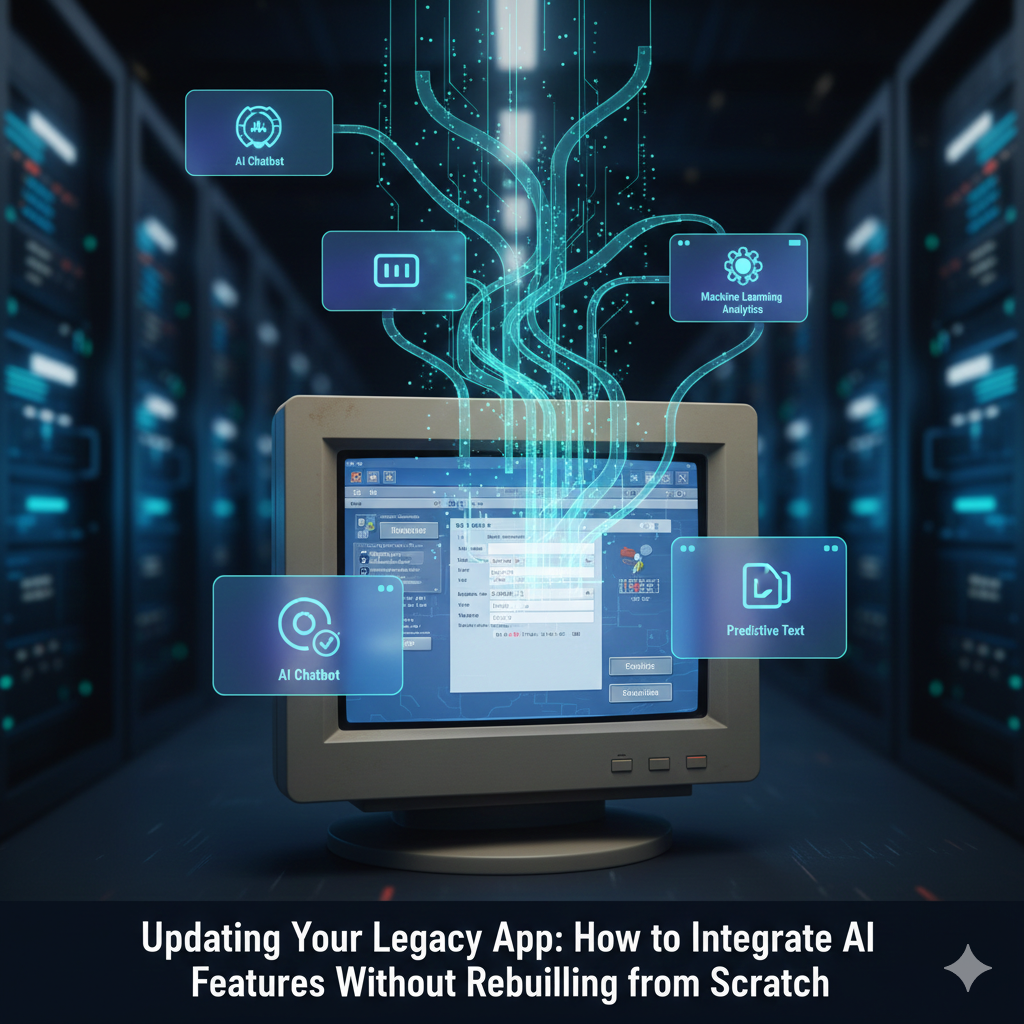
Business success depends on legacy applications which function as essential systems. The systems maintain business operations while preserving decades of important information and providing service to their dedicated customers. The legacy applications face difficulties in meeting customer expectations because modern software now includes artificial intelligence as an essential component. The good news is that integrating AI does not require tearing down your existing system and starting over. The right strategy enables businesses to modernise their applications while they gain new capabilities and maintain their competitive edge without incurring the expenses and dangers of total system reconstruction. The article demonstrates the process of efficiently integrating AI capabilities into existing systems while outlining the associated challenges and providing best practices for achieving successful system changes.
Why Modernise a Legacy App with AI?
AI acts now as a necessary business requirement because companies need it to establish their unique market identity. Through its various applications, which include personalised recommendations and predictive analytics and chatbots and automation services, AI technology improves both user experience and operational productivity.
Key benefits of AI integration include:
- Improved user engagement through personalization
- Automation of repetitive tasks which decreases operational expenses
- Smarter decision-making through data-driven insights
- The system provides both expansion capacity and future development flexibility
Organisations that spend money on app development services Australia now selects AI enhancements as their main focus because these upgrades will help them maintain their existing systems for a longer period while preserving their operational value.
The Midway Point with Legacy Applications
It is important to know what your boundaries are on your older systems before implementing any AI.
Outdated Architecture
Having monolithic designs is very hard when it comes to adding any new features to an application without breaking something else.
Limited API Access
Most legacy applications do not come with a well-documented API; hence, there are challenges with integrating AI into those applications.
Data Silos/Bad Data
The data that is needed to train an AI is clean and positioned in a structure; this is not the case with legacy systems.
Potential to Affect Performance and Security
Not preparing before adding AI can put a strain on your applications and leave holes in your application’s security.
These are the reasons modernisation needs to be strategy driven and phased in, not a blanket approach to revamping an application.
Process of Integrating AI Without People Rebuilding
Assess AI Readiness
Begin with conducting both a technical and a business audit. Identify which AI capabilities will help you achieve an end goal (i.e., automating customer support, fraud, and/or recommendation engines) to see if your infrastructure can support it enough to move forward.
Use APIs and Microservices
The system requires you to implement AI through APIs and microservices instead of direct integration into its core system. The system enables AI components to function as separate entities while they maintain continuous communication with the existing application.
The advantages of this solution provide:
- The existing code base experiences no major interruptions
- The system achieves simpler maintenance procedures and software updates
- The organization can implement new software releases with increased speed
The modular approach stands as the most successful method for contemporising systems while avoiding complete system reconstruction.
Leverage Cloud-Based AI Solutions
Businesses must use cloud-based artificial intelligence systems to meet their operational needs. The cloud systems from cloud providers offer ready-to-use artificial intelligence models and flexible computing resources, which remove the requirement for extensive changes to local systems. The cloud services enable fast integration of natural language processing, image recognition and predictive analytics capabilities. The best AI app development company in Australia helps businesses implement cloud-first AI solutions which reduce operational costs and system complexity and deployment duration.
Modernise Data Pipelines
Data pipelines require modern updates because they need current data processing methods. The AI system depends on its training data because the quality of its output relies on the data that serves as its training base. The team should concentrate their efforts on two main tasks, which involve first transforming their existing information into a usable format and second developing systems that can process data either in real time or through scheduled updates; and third, building systems that will guarantee their organisation complies with all privacy regulations. The enhanced availability of data permits AI systems to produce precise results while maintaining the fundamental structure of their software.
Start Small with Pilot Features
The organisation should begin its AI implementation through a pilot project which will test one AI feature at a time. The following two examples show this method:
- AI-powered chatbots for customer support
- Predictive analytics for sales forecasting
- Recommendation engines for content or products
The organisation uses this method because it decreases potential dangers while enabling teams to assess their return on investment before expanding operations.
Security & Compliance Considerations
When AI is integrated into existing systems, new security and compliance challenges arise. Businesses should also consider:
- Secure API communication
- Data encryption/access control
- Local and international compliance
Because of this, app development companies in Australia that focus on a secure-by-design approach to developing applications will help protect both business and customer data during integration.
Measuring Success After AI Integration
KPIs (key performance indicators) should be established early to assess the quality of results from AI features. Examples of KPIs could be:
- Reduced Operation Costs
- Faster Response Times
- Improved User Retention/Engagement
- Higher Conversion Rates
To guarantee that the investment made in the AI feature returns real value, ongoing measurement will allow you to determine whether or not the feature is truly creating value and not simply an underutilised feature.
Why Partnering with the Right Development Team Matters
The appropriate development team selection process determines the success of development projects. AI integration into legacy applications requires expertise across multiple domains—software architecture, data engineering, cloud platforms, and machine learning. In-house implementation without proper expertise leads to project delays and budget increases and system failures. The app development services Sydney organisations work with AI-specialised development firms to create modern applications. The best AI app development company in Australia brings proven frameworks to their clients which help them achieve fast results with reduced operational risks.
The Future of Legacy Applications with Artificial Intelligence
The process of modernising a legacy application now serves to achieve innovative solutions rather than simply maintaining operational systems. Artificial intelligence enables businesses to extend their application lifespan while satisfying current user requirements. Through their implementation of APIs and cloud-based AI services and their phased execution approach, companies can upgrade their current software systems into intelligent platforms which will remain operational for upcoming technological advancements without needing complete system reconstruction.
Conclusion
The process of AI-based system modernisation constitutes a strategic investment for organisations, which they should not view as an operational challenge. Through proper execution of the modernisation process, organisations can achieve efficient progress while maintaining their market position and developing advanced digital solutions that will benefit them for future years.