United States Residential Remodeling Market Size and Forecast 2025–2033
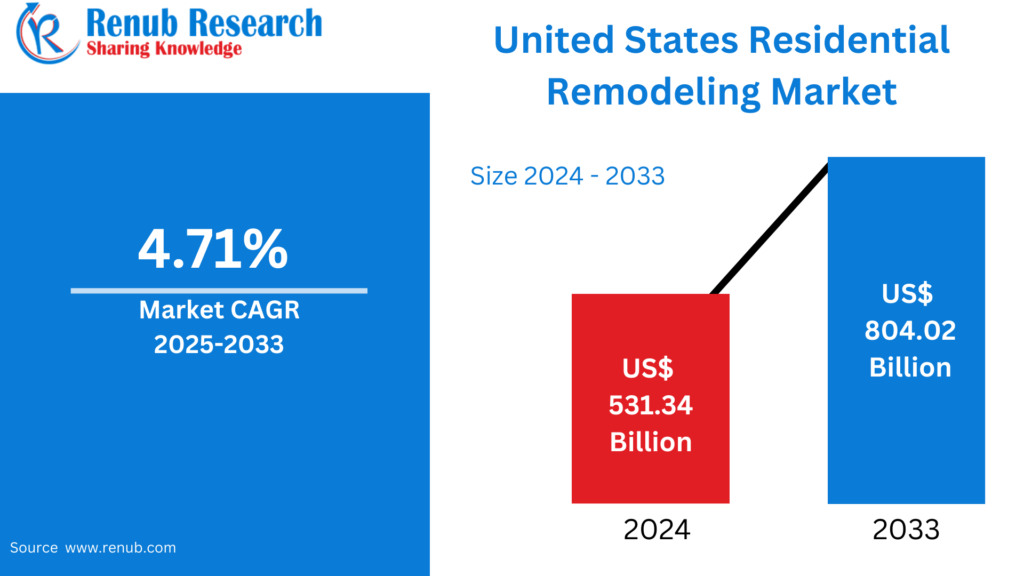
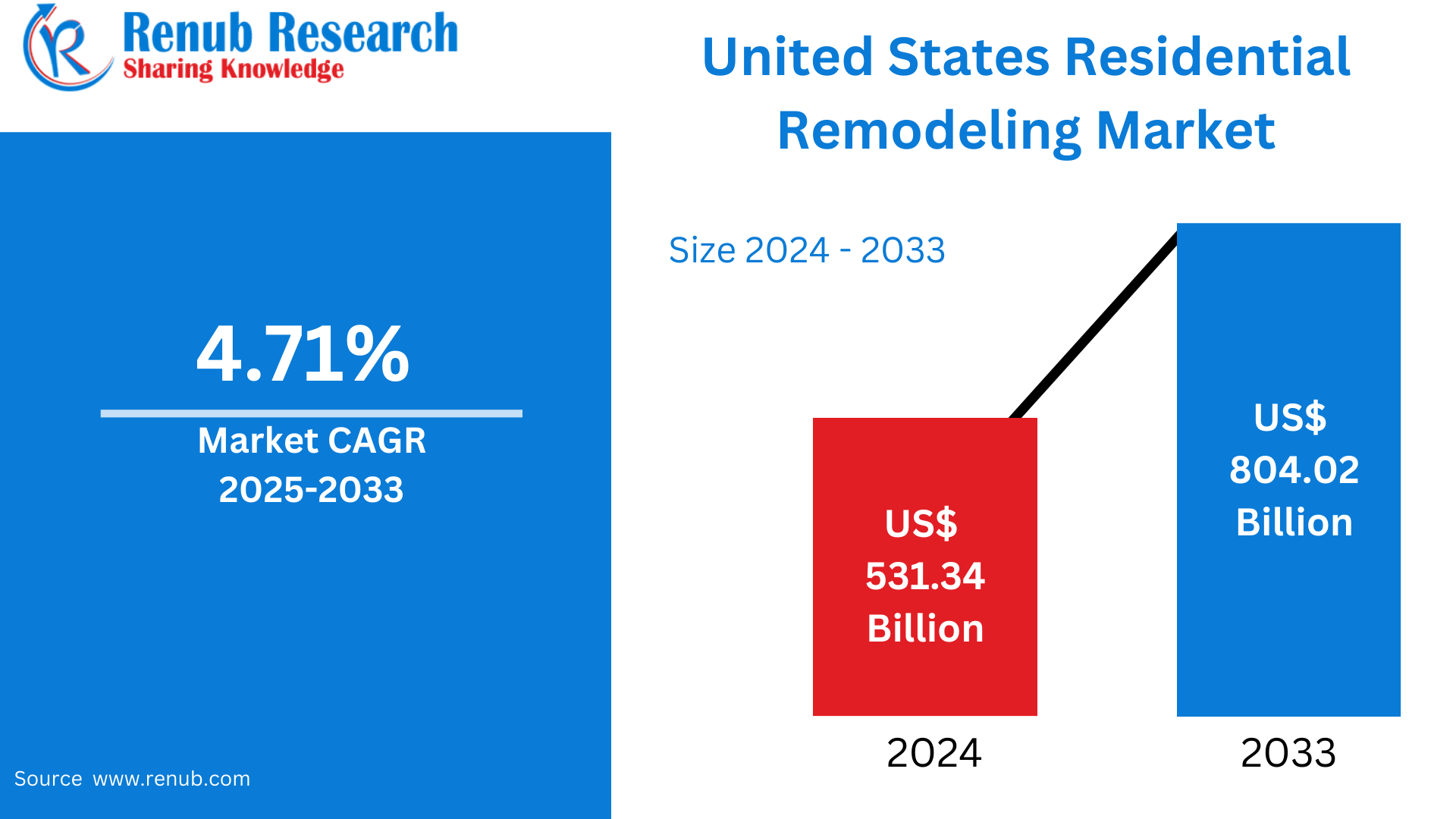
According to Renub Research United States Residential Remodeling Market is projected to reach US$ 804.02 billion by 2033, increasing from US$ 531.34 billion in 2024, registering a CAGR of 4.71% from 2025 to 2033. Steady economic conditions, rising homeowner investments, and modernization of aging housing infrastructure are significantly boosting market demand. In addition, the growing focus on energy efficiency, sustainability, and enhanced home comfort is reshaping remodeling priorities across the country.
United States Residential Remodeling Market Overview
The U.S. residential remodeling market forms a crucial pillar of the overall construction industry, reflecting evolving living standards, lifestyle upgrades, and long-term property value optimization. This market consists of renovation, upgrade, maintenance, and improvement projects that enhance both structural performance and aesthetic appeal of homes. With millions of American homes now over 30 years old, the need for modernization has intensified. Urbanization trends, demographic shifts, and modernization expectations continue to influence market expansion, making remodeling a preferred alternative to costly new housing development.
In recent years, technology-driven remodeling has transformed consumer experiences. Digitization through 3D design tools, virtual consultations, AI-enabled planning, and online contractor platforms has increased project transparency and customization. Contractors are now able to offer faster execution with precision-driven processes, while homeowners benefit from improved cost efficiency and design flexibility.
Environmental consciousness has also become a strong market influencer. The adoption of green building materials, smart energy systems, insulated windows, solar enhancements, and sustainable interiors has surged dramatically. Federal and state incentives supporting sustainability and energy conservation continue to encourage remodeling expenditure.
Despite periodic economic pressures, the U.S. residential remodeling market has displayed strong resilience. Increased home equity, rising disposable income, and lifestyle-centric renovation needs continue to propel demand across diverse segments including kitchen upgrades, bathroom remodeling, outdoor living enhancements, and structural improvements.
Download Free Sample Report:https://www.renub.com/request-sample-page.php?gturl=united-states-residential-remodeling-market-p.php
Key Growth Drivers of the United States Residential Remodeling Market
Aging Housing Stock and Maintenance Demand
A substantial portion of U.S. residential properties was built decades ago, resulting in structural wear, outdated layouts, and declining energy efficiency. Homeowners are increasingly investing in essential upgrades such as roofing replacement, electrical rewiring, plumbing modernization, foundation strengthening, and interior redesign to improve safety and comfort. Energy-efficient retrofits supported by government incentives are helping homeowners prolong home life cycles rather than shifting to new construction, thereby solidifying remodeling demand.
Increasing Homeowner Equity and Spending Ability
Rising home values across the United States have significantly improved homeowner equity, enabling households to allocate greater financial resources toward remodeling. Rather than relocating, many Americans now view home remodeling as a strategic investment that enhances resale value while improving living conditions. Accessible financing options, home improvement loans, and increased disposable incomes further support large-scale and luxury renovation projects.
Growing Emphasis on Sustainability and Energy Efficiency
Energy efficiency has become a defining theme in U.S. home improvement. Homeowners are increasingly prioritizing eco-friendly materials, insulated windows, smart thermostats, energy-efficient HVAC systems, solar power integration, and sustainable building practices. Younger generations, particularly environmentally conscious homeowners, are driving strong adoption of green remodeling solutions. Federal and state-based incentive programs encourage the installation of high-efficiency and renewable systems, creating long-term cost savings and higher property value, fueling sustained market growth.
Key Challenges in the United States Residential Remodeling Market
Skilled Labor Shortages and Rising Labor Expenses
The construction workforce shortage remains one of the most critical constraints in the U.S. remodeling sector. A retiring workforce, limited vocational entrants, and high demand have led to labor scarcity, escalating labor costs and extending project timelines. Contractors face operational challenges in scaling services and maintaining timelines, while homeowners experience higher budget requirements. Addressing this gap requires increased investment in trade training programs and workforce development initiatives.
Material Cost Instability and Supply Chain Issues
The market continues to experience periodic material cost fluctuations due to inflation, global disruptions, and logistics constraints. Volatility in lumber, steel, cement, fixtures, and energy-efficient products impacts pricing structures and project feasibility. Supply delays and rising freight costs often result in postponed projects or adjustments in renovation plans. Although contractors increasingly source from multiple suppliers and promote locally produced materials, ongoing fluctuations remain a challenge for industry stability.
United States Residential Remodeling Market Overview by States
California Residential Remodeling Market
California remains a key remodeling hub driven by high property values, strict environmental policies, and strong demand for modernization. Homeowners prioritize solar installations, sustainable materials, outdoor living enhancements, smart home systems, earthquake resilience upgrades, and fire-resistant construction. Despite premium labor and material costs, property appreciation continues to justify remodeling investments across major urban centers including Los Angeles, San Francisco, and San Diego.
Texas Residential Remodeling Market
Texas benefits from rapidly expanding residential communities, population growth, and increasing income levels. Homeowners focus on kitchen and bathroom renovations, HVAC improvements, insulation, roofing upgrades, and outdoor extension projects. Urban development in Dallas, Houston, and Austin continues to drive strong remodeling momentum. Despite labor shortages and supply chain constraints, strong consumer confidence sustains robust market growth.
New York Residential Remodeling Market
New York’s market reflects urban density, aging buildings, and high remodeling sophistication. Homeowners focus heavily on space optimization, luxury interiors, modernization of historical structures, smart technology integration, and energy-efficient retrofits. Due to limited housing availability, homeowners invest in high-value improvements rather than relocating, ensuring sustained remodeling demand despite elevated project costs.
Florida Residential Remodeling Market
Florida’s robust remodeling growth is influenced by strong population expansion, tourism-driven upgrades, and climate resilience requirements. Key focus areas include hurricane-resistant construction, roofing reinforcement, stormproof windows, outdoor lifestyle upgrades, luxury interiors, and accessibility renovations. High second-home ownership and retirement housing trends further strengthen spending dynamics.
Recent Developments in the United States Residential Remodeling Market
Major developments are enhancing the competitive landscape of the U.S. remodeling sector. Industry leaders are expanding service capabilities, strengthening contractor networks, and enhancing supply capacity to meet rising consumer expectations. Strategic acquisitions, capacity investments, and professional service enhancements are significantly supporting the industry’s modernization and service diversification initiatives.
Market Segmentation of the United States Residential Remodeling Market
By Application
Flooring
Walls
Ceilings
Porch, Garden, and Garage
System and Equipment
Disaster Repair
Others
By Service Type
Full-Remodeling Service Providers
Specialized Service Providers
By States
California
Texas
New York
Florida
Illinois
Pennsylvania
Ohio
Georgia
New Jersey
Washington
North Carolina
Massachusetts
Virginia
Michigan
Maryland
Colorado
Tennessee
Indiana
Arizona
Minnesota
Wisconsin
Missouri
Connecticut
South Carolina
Oregon
Louisiana
Alabama
Kentucky
Rest of United States
Competitive Landscape of the United States Residential Remodeling Market
The competitive environment is defined by innovation, product quality, technological integration, sustainability initiatives, and extensive distribution networks. Market leaders focus on strategic partnerships, acquisitions, capacity enhancement, and digital expansion to strengthen market presence. Key companies include:
Kohler Co.
Trex Company
Dow Inc.
Pella Corporation
JELD-WEN
IndustrieCottoPossagno S.p.A
Lutron Electronics Co. Inc.
Boise Cascade Company
Andersen Corporation
Seven Group Holdings Limited
Future Outlook of the United States Residential Remodeling Market
From 2025 to 2033, the United States Residential Remodeling Market is expected to maintain strong and stable growth. Increasing modernization trends, sustainability priorities, demand for smart living solutions, population expansion, and long-term home value enhancement will continue driving investment across residential segments. Aging infrastructure, technological innovation, and increasing homeowner spending power will ensure that remodeling remains a cornerstone of the U.S. housing economy in the coming decade.