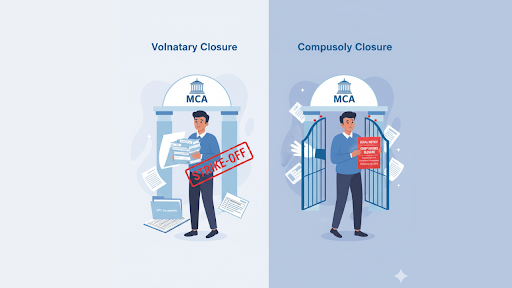
A One Person Company (OPC) offers entrepreneurs the flexibility of limited liability and single ownership. However, there may come a time when the business becomes inactive, unprofitable, or no longer aligned with the promoter’s goals. In such cases, closing the company legally is necessary to avoid ongoing compliance costs and penalties.
There are two main ways to close an OPC in India: Voluntary Closure and Compulsory Closure. While both lead to the same outcome (dissolution of the company), the process, reasons, and legal requirements differ. Let’s understand both in detail.
What Is the Closure of an OPC?
The closure of OPC means formally dissolving it under the Companies Act, 2013 so that it ceases to exist as a legal entity. After closure, the OPC is removed from the Register of Companies maintained by the Registrar of Companies (ROC).
Closing an OPC ensures that no further annual compliance, tax filings, or financial statements are required. It also helps the director avoid unnecessary penalties or legal risks for an inactive company.
Why Might an OPC Need to Be Closed?
Several reasons can lead to the closure of an OPC:
- The business is no longer operational or profitable.
- The promoter wants to start a new business structure.
- Non-compliance or continuous financial losses make operations unviable.
- The company has remained inactive for more than one year.
- The ROC issues a notice for non-filing of annual returns or financial statements.
Whether the decision is voluntary (by the owner) or compulsory (by order of law), the closure must be completed as per the prescribed legal process.
Types of OPC Closure
There are two recognized types of OPC closure under Indian company law:
- Voluntary Closure – when the member/director decides to shut down operations willingly.
- Compulsory Closure – when the ROC or NCLT (National Company Law Tribunal) orders closure due to default or non-compliance.
Let’s look at both types in depth.
Voluntary Closure of OPC
A Voluntary Closure is initiated by the sole member or director when they decide that continuing the business is no longer necessary. It is carried out through the Fast Track Exit (FTE) process governed by Section 248(2) of the Companies Act, 2013.
When Can an OPC Apply for Voluntary Closure?
An OPC can apply for voluntary closure if:
- It has not commenced business since its incorporation, or
- It has not carried out any business activities for at least one year.
The company should not have any outstanding liabilities, loans, or ongoing legal proceedings before applying for closure.
Procedure for Voluntary Closure of OPC
- Board Resolution
The director must pass a resolution approving the closure of the company and authorizing the filing of necessary applications with the ROC. - Filing of Application (Form STK-2)
An application for striking off is filed in Form STK-2 along with prescribed documents and fees. - Documents Required
- Copy of Board Resolution for closure
- Indemnity Bond by the director
- Affidavit from the director confirming no liabilities
- Statement of Accounts (not older than 30 days)
- Copy of PAN card and Aadhaar card of the director
- Consent from the member (in case of any nominee)
- ROC Verification and Approval
After verifying all documents, the ROC may publish a public notice inviting objections (if any) and then strike off the name from the Register of Companies.
Timeframe and Cost
The voluntary closure of an OPC typically takes 3–6 months, depending on documentation and ROC processing time. The government filing fee for Form STK-2 is ₹10,000, excluding professional charges.
Advantages of Voluntary Closure
- No future compliance or penalties
- Legally ends all company obligations
- Simple and faster process under Section 248(2)
- Protects the director from unnecessary liabilities
Compulsory Closure of OPC
A Compulsory Closure occurs when the ROC strikes off the company’s name on its own under Section 248(1) of the Companies Act, 2013. This usually happens when the company fails to comply with statutory requirements or remains inactive for long periods.
When Does Compulsory Closure Apply?
The ROC can initiate compulsory closure if:
- The OPC has not commenced business within one year of incorporation.
- The company has not carried out any business activity for the past two financial years and has not applied for dormant status.
- The OPC has not filed annual returns or financial statements for two consecutive years.
- The company’s registered office is found non-existent or false.
- The company is carrying on illegal or fraudulent activities.
Procedure for Compulsory Closure
- Notice by ROC (Form STK-1)
The ROC sends a notice to the company and its director, stating the intention to remove the name from the register and allowing 30 days to respond. - Opportunity to Respond
The director can reply with supporting evidence showing that the company is operational or compliant. - Publication of Notice
If no satisfactory reply is received, the ROC publishes a notice in the Official Gazette and on the MCA website. - Striking Off and Dissolution
After expiry of the notice period, the company name is struck off, and the company stands dissolved. The notice of dissolution is also published in the Gazette.
Consequences of Compulsory Closure
- The company ceases to exist legally.
- Directors may face disqualification under Section 164(2) if defaults are found.
- Outstanding liabilities or pending legal cases remain enforceable.
- The company’s assets, if any, vest with the government.
Key Differences: Voluntary vs Compulsory Closure of OPC
|
Basis |
Voluntary Closure |
Compulsory Closure |
| Initiated by | Company itself | ROC (Registrar of Companies) |
| Governing Section | Section 248(2) | Section 248(1) |
| Reason | Non-operation or voluntary decision | Non-compliance or default |
| Notice Requirement | Self-initiated by the director | ROC issues notice to the company |
| Liability of Director | Ends after closure | May continue if defaults exist |
| Timeline | 3–6 months | 6–12 months (depends on ROC action) |
| Control over Process | Full control by the company | No control; decided by ROC |
| Future Impact | Clean legal exit | May cause director disqualification |
Can an OPC Be Revived After Closure?
Yes, under certain conditions, a closed OPC can be revived. As per Section 252 of the Companies Act, 2013, the company or any aggrieved person can apply to the National Company Law Tribunal (NCLT) within 20 years of strike-off to restore the company’s name.
However, revival is subject to valid reasons and documentary proof that the company was carrying on business or willing to rectify past defaults.
Important Compliance Tips Before Closing an OPC
Before initiating the closure process, ensure the following:
- All pending taxes, dues, and government liabilities are cleared.
- No ongoing court or legal cases exist.
- Bank accounts are closed, and NOC obtained.
- All assets and liabilities are settled.
- Final financial statements are prepared and approved.
Completing these steps ensures a smooth and lawful closure without future complications.
What Happens If an OPC Is Not Closed Properly?
If an OPC remains inactive but is not formally closed:
- ROC may strike off the company compulsorily.
- The director can be disqualified for 5 years under Section 164(2).
- The PAN and bank accounts may be flagged as non-compliant.
- Legal notices or penalties may continue even for an inactive company.
Hence, closing the OPC legally is always recommended rather than letting it remain dormant without proper filings.
Final Thoughts
Understanding the difference between Voluntary and Compulsory Closure of OPC helps you take timely action and avoid legal risks. A voluntary strike-off is always a cleaner, faster, and safer way to exit, as it demonstrates compliance and good governance.
If your OPC is no longer active, it’s wise to apply for voluntary closure before the ROC initiates action. Professional assistance from a company law expert or consultant can help you prepare documents correctly and ensure smooth approval by the authorities.