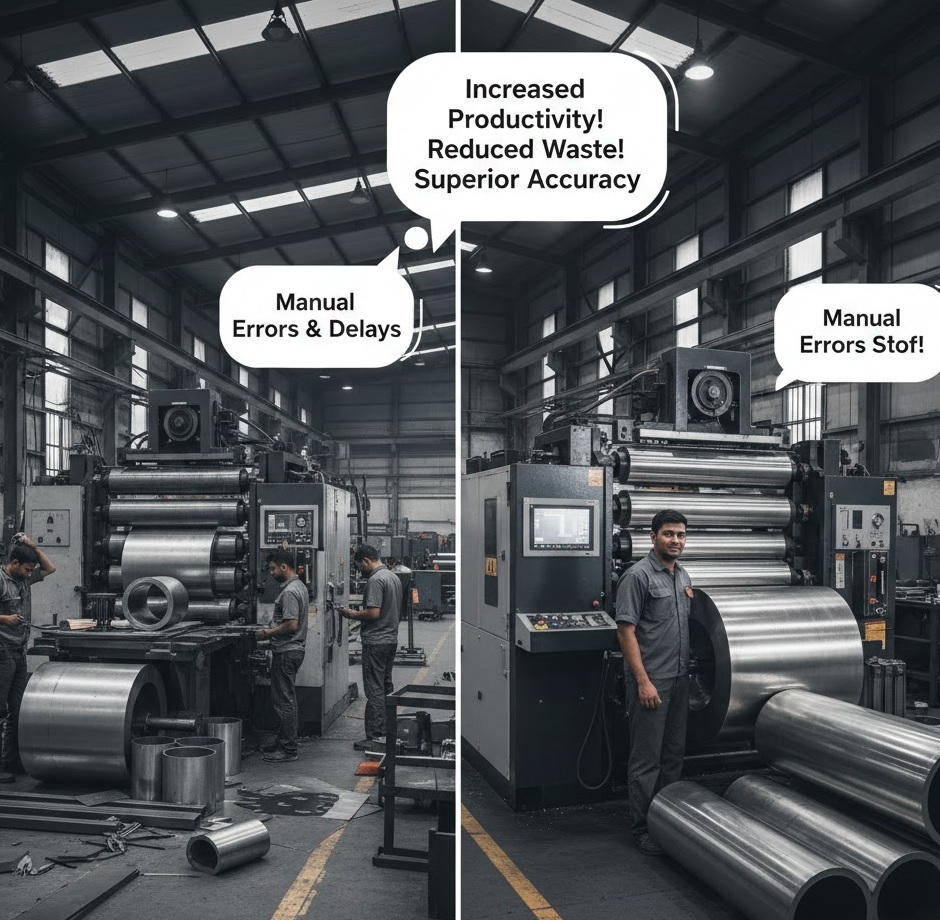
The change is not dramatic on day one. No fireworks. No sudden productivity miracle. But after a few weeks on the shop floor, patterns emerge. Operators behave differently. Rework bins stay emptier. Schedules stop slipping for reasons nobody can explain at first.
That quiet shift is what happens when fabrication moves from manual or semi-automatic rolling to automatic plate rolling machines. The difference is not just automation. It is consistency under load, repeatability under pressure, and control where it was previously assumed impossible.
The First Thing Noticed Is How Predictable the Output Becomes
Fabrication shops are used to variation.
Thickness variation. Springback variation. Operator variation.
With automatic plate rolling machines, unpredictability shrinks fast. Radius accuracy stops depending on who is standing at the console. The same plate, the same program, the same result—shift after shift.
This predictability changes how jobs are quoted and scheduled. Fabricators stop padding timelines “just in case.” Once rolling becomes repeatable, downstream operations stop waiting for corrections that never come.
Consistency is not glamorous. But it is addictive.
Operator Fatigue Drops Before Anyone Talks About Productivity
One of the most noticeable changes is physical, not numerical.
Manual rolling demands constant micro-adjustments—pressure tweaks, roll gap checks, repeated passes. Operators stay tense. Eyes glued to alignment. Hands always ready.
With automatic plate rolling machines, physical strain drops sharply. Programs handle sequencing. Load distribution stays balanced. The operator monitors instead of fights the machine.
- Fatigue reduction does something subtle: mistakes reduce without retraining.
- That alone justifies the switch for many shops.
Springback Stops Being a Daily Argument
Springback has always been the silent tax on plate rolling.
Manual setups rely on experience and guesswork. Overbend slightly. Check. Re-roll. Adjust. Repeat. The process works—but it wastes time and material.
Automatic systems model springback into the process. Not perfectly, but consistently. That matters more.
When automatic plate rolling machines compensate for material behavior the same way every time, rework drops. Scrap drops. Arguments between quality and production quietly disappear.
Material Utilization Improves Without Changing Material Grades
Forging exporter India often assume better yield requires better material.
Not always.
Uneven rolling introduces localized thinning, edge distortion, and internal stress. These flaws force wider allowances and higher rejection rates.
Automatic rolling keeps pressure distribution stable across the plate width. Bending is uniform. Thickness variation stays within predictable limits.
The result:
- plates cut closer to final dimensions
- less corrective trimming
- more usable output per sheet
- No material upgrade required.
Job Complexity Stops Being a Bottleneck
Complex geometries expose manual limits fast.
Cones, multi-radius shells, offset cylinders—manual rolling handles them, but slowly, cautiously, inconsistently.
With automatic plate rolling machines, complexity becomes a programming issue, not a mechanical struggle. Once parameters are validated, repetition becomes effortless.
Fabricators notice something important here:
jobs once avoided suddenly become viable.
That changes bidding strategy, customer profile, and long-term positioning.
Quality Inspection Moves from Correction to Confirmation
In manual rolling environments, inspection often means correction. Parts come back. Adjustments are made. Rework cycles continue.
After switching to automatic systems, inspection behavior changes. Measurements confirm instead of diagnose.
Radius gauges align. Edge mismatch reduces. Weld prep stays uniform.
This is when fabrication managers realize automation didn’t just speed up rolling—it stabilized the entire process chain.
Maintenance Becomes Predictable Instead of Reactive
Manual and semi-automatic machines hide stress until something fails.
Automatic systems expose load patterns clearly. Sensors, feedback loops, and controlled motion reduce shock loading.
Fabricators notice fewer “mystery breakdowns.” Wear follows patterns. Maintenance shifts from emergency response to scheduled intervention.
A shop that knows when something will need attention can plan production honestly.
Where SIDDHAPURA’s Plate Rolling Philosophy Stands Out
At SIDDHAPURA, automatic plate rolling systems reflect a focus on controlled force application rather than brute power. Frame stiffness, roll alignment, and synchronized motion are designed to keep load paths stable across varying plate thicknesses.
This approach matters because automatic control without mechanical discipline only automates inconsistency. Machines that stay accurate under real shop conditions earn long-term trust.
The Real Change Is How Fabricators Think About Rolling
After months of running automatic plate rolling machines, fabrication teams stop treating rolling as a risky operation.
It becomes predictable. Plannable. Scalable.
That mental shift is the real upgrade.
Jobs are scheduled tighter. Confidence replaces caution. Skilled operators focus on optimization instead of damage control.
Rolling stops being a variable and becomes a foundation.
Rolling Accuracy Starts Affecting Welding Long Before Anyone Notices
One of the least discussed effects of automatic plate rolling machines shows up at the welding station, not at the rolling bay.
When plates are rolled evenly, seam gaps stay consistent. Fit-up stops fighting gravity. Tack welds hold without forcing alignment. Welders stop using heat as a correction tool.
In manual rolling environments, welders quietly compensate for poor geometry. They pull edges together. They overweld. They introduce distortion just to make parts meet. The problem looks like a welding issue, but it started at rolling.
After switching to automatic systems, fabricators notice weld shrinkage reducing, post-weld straightening dropping, and overall structural accuracy improving. Not because welding changed—but because rolling stopped creating hidden problems upstream.
Repeat Jobs Stop Depending on “That One Experienced Operator”
Every fabrication shop has that one operator who “knows the machine.”
Manual rolling survives on tribal knowledge. Settings are remembered, not documented. Results vary when shifts change or people leave.
With automatic plate rolling machines, repeatability becomes institutional, not personal. Programs store logic. Parameters stay locked. Results don’t drift with mood, fatigue, or experience level.
Fabricators notice a critical shift here:
knowledge moves from people into process.
That makes scaling possible. It also makes quality sustainable when production volumes rise or teams rotate. The shop stops being fragile.
Conclusion
The move to automatic plate rolling does not announce itself loudly. It reveals itself quietly—in fewer corrections, calmer operators, steadier quality, and predictable delivery.
Fabricators notice the difference not because machines run faster, but because problems stop repeating.
And in fabrication, the absence of problems is the strongest performance metric of all.