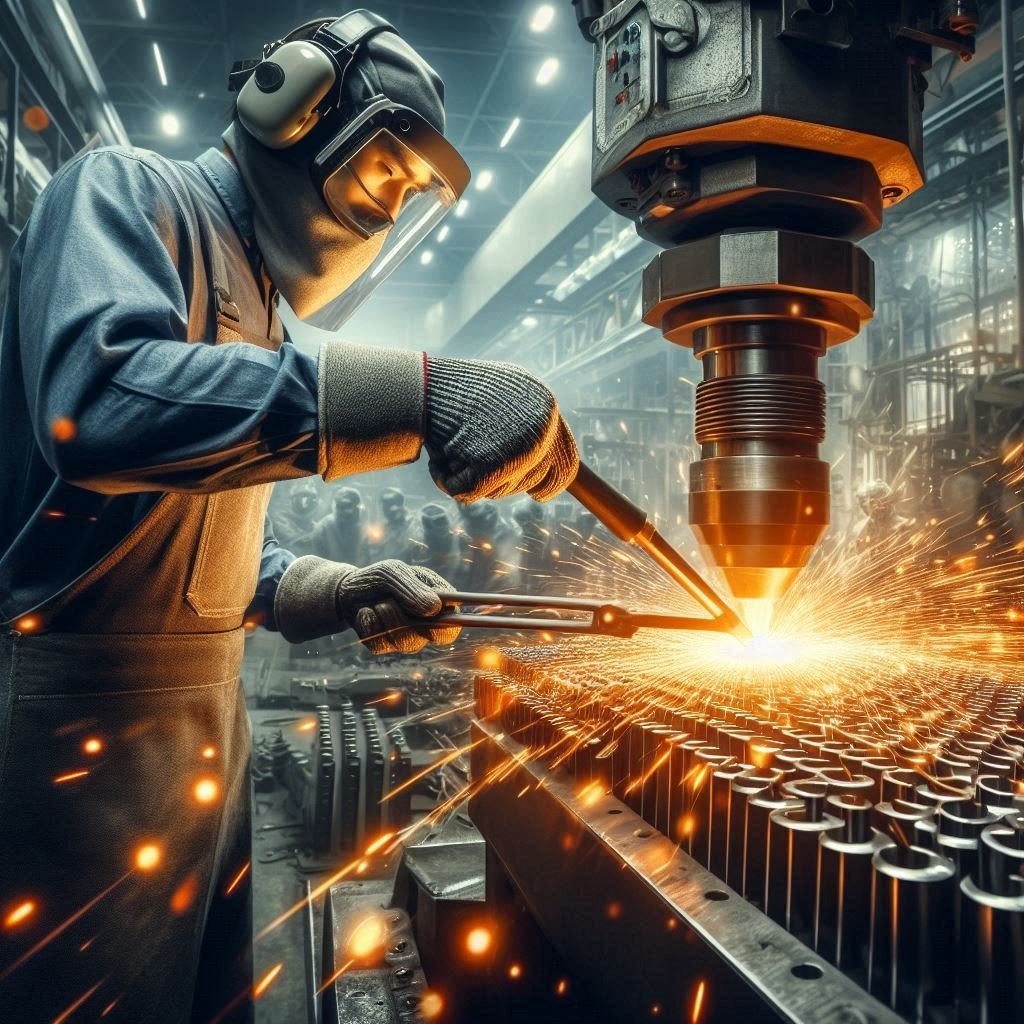
Let’s clear one myth immediately.
Forging is not the blunt-force process people imagine anymore.
If someone still thinks forging means “hammer it hot and machine it later,” they’re stuck twenty years behind the shop floor reality.
Modern precision forging is not guesswork. It is measured, simulated, temperature-mapped, tool-calibrated metal forming. And when it is done correctly, the dimensional results are tight. Not “forging tight.” Actually tight.
Now — how tight?
That depends. And if someone gives you one single tolerance number without asking about geometry, material, or size, they don’t understand forging.
First: Size Changes Everything
Small components behave differently from large ones. Always.
For parts under roughly 250–300 mm in length, properly controlled closed-die precision forging can routinely maintain:
- ±0.1 mm to ±0.25 mm on critical linear dimensions
- ±0.2 mm to ±0.5 mm on general features
- Bore and shaft diameters within ±0.1 mm to ±0.2 mm when tooling and billet volume are tightly controlled
That’s not marketing talk. That’s achievable when:
- Billet weight variation is tightly controlled
- Die wear is monitored
- Press bottom stroke repeatability is consistent
- Heating temperature does not fluctuate wildly
Once you cross into larger geometries, physics starts pushing back. Thermal gradients increase. Cooling distortion grows. Material flow gets more complex.
Then you’re typically looking at:
- ±0.5 mm to ±1.0 mm on major dimensions
- Slightly broader control on non-critical features
Still far tighter than traditional open-die work. Still very workable for near-net manufacturing.
Tolerances Don’t Fail Because of Metal. They Fail Because of Process Drift.
Most dimensional problems in forging don’t come from “metal being unpredictable.”
They come from:
- Billet volume inconsistency
- Uneven heating
- Press misalignment
- Worn dies
- Poor lubrication control
Precision forging is brutally sensitive to billet volume. In flashless or near-net processes, even a small overfill changes cavity pressure and can swell features. Underfill leaves incomplete geometry.
So what separates controlled operations from messy ones?
Measurement discipline.
Billets are weighed. Heating is monitored. Dies are inspected on schedule. Press stroke is calibrated. Nothing is left to “it should be fine.”
That’s how you hold ±0.2 mm consistently instead of occasionally.
Angularity, Flatness, and Concentricity — The Real Engineering Game
Linear dimensions are easy to talk about. The real engineering challenge sits in geometric tolerances.
Concentricity on forged shafts?
With proper die alignment and balanced material flow, you can hold roughly 0.1–0.3 mm depending on length and section ratio.
Flatness on forged faces?
0.1–0.4 mm is realistic when cooling distortion is controlled and section thickness is balanced.
Parallelism between surfaces?
Achievable within tight functional ranges — but only when die closure alignment is stable.
And that last part matters.
If your press has alignment play, no amount of inspection will save you. Forging precision starts at machine geometry, not at final inspection tables.
The Role of Temperature — The Silent Variable
Temperature is the quiet destroyer of tolerance.
Overheat the billet and metal flows too freely. Shrinkage behavior shifts. Dimensions drift.
Underheat it and cavity fill suffers. Surface quality degrades. Dimensional consistency suffers in a different way.
Modern induction heating systems with temperature monitoring are not luxury equipment. They are mandatory if you care about repeatability.
And die temperature? Equally critical.
Cold dies pull heat from the billet too aggressively. Hot dies change flow characteristics. Controlled die temperature means dimensional stability over long production runs.
Precision forging is not about one good part. It’s about the 500th part being as stable as the 5th.
Near-Net Shape Is Where Precision Forging Earns Its Reputation
Let’s talk machining.
Traditional forging left generous machining allowances because tolerances were wider. That meant more cutting, more scrap, more time.
Modern precision forging shrinks those allowances.
Not eliminating machining — that’s unrealistic in many critical parts — but reducing it dramatically.
Less material removal means:
- Lower cycle time
- Reduced tool wear
- Better material utilization
- Preserved grain flow in functional zones
And that grain flow matters. Forging aligns material structure along stress paths. If you over-machine, you remove part of that advantage.
So tighter forging tolerances aren’t just about dimension. They protect mechanical performance too.
Simulation Changed the Game
Older forging setups relied heavily on trial-and-error.
Today, serious operations simulate material flow before dies are cut. They analyze:
- Fill behavior
- Flash formation
- Stress concentration
- Cooling shrinkage
This reduces the number of physical corrections needed after tooling investment.
More importantly, it reduces tolerance surprises.
Simulation does not replace process control. It prevents predictable mistakes before they cost money.
Precision Forging in Real Manufacturing Environments
In industries like automotive, heavy equipment, and industrial transmission systems, tolerance consistency is not optional.
A forged hub that varies too much increases bearing misalignment.
A flange that isn’t flat enough compromises sealing.
A shaft with eccentricity creates vibration at speed.
These are not academic issues. They show up as warranty claims and downtime.
Modern precision forging, when properly controlled, reduces these downstream risks significantly. Assemblies fit with less correction. Machining is predictable. Parts interchange without drama.
That is the real value of tight tolerances — operational stability.
What It Looks Like in Practice at Sendura Forge PVT. LTD.
At Sendura Forge PVT. LTD., precision forging is not treated as a rough preform stage. It is engineered with dimensional intent from the beginning.
Tooling is manufactured with strict cavity accuracy. Billet preparation is controlled. Heating cycles are monitored. Press calibration is not ignored. Die maintenance is scheduled, not reactive.
That combination is what allows tolerance control to stay stable across batches.
Not perfect parts once.
Stable parts repeatedly.
And that’s what separates serious precision forging operations from shops that just happen to own a press.
So What Tolerances Are Truly Achievable?
Here’s the honest answer:
- ±0.1 mm to ±0.3 mm on smaller critical features in controlled precision forging
- ±0.3 mm to ±0.8 mm on general features
- Predictable geometric tolerance control when tooling, temperature, and press alignment are managed properly
But those numbers mean nothing without process discipline.
Precision forging is capable of tight tolerances.
It is not capable of forgiving sloppy control.
That’s the difference.
And that’s why modern precision forging, done properly, is no longer a rough forming method.
It is a controlled manufacturing process — capable, repeatable, and engineered.